
How an HVAC Company Can Offer a Lifetime Warranty on Every Install
By Noble Administration Network · October 26, 2026 · How we research and compare
Noble Administration Network | Published on: October 26, 2026 | Time to read: 14 min | Updated on: October 30, 2026
An HVAC company can offer a lifetime warranty two ways: join an insurance-backed lifetime warranty network such as Noble Administration Network, or promise it and pay every covered repair from its own cash. Noble's coverage lasts as long as the homeowner owns the home, with labor included on covered repairs, while third-party plans run a fixed term of up to 10 years at Trinity Warranty Solutions and up to 12 years of parts coverage at JB Warranties. Noble offers the warranty program to only one residential HVAC retailer per territory. A retailer that proves its volume in its first 90 days holds the territory exclusively from then on.
Noble Administration Network publishes this guide for HVAC shop owners deciding how to cover labor on the systems they install. It compares the four routes on who pays the labor, how long coverage runs, and what each one does to callbacks. It also shows what four major brands already cover, lays out the protection plan options worth offering, and ends with a worksheet that prices labor coverage in your own numbers.
Key Takeaways
There are four routes, and they differ on who pays the labor and how long coverage lasts. A manufacturer's extended plan and a third-party plan run for a fixed term. A self-funded warranty can last a lifetime, but your shop pays every claim. An insurance-backed network gives a lifetime term with an insurer paying covered repairs.
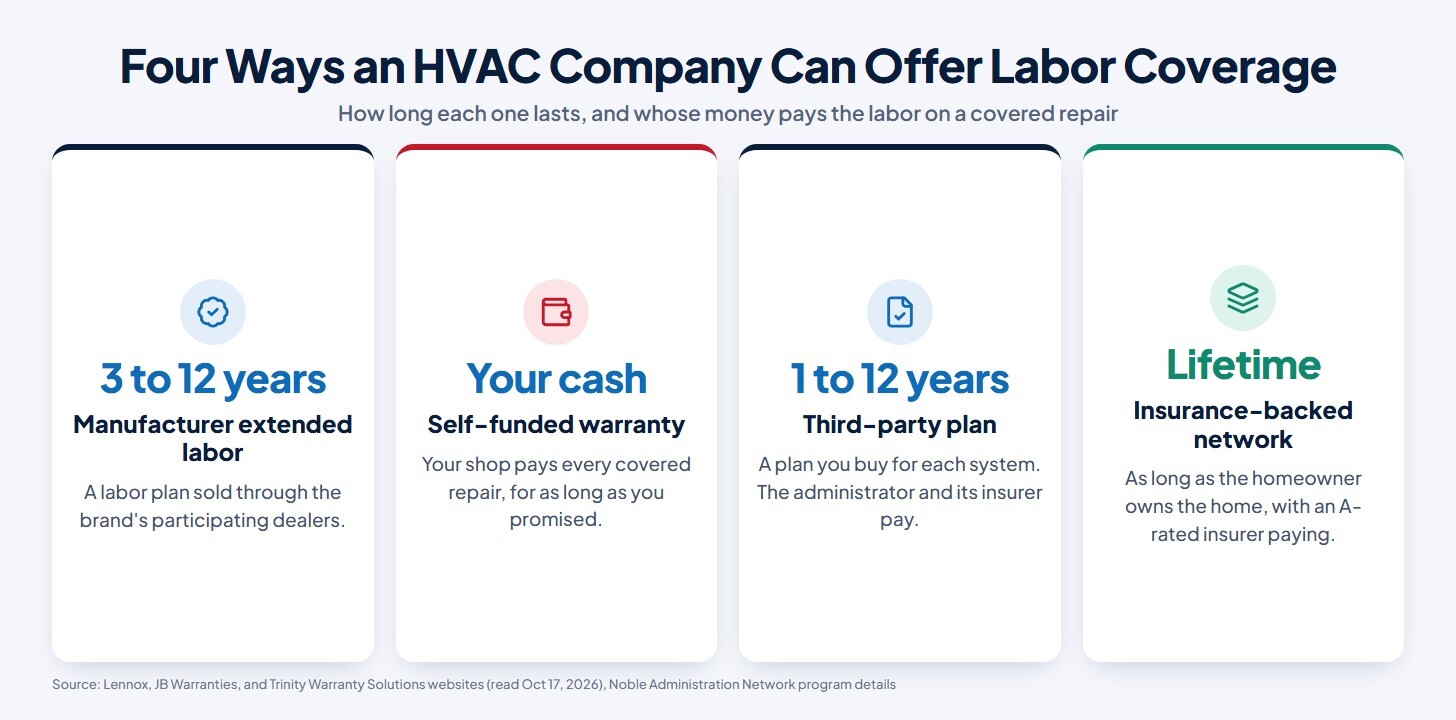
The table draws each row from the company's own website, read on October 17, 2026.
| Route | Whose money pays the labor | Longest term | What it does to callbacks | What your shop does |
|---|---|---|---|---|
| Manufacturer extended labor plan | The provider of the brand's extended service agreement, for example Lennox Comfort Shield | Lennox: 3, 5, 7, 10, or 12 years of labor, starting after the manufacturer's warranty ends | Covered callbacks are paid during the term. After it ends, the homeowner pays the labor, or you do it for free. | Sell it as a participating dealer of that brand |
| Self-funded warranty | Your shop | Whatever you promise, lifetime included | Every covered callback is unpaid time on your payroll, for as long as the promise lasts. | Set cash aside, and register where your state requires it |
| Third-party plan | JB Warranties says Dealers Assurance Company underwrites its plans, and Trinity Warranty Solutions says an "A" rated insurance company insures each one | JB: parts up to 12 years from installation. Trinity: 1, 2, 3, 5, or 10 years | Covered callbacks become paid work at the labor rate you chose: $85 to $300 an hour at JB, or $75, $100, or $125 at Trinity. | Buy a plan for each system, within 2 years of installation at both |
| Insurance-backed lifetime network | A national, brand-name A-rated insurance company | As long as the homeowner owns the home | Covered repairs include labor for as long as the coverage lasts, and an insurer, not your shop, pays them. | Enroll each system. Noble Administration Network's lifetime warranty is one example of this route. |
Two columns decide most choices. The longest-term column shows that only the self-funded and network routes can run for a lifetime. The second column shows that only the network does it without your cash. If you're weighing the self-funded route, expect state rules and money set aside for future repairs. Texas, for one, requires the company that's obligated on a service contract to register and show financial security.
A long promise also raises a fair question from the homeowner: who actually pays the claims? Our guide to who pays an insurance-backed HVAC warranty claim answers it. To compare named providers, see how a shop should pick an HVAC warranty program and the warranty programs for HVAC contractors, compared. The word "lifetime" gets stretched, too, so it helps to know what a limited lifetime warranty actually means.
A parts warranty pays for a component that fails from a defect. A labor warranty pays for the technician's time to replace it. Manufacturers write the first, and on most brands they don't write the second. So the labor on a year-6 compressor swap falls to the homeowner unless someone sold them labor coverage.
Here's what four major brands say on their own warranty pages, read on October 17, 2026. Terms vary by product line, so check the model you install.
| Brand | Parts, not registered | Parts, registered | Registration window | Labor |
|---|---|---|---|---|
| Trane | 5 years in most cases | 10 years in most cases | 60 days from installation | Not covered under the base or registered warranty. An optional extended warranty from the dealer might cover it. |
| American Standard | Typically 5 years | Up to 10 years | 60 days from installation | Not covered. Whether an optional extended warranty covers it depends on the one bought. |
| Carrier | 5 years | 10 years of parts only, or 5 years of parts plus 3 years of labor | 90 days from installation | 3 years, only if the installing dealer participates in Carrier's labor option. New construction isn't eligible. |
| Lennox | 5 years on Elite and Merit, 10 on Signature | 10 years (12 on Signature), or fewer parts years plus 3 years of labor | 60 days from installation, or from closing on new construction | None in the base warranty. Registration can trade parts years for 3 years of labor, and Comfort Shield sells 3 to 12 years through a participating dealer. |
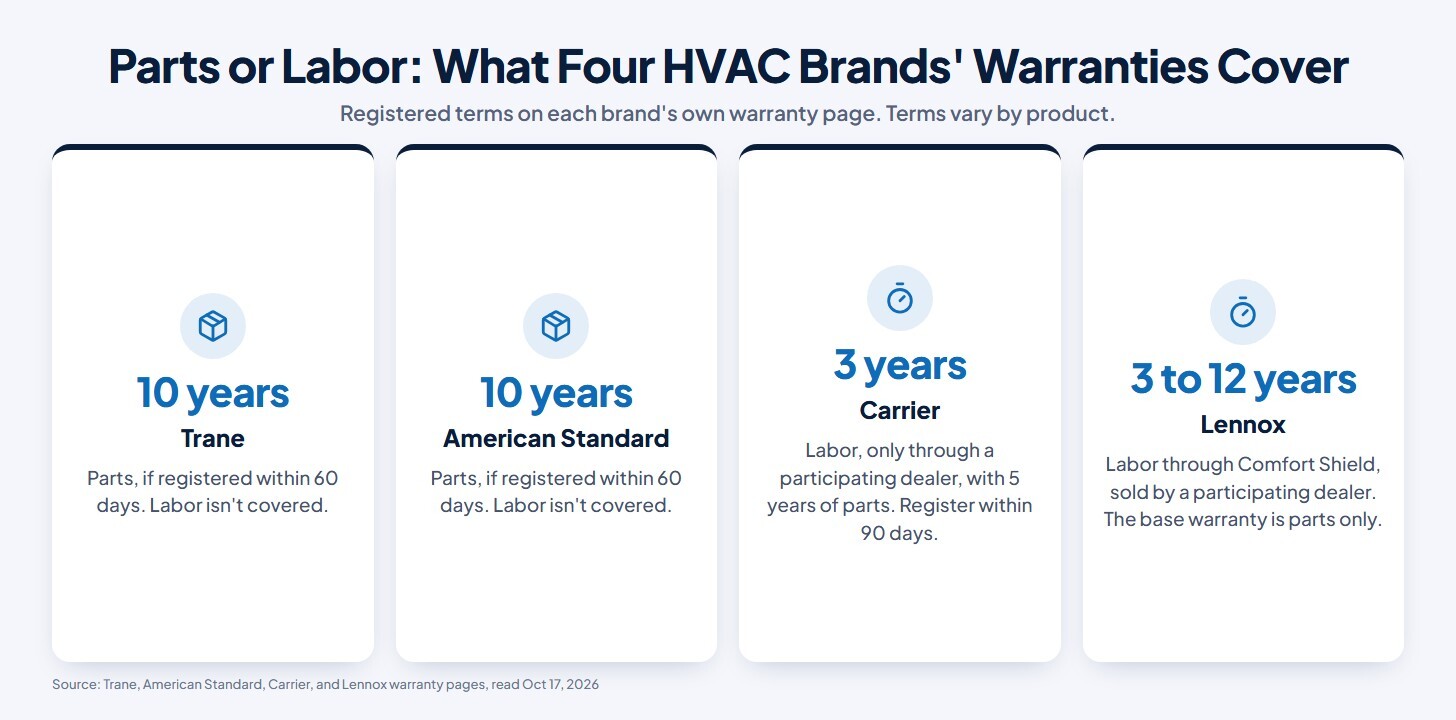
The most any of these four brands gives from the factory is 3 years of labor. Past that, your shop decides who pays each labor hour: the homeowner, a plan you sell, your own payroll, or a network. Our guide to what HVAC manufacturer warranties cover goes brand by brand.
For HVAC retailers
Offer a lifetime warranty on every install, with labor included and an insurer paying covered claims.
Noble offers the warranty program to only one residential HVAC retailer per territory. A retailer that proves its volume in its first 90 days holds the territory exclusively from then on. Every warranty you sell books maintenance with you: a spring and a fall service every year. Every contract is A-rated insurance-backed.
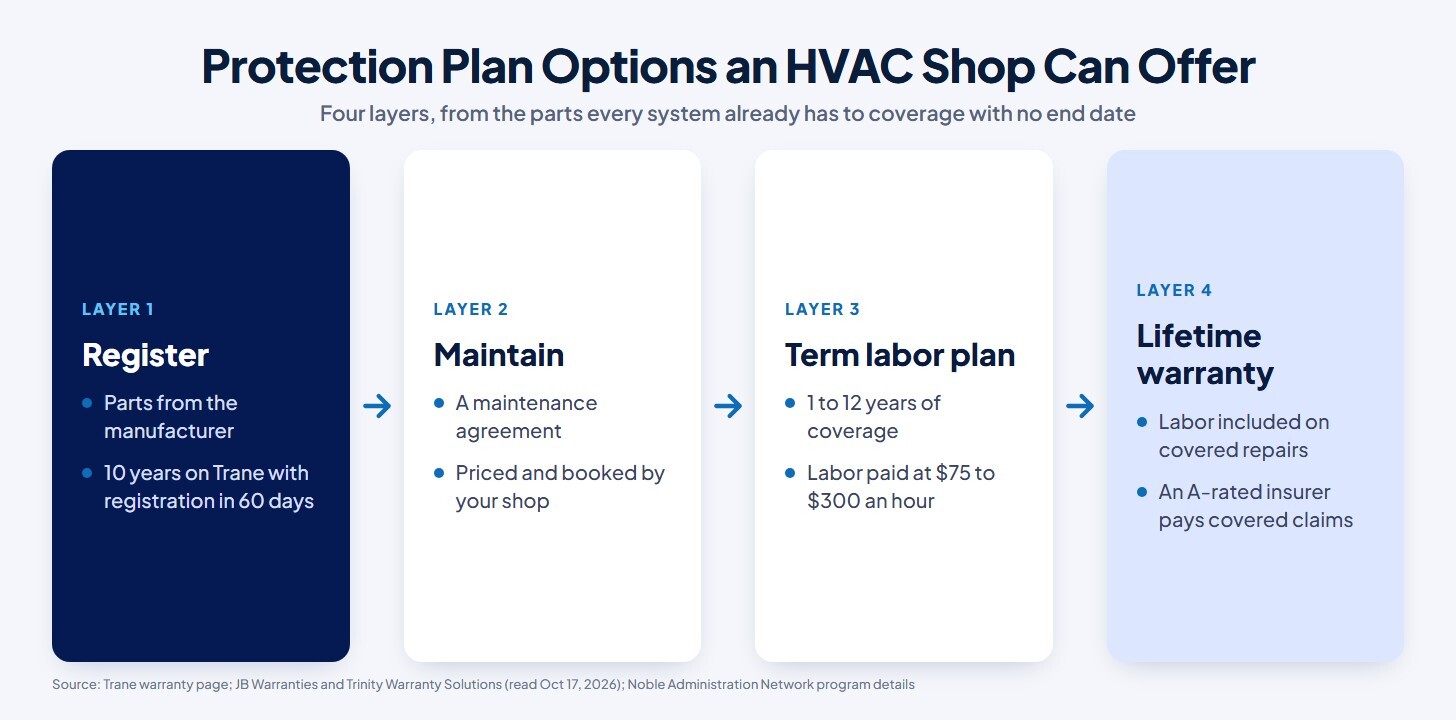
See the warrantyOffer four layers and let the homeowner choose how far up to go. Register every system so the manufacturer's parts term runs its full length. Offer a maintenance agreement. Offer a fixed-term labor plan for the homeowner who wants a lower price. Then put one lifetime option, with labor included and an insurer behind it, at the top.
| Layer | What it covers | Who pays a covered repair | Term | Who it fits |
|---|---|---|---|---|
| Manufacturer registration | Parts that fail from a defect | The manufacturer | Usually 10 years of parts when registered on time | Every system you install |
| Maintenance agreement | Scheduled tune-ups and checks, priced by your shop | The homeowner pays for the visits | Usually renewed every year | Homeowners who want the system looked after |
| Fixed-term labor plan | Labor on covered repairs, at the rate you picked | The plan provider and its insurer | 1 to 12 years, depending on the provider | Homeowners who want labor covered for a set period |
| Insurance-backed lifetime warranty | Covered repairs on the major internal components, labor included | An A-rated insurance company | As long as the homeowner owns the home | Homeowners who plan to stay and want no end date |
Registration takes a few minutes per install. On a Trane system, registering within 60 days doubles the parts term from 5 years to 10 in most cases. Make it part of the install checklist, not a reminder for later.
The maintenance layer does a second job when the lifetime warranty requires a spring and a fall service every year to stay active, as Noble's does. Our guide to pairing an HVAC maintenance agreement with a lifetime warranty covers what to include and how to price the agreement.
How you present the layers is a sales question with its own answers. Bundling, attachment rates, and good, better, best tiers are in the guide to bundled versus add-on HVAC warranties. The words to use at the kitchen table are in how to sell an HVAC warranty, and how to stop competing on price shows why the top layer matters when every quote looks alike.
Ten years is the market's benchmark. Roughly 58% of contractors already sell extended labor coverage, and 10 years is the length they choose most, according to an ACCA and Farmington Consulting Group survey reported by ACHR News in February 2026. A shorter term is cheaper to back. A lifetime term outlasts any 10-year plan a competitor can sell.
The plans on the market show the range you can choose from. Carrier's factory labor option is 3 years. Trinity sells 1, 2, 3, 5, or 10 years. Lennox Comfort Shield sells 3 to 12 years of labor that starts after the manufacturer's warranty ends. JB lets you extend parts coverage up to 12 years from installation.
Pick the term by asking what happens the day after it ends. A term plan protects the homeowner during the term, and then the next repair is theirs again, often on a system they still expect to run for years. A 10-year plan matches the most common length on the market, so it doesn't set your quote apart.
Homeowners ask the same question from the other side of the table. When one asks whether paying for 10 years of labor makes sense, send them our homeowner guide to paying for 10 years of HVAC labor coverage.
It costs whatever the covered repairs take in technician time, multiplied by the years you promise. Under a term plan, that cost moves to the plan provider for the price of the plan. Under a self-funded promise, it stays on your payroll. The worksheet below prices the self-funded case in your own numbers, so you can compare it with any quote.
Start with what an hour of technician time costs you. The Bureau of Labor Statistics puts the median pay for HVAC mechanics and installers at $29.33 an hour in May 2025. Your fully loaded cost is higher, because payroll taxes, insurance, the truck, and paid time off sit on top of that wage. Our HVAC pricing guide works out a fully loaded hour step by step.
| Line | What to enter | Where to find it | Example |
|---|---|---|---|
| A | Systems a year you'd cover | Your install count | 150 |
| B | Share of covered systems that need a labor repair in a year | Your callback and service records | 5% |
| C | Technician hours per repair, trip included | Your job history | 3 |
| D | Fully loaded labor cost per hour | Wage, payroll taxes, insurance, truck, and time off | $50 |
| E | Years of coverage you promise | Your warranty terms | 10 |
| F | Labor cost per covered system: B × C × D × E | Multiply lines B to E | $75 |
| G | Labor cost of one year's installs: A × F | Multiply line A by line F | $11,250 |
Say your shop covers 150 systems a year, 5% of them need a labor repair in any given year, each repair takes 3 hours, and an hour of technician time costs you $50 fully loaded. Ten years of labor coverage then costs $75 per system, or $11,250 for one year's installs, paid out over the decade. These inputs are made up to show the math, so replace each one with your own. The 5% and the $50 aren't market rates.
The worksheet makes three things plain. Line E is the problem with a self-funded lifetime promise: there's no end date, so there's no honest number to put in it. Line G doesn't come due at once. You pay it out of payroll over 10 years, and every hour your technicians spend on a covered callback is an hour they can't bill. When you get a quote for a term plan or a lifetime network, compare its cost per system with line F.
Choose by who you want paying the labor in year 15. If it's your shop, self-fund it and set the cash aside. If a fixed term is enough for your customers, a manufacturer or third-party labor plan is simple to add. If you want a lifetime term that an insurer pays, join an insurance-backed network and apply for your territory.
Before you decide, run your own install numbers through the territory value calculator, read what the Noble lifetime warranty covers, and leave the kitchen-table close sheet with the homeowner after each visit.
Noble offers the warranty program to only one residential HVAC retailer per territory. A retailer that proves its volume in its first 90 days holds the territory exclusively from then on. Every warranty you sell books maintenance with you: a spring and a fall service every year. Every contract is A-rated insurance-backed.

Join an insurance-backed lifetime warranty network. The shop enrolls each system it installs, and an A-rated insurance company pays covered repairs, labor included, for as long as the homeowner owns the home.
What is an HVAC labor warranty program?It's a plan that pays a technician's time on a covered repair, which most manufacturer warranties leave out. Third-party plans pay labor at the hourly rate the shop picks for a fixed term, and an insurance-backed lifetime network includes labor on covered repairs with no end date.
Do HVAC manufacturers pay for labor on a warranty repair?Not on most brands. Trane and American Standard cover parts only, and Carrier adds 3 years of labor only when the installing dealer participates. Labor beyond that comes from an extended plan, a third-party plan, or the shop itself.
How long should a labor warranty be?Ten years is the most common length among contractors that offer one, according to an ACCA and Farmington Consulting Group survey reported by ACHR News in February 2026. A shorter term costs less to back, and a lifetime term outlasts any 10-year plan a competitor can sell.
Who pays labor if a part fails in year 8?If the system was registered, the manufacturer usually still pays for the part, but on most brands the homeowner pays the labor unless a labor plan is in force, in which case the plan provider pays. Under a self-funded promise your shop pays the labor, and under an insurance-backed lifetime network an A-rated insurance company pays the covered repair.
Is a 10-year labor plan worth offering to your customers?Yes, if you want to match the market, because 10 years is the most common length contractors offer. It won't set your quote apart from the 58% of contractors who already offer extended labor warranties, so a lifetime option is the way to stand out.
What protection plan options should HVAC dealers offer?Register every system for the manufacturer's full parts term, offer a maintenance agreement, offer a fixed-term labor plan, and put an insurance-backed lifetime warranty with labor included at the top. Each layer answers a different homeowner, from the one who wants the lowest price to the one who plans to stay.