
HVAC Extended Warranty: How to Choose One for Your Shop
By Noble Administration Network · September 9, 2026 · How we research and compare
Noble Administration Network | Published on: September 9, 2026 | Time to read: 13 min | Updated on: November 7, 2026
An HVAC extended warranty, also called an Extended Service Agreement, is coverage that runs past the manufacturer's warranty, which pays for some parts, needs registration, and includes short labor coverage on only some brands. For a shop, the program you sign with decides who pays labor, how long coverage lasts, and who stands behind every claim.
This guide explains the four kinds of coverage, how programs are funded, and what the shop and the homeowner each pay. Then it gives you one scorecard to rate any program from its written answers.
Key Takeaways
An HVAC extended warranty is a service contract that keeps paying for covered repairs after the manufacturer's warranty ends or where it never reached, most often labor. Its formal name is an Extended Service Agreement, or ESA, and the program behind it sets the term, the coverage, and the rules.
Trinity Warranty Solutions, an HVAC extended warranty provider, says HVAC extended warranties “are more accurately called Extended Service Agreements or ESAs,” and that a plan's length in years “typically refers to only labor coverage” (Trinity's cost guide).
The legal line matters for how you price it. Under federal warranty law, “warranties come with a product and are included in the purchase price,” while a service contract is separate and can “cost the customer a fee beyond the purchase price of the product” (the FTC's guide to federal warranty law). So the same coverage can sit inside your quote or be a plan the homeowner buys on top of it.
Parts coverage comes from the manufacturer, usually 5 to 10 years on some parts with registration. Factory labor, where a brand offers it, runs up to 3 years. An extended service agreement most often adds 10 years of labor. A lifetime program runs as long as the contract says, ideally as long as the homeowner owns the home.
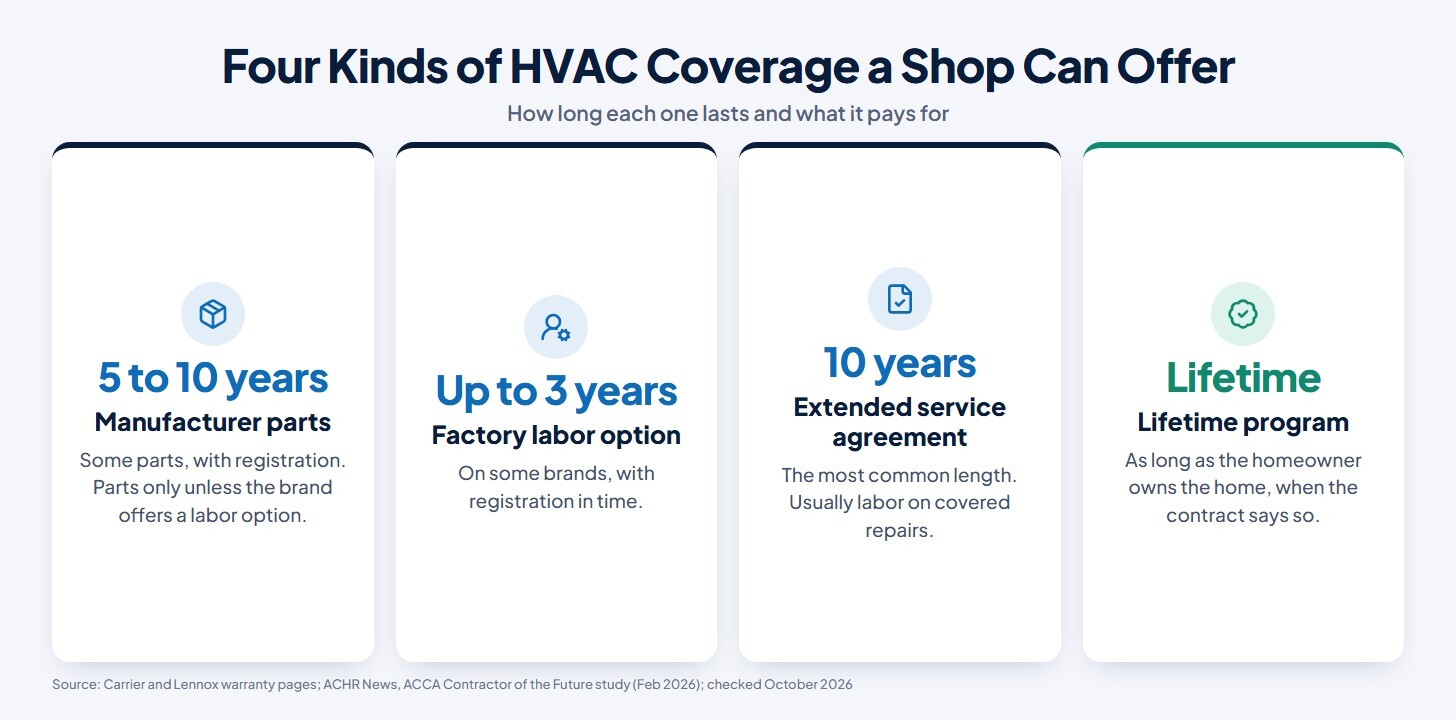
| Coverage | Typical term | Who pays for it | What cuts it short |
|---|---|---|---|
| Manufacturer parts warranty | 5 to 10 years on some parts, with registration | Included in the equipment price | A missed registration deadline on brands that set one |
| Factory labor option | Up to 3 years, on some brands | Included, with registration and a participating installer | A missed registration, or an installer outside the brand's program |
| Extended service agreement | 10 years is the most common length | The shop inside the job price, or the homeowner as an add-on | Whatever the contract lists, such as skipped maintenance |
| Lifetime program | As long as the contract says; the clearest version is as long as the homeowner owns the home | Set by the program; in a retailer-funded program, the shop | Whatever the contract lists, such as skipped maintenance |
Two brands show how registration shapes the base coverage (checked October 2026). Carrier offers “a 10-year parts-only limited warranty or a 5-year parts plus 3-year labor limited warranty” when owners register “within 90 days of installation,” and without registration its standard 5-year parts warranty applies and labor isn't covered (Carrier's warranty page). Lennox says its “factory warranty covers parts only,” and that with registration owners “can select up to 3 years of labor coverage” (Lennox Warranty Your Way). The brand-by-brand detail lives in our guide to what HVAC manufacturer warranties cover.
The 10-year figure for an ESA is the most common length in the Contractor of the Future survey of more than 1,000 contractors by the Air Conditioning Contractors of America (ACCA) and Farmington Consulting Group, reported by ACHR News in February 2026. Hold every program to the FTC's test for buyers: “It's not a good value if it doesn't offer more coverage than the warranty that came with the product” (FTC consumer advice). Before you weigh a lifetime program, read what a limited lifetime warranty really means.
An HVAC protection plan is the homeowner's name for an HVAC extended warranty: a plan that pays for covered repairs after the manufacturer's warranty ends, most often labor. You'll also hear it called an AC protection plan or an HVAC warranty plan.
Read what the plan's extended warranty coverage really includes. A labor only plan pays the technician's time and leaves the part to the manufacturer's warranty. A parts and labor plan pays for both on covered repairs. Either way, it's an extended warranty program, so the scorecard below works on it.
A home warranty is a different product. It's a service contract the homeowner buys for the house, and it usually has a dollar limit per system and a service fee on every visit. See whether a home warranty covers HVAC for what those plans pay.
In one of two ways. A self-funded program pays claims from its own reserves or balance sheet. An insurance-backed program has an insurer standing behind the contracts, so covered claims still get paid if the program company can't pay them. For a lifetime contract, that difference decides whether a claim in year fifteen gets paid.
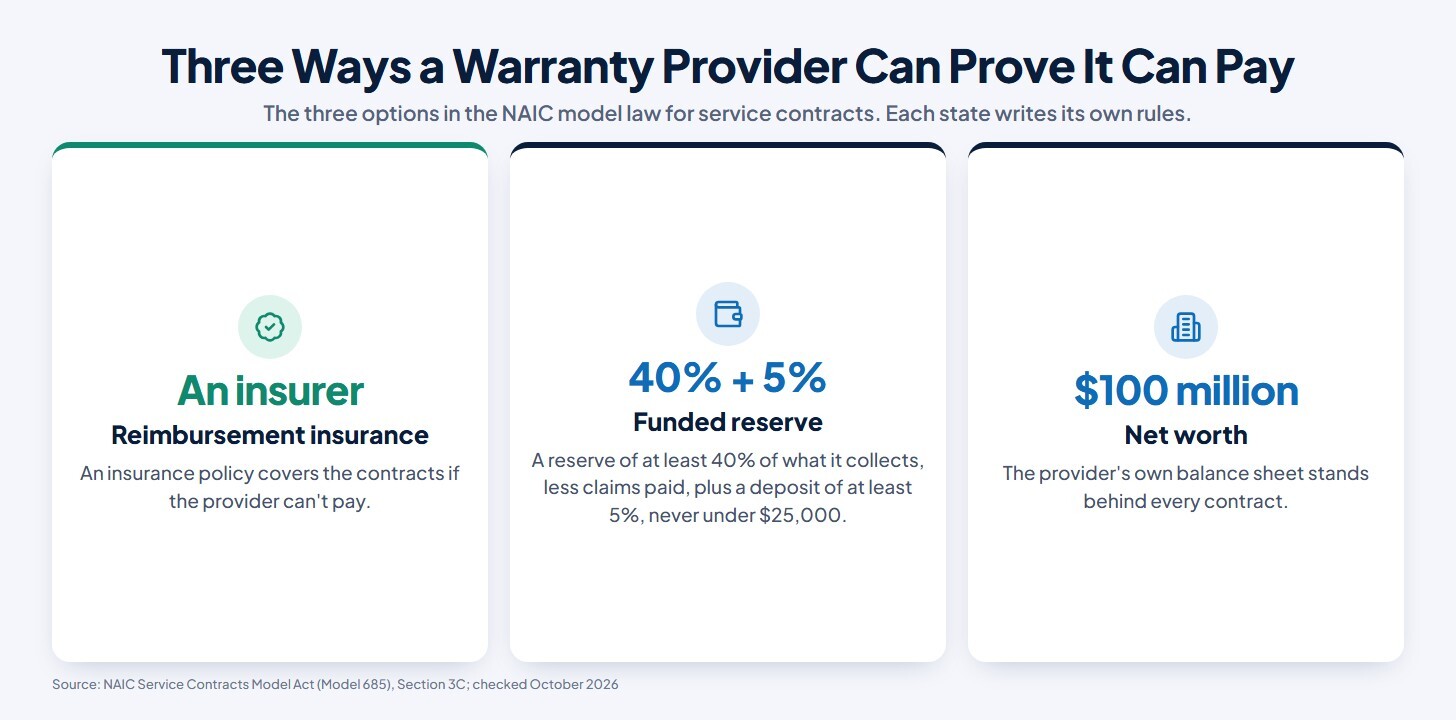
Many states regulate service contracts, and the NAIC model law sets out three ways a provider can prove it can pay: insure every contract under a reimbursement insurance policy; keep a funded reserve of at least 40% of what it collects, less claims paid, plus a security deposit of at least 5% and never under $25,000; or hold a net worth of $100 million (NAIC Service Contracts Model Act, Section 3C). A contract without the insurance policy must say its obligations are “backed only by the full faith and credit of the provider.” Ask which of the three a program uses, and check any insurer's rating with AM Best, where an A or A- rating means “an excellent ability to meet their ongoing insurance obligations.” Who pays a claim, and what happens if the program company closes, is covered step by step in our guide to insurance-backed HVAC warranty claims.
A shop can also start its own warranty company, but in many states that means registering as a service contract provider and proving it can pay every claim. Under the NAIC model law above, that proof is one of the same three: a reimbursement insurance policy, a funded reserve with a security deposit, or a $100 million net worth. On a lifetime promise, the shop also carries claims that can arrive decades from now. Compare that job with the other ways to offer a lifetime warranty on your installs.
It depends on who buys it. When the shop bundles the warranty into the job, the shop pays the program for each system and builds that cost into one job price. When it's sold as an add-on, the homeowner pays for the plan separately and the shop earns a margin on the sale.
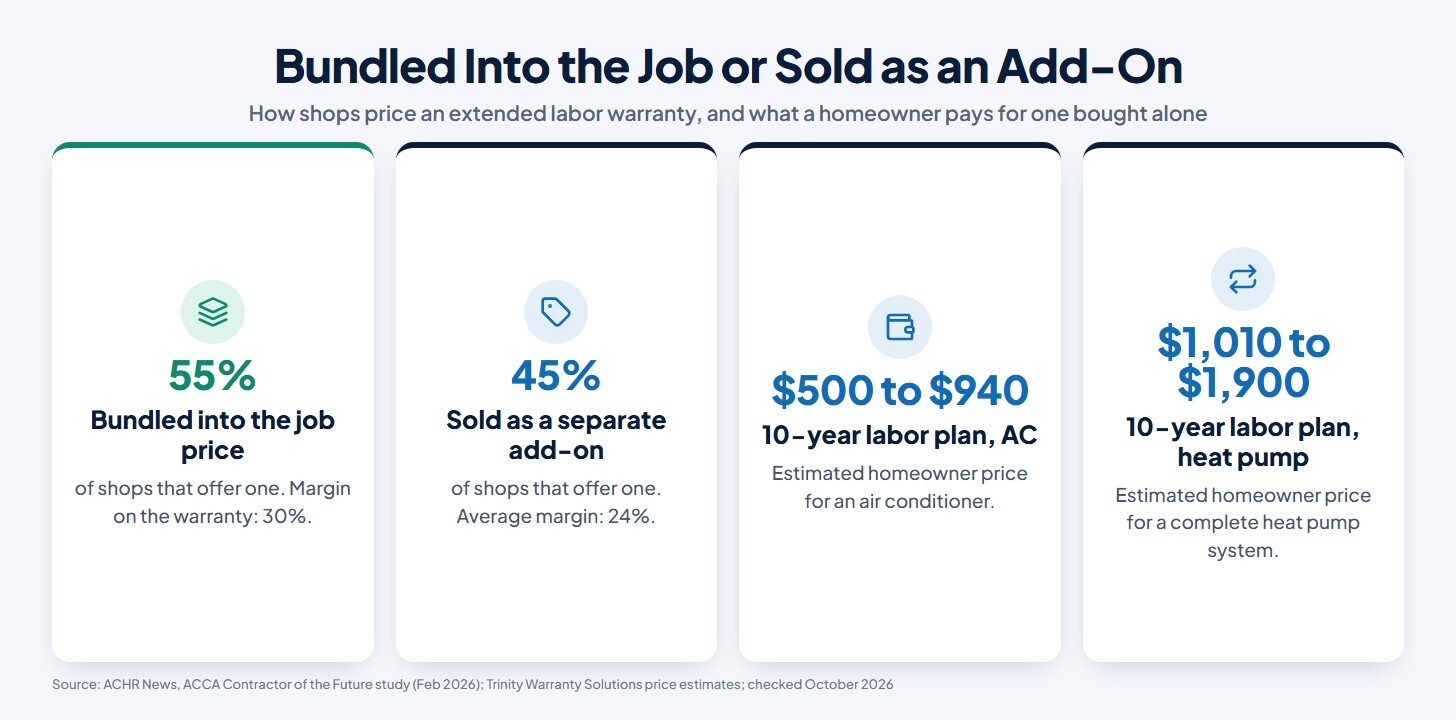
The same survey, reported by ACHR News, gives the split. About 58% of HVAC contractors offer extended labor warranties. Of those, 55% include the warranty in the total cost of the job, which ACCA recommends as the best practice and which carried a 30% margin on the warranty. The other 45% sell it as a separate add-on, at an average 24% margin.
As a guide to what a homeowner pays for a plan bought alone, Trinity Warranty Solutions publishes estimated homeowner prices for a 10-year extended labor warranty: $500 to $940 for an air conditioner and $1,010 to $1,900 for a complete heat pump system (Trinity's price estimates). It notes that “actual costs could be lower or higher” and that the price rises with the labor rate in your area.
What a shop pays a program per system is set by each provider, so ask for every fee in writing. For the bundle or add-on decision itself, our guide to bundling an HVAC warranty or selling it as an add-on walks through it.
The Noble lifetime warranty
Offer a lifetime warranty with labor included on covered repairs.
Covered repairs on the major internal components of the systems you install, with possible territory exclusivity. There's no separate warranty fee for the homeowner.
See the warrantyScore it on eight lines, 0, 1, or 2 points each, from the provider's written answers rather than the sales call. Add the points for a total out of 16. Our rule of thumb is that 12 or more is worth a meeting, and under 8 means keep looking.
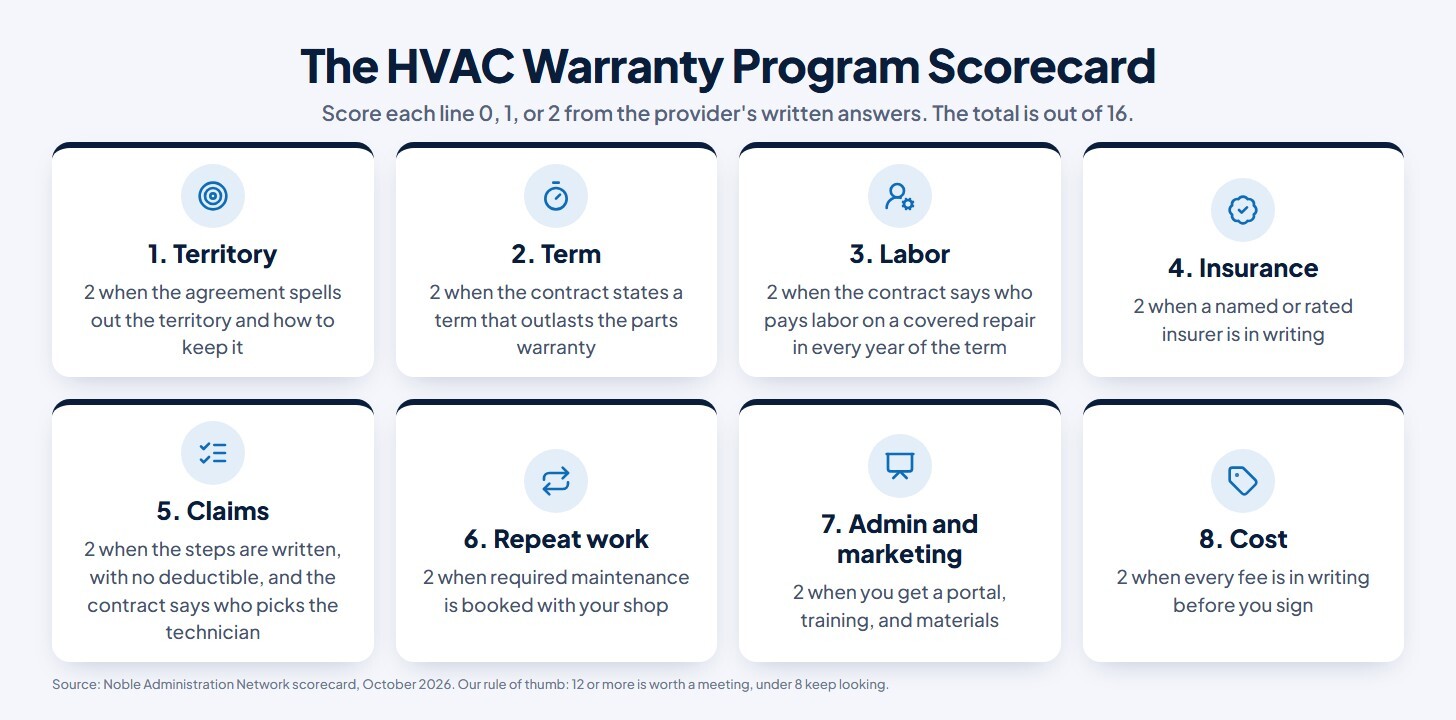
| Line | The question to ask | Scores 2 when | Scores 1 when | Scores 0 when |
|---|---|---|---|---|
| 1. Territory | Can another shop near me sell this, and what must I do to keep my territory? | The agreement spells out the territory and the terms to keep it | A written limit on nearby sellers, or a territory with vague terms to keep it | Anyone can sign up, or the territory is only promised out loud |
| 2. Term | How long does coverage last, according to the contract? | The contract states a term that outlasts the parts warranty | The term ends at or before the parts warranty | The brochure and the contract disagree, or “lifetime” isn't defined |
| 3. Coverage and labor | What's covered, and is labor paid on a covered repair? | Major components are covered, and the contract says who pays labor on a covered repair in every year of the term | Labor is capped or starts after a waiting period | Parts only, or labor sold separately |
| 4. Insurance backing | Who pays claims if your company closes? | A named or rated insurer, in writing | “We're insured,” with no name or rating | Claims are paid only from the company's own reserves |
| 5. Claims process | Who files, who pays the technician, and how fast? | Written steps, no deductible, and the contract says who picks the technician | Clear steps, but a deductible or slow payment | No written process |
| 6. Repeat work | Does the warranty bring the customer back to me? | Required maintenance is booked with your shop | Maintenance is required, but any shop can do it | Nothing brings the customer back |
| 7. Admin and marketing | What does my office do, and what do I sell with? | A portal, sales training, print materials, and freedom to market it | Templates you build yourself, or limits on where you can mention it | A logo file and a rate sheet |
| 8. Cost | What do I pay, and what does the homeowner pay? | Every fee, yours and the homeowner's, on one page before you sign | Most fees are written down, but some vary by job or come later | No straight answer, or fees appear after you sign |
A line the provider won't answer in writing scores 0. The total says how close a program is, and the red flags below say whether to keep talking at all.
Take a made-up program: territory terms in the agreement (2), a 10-year term that ends with the parts warranty (1), labor after a 90-day wait (1), a named insurer in writing (2), a deductible on each claim (1), maintenance at any shop (1), a portal and training (2), and every fee on one page (2). That's 12 of 16, so take the meeting and push on the four lines that scored 1.
Ask where the boundary sits and what you must do to keep the territory, such as a volume target or a review date, and score 2 only when both are in the agreement. The Census Bureau's American Community Survey publishes 5-year estimates down to census tracts, so you can count the owner-occupied homes inside it. The territory value calculator estimates what a territory is worth with your own numbers. A competitor can't copy a protected territory by cutting a price, which is why it beats competing on price.
A contract backed only by the provider's own reserves scores 0, because a lifetime contract may have to pay a claim decades from now. Don't count on a state guaranty fund to fill that gap, because the NAIC's model guaranty act leaves out insurance of warranties and service contracts (NAIC Model 540, Section 3E).
Ask the provider to walk you through a claim that wasn't paid, because the claim is when the homeowner judges your company. On repeat work, warrantied systems need maintenance 2X a year. When those visits are booked with your shop, the customer comes back every spring and fall, which are your slow months. To turn that visit into a priced plan, read what to include in an HVAC maintenance agreement.
Score 2 on marketing only when you can put the warranty on your website, in proposals, and in the first sentence of your pitch. Our guide on how to sell an HVAC warranty shows what that sentence sounds like. On cost, the FTC tells buyers to look for costs “that might be hidden, like deductibles or fees you must pay each time the product is serviced” (FTC consumer advice), so expect your customers to ask about the same costs.
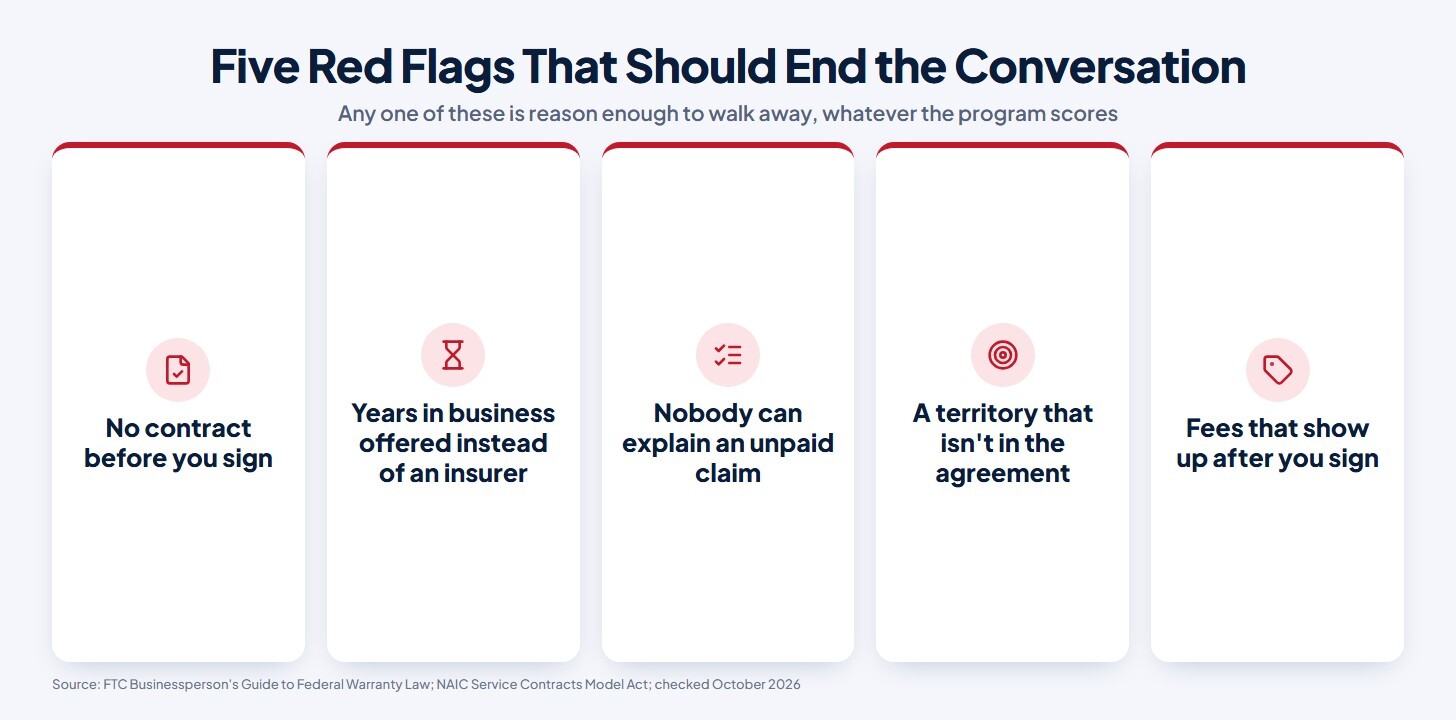
Any one of five should end it, whatever the program scores elsewhere: no contract before you sign, years in business offered in place of an insurer, nobody able to explain an unpaid claim, a territory that isn't in the agreement, and fees that show up after you sign.
Ask the questions that fill in the scorecard, and ask for every answer in writing. A provider that can't answer clearly has told you what you need to know. Once you're down to two or three programs, these six questions cover the lines that matter most.
Noble Administration Network administers a lifetime warranty on the residential HVAC systems a participating retailer installs, with labor included on covered repairs to the major internal components once the retailer's own installation warranty ends, for as long as the homeowner owns the home and keeps up a spring and a fall service every year. The retailer funds it, and a national, brand-name A-rated insurance company stands behind every contract. For named programs side by side, each described from its own website, read our comparison of HVAC warranty programs for contractors.
Noble offers the warranty program to only one residential HVAC retailer per territory. A retailer that proves its volume in its first 90 days holds the territory exclusively from then on. A person who knows the program calls you back after you apply.

Trinity Warranty Solutions estimates $500 to $940 for a 10-year extended labor warranty on an air conditioner and $1,010 to $1,900 on a complete heat pump system, and notes actual costs can be lower or higher. When a shop bundles the warranty into the job, the homeowner sees one job price instead.
What are two reasons not to buy an extended warranty?Duplicate coverage and an unbacked provider. The FTC says a service contract isn't a good value if it doesn't offer more coverage than the warranty that came with the product, and that its value is only as good as the company responsible for coverage. Both are reasons for a shop to choose a program that adds labor and has an insurer behind it.
Which kind of program is right for a small shop?Usually one the shop funds inside the job price, with labor included on covered repairs, an insurer behind the contracts, and a light load for the office. In the ACCA survey ACHR News reported in February 2026, 55% of contractors who offer a warranty include it in the job price, which carried a 30% margin on the warranty against an average 24% for a separate add-on.
How do I know if a warranty program is really insurance-backed?Ask for the insurer's name or rating, in writing. Under the NAIC model law, a contract without a reimbursement insurance policy should say it's backed only by the full faith and credit of the provider. Then check the insurer's rating with AM Best.
How much admin does a program add to my office?It depends on the program, so ask to see the office side before you sign. A light program gives your office a portal to enroll systems and look up customers, and handles the claim paperwork itself. A heavy one runs on emails to a rep.
Are home warranties worth it for HVAC?It depends on the plan's limits. Many home warranty plans set a dollar limit per system. Read the limit, the fee, and the exclusions before renewing one.