How Can HVAC Dealers Increase Warranty Attachment Rates?
By Noble Administration Network · October 23, 2026 · How we research and compare
Noble Administration Network | Published on: October 23, 2026 | Time to read: 12 min | Updated on: October 23, 2026
The surest way to raise your warranty attachment rate is to include the warranty in the price of every option, so every install leaves with it. In ACCA's 2026 contractor study, reported by ACHR News, warranties included in the job price earned about a 30% margin, against 24% when sold as a separate add-on.
If you own a residential HVAC shop and want more installs to leave with a warranty, start here. You'll get a plain definition and a way to measure it by tech, what the 2026 study found, five years of the math in your own numbers, and where a lifetime warranty fits in good, better, best options.
Key Takeaways
Your warranty attachment rate is the share of installs that leave with an extended or lifetime warranty. Divide the installs that carried the warranty by all the installs you sold in the same period. If you sold 50 systems last quarter and 20 carried the warranty, your attachment rate is 40%.
Count any coverage the homeowner gets beyond the manufacturer's warranty, which comes with the equipment and covers some parts, often for longer when the system is registered on time. An extended labor warranty counts, and so does a lifetime warranty. Then work the rate out three ways, because each one answers a different question.
| Measure | How to work it out | What it tells you |
|---|---|---|
| By shop, each month | Installs with the warranty, divided by all installs | Whether your prices and proposals are working |
| By tech or comfort advisor | Each person's installs with the warranty, divided by that person's installs | Who to learn from and who needs coaching |
| By option | Warranties sold on each option, divided by the installs of that option | Whether coverage only sells in the top tier |
We looked for a published industry benchmark and didn't find one. The ACCA study counts how contractors sell the warranty, not the share of installs that leave with it, so your own last 12 months is the number to beat. The same study found that about 58% of HVAC contractors offer extended labor warranties at all, and that 10 years is the most common length. When the warranty is included in the price of every option, every install carries it, and the rate becomes 100% of the jobs you sell.
Make the warranty part of the price of every option, so the rate is set by your price book instead of by how each tech feels at the table that day. If you keep it as an add-on for now, five habits move the number: timing, writing, pricing, follow-up, and tracking.
If a homeowner says a lifetime warranty sounds too good to be true, here's how to answer a doubting homeowner in a way they'll believe.
Bundle it, unless your own numbers say otherwise. In the ACCA study, 55% of contractors who offer a warranty include it in the total cost of the job, and 45% sell it as a separate add-on. The first group earned about a 30% margin on the warranty, and the second group earned about 24%.
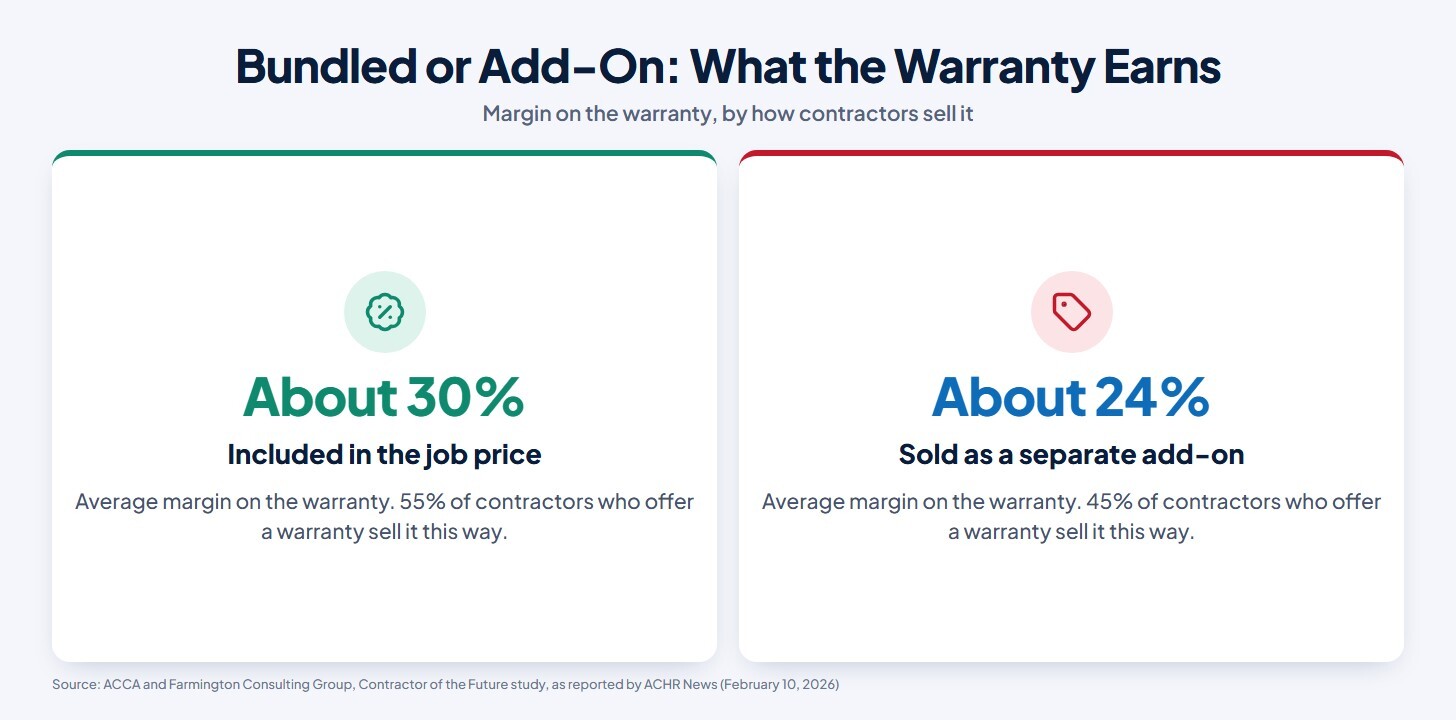
The figures come from ACCA's Contractor of the Future study with Farmington Consulting Group, a survey of more than 1,000 contractors that ACHR News reported on February 10, 2026. ACCA recommends including the warranty in the job price as the best practice.
| Question | Included in the job price | Sold as a separate add-on |
|---|---|---|
| Average margin on the warranty (ACCA study) | About 30% | About 24% |
| Share of contractors who sell it this way | 55% | 45% |
| Attachment rate | Every job you sell | Only the jobs where the homeowner says yes |
| What the homeowner decides | One price for the system and its coverage | A second purchase, after the system |
| What the tech does at the table | Explains what's included | Sells a second product |
Why does the margin move? The study reports the gap but doesn't explain it, so this part is our reasoning. A separate line on a quote gets negotiated on its own, and it's the first thing a homeowner asks you to drop when the total feels high. Coverage that's part of the system price isn't a line to cut, so it holds its price the way the equipment does.
Shops that bundle tend to talk about the coverage differently too. In a 2021 ACHR News report on extended warranties, a manager at a warranty company said contractors were packaging the warranty with the comfort system and presenting it as a guarantee they offer, not as an extra product. For the rest of that price conversation, read our post on winning HVAC jobs without cutting your price.
Run your own numbers
See what your installs and maintenance base could be worth.
Put in your monthly quotes, close rate, average install, and maintenance price, and the calculator shows five years of install and maintenance revenue. It's free, with no form and no sales call attached.
Open the calculatorOn the example below, including the warranty in every job earns about three times the warranty margin of selling it as an add-on: $60,000 a year against $19,200, or $300,000 against $96,000 over five years. Only the two margins come from the ACCA study. Every other input is an assumption you should replace with your own.
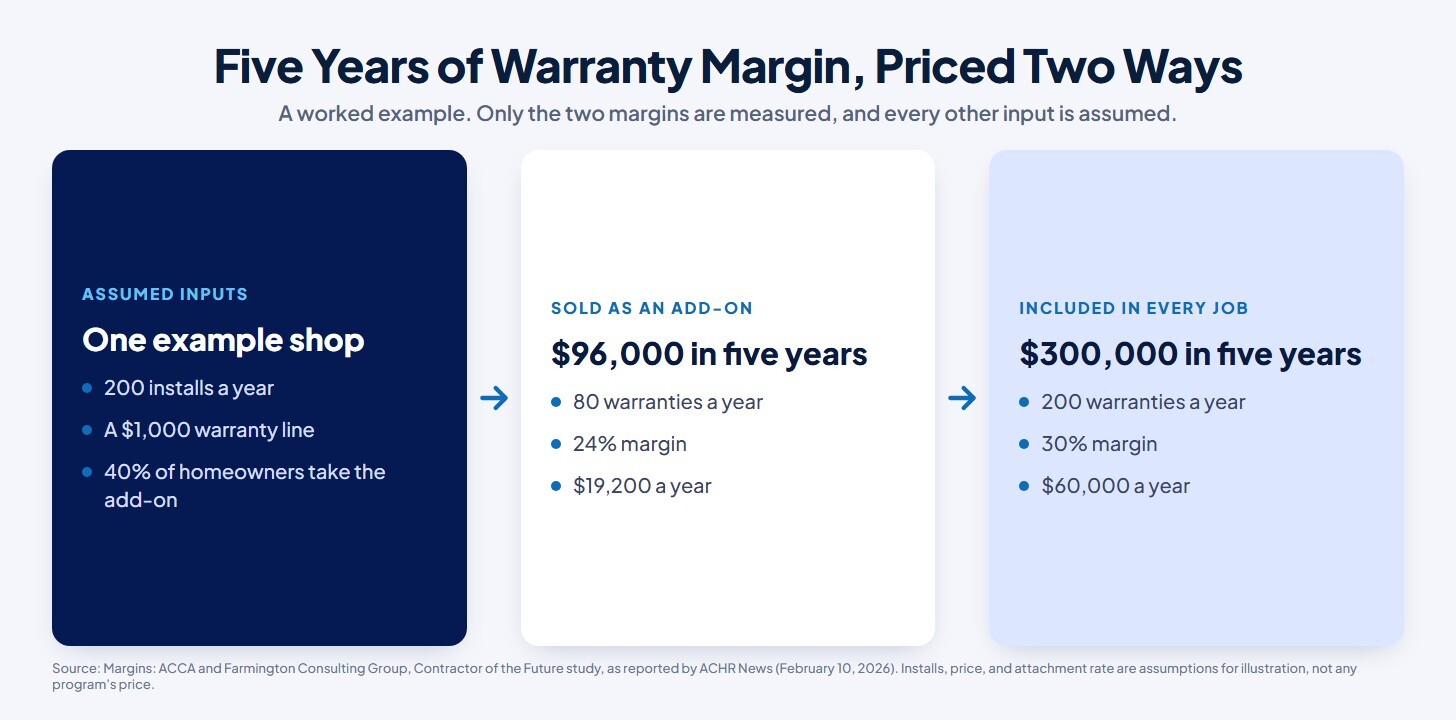
Use this worksheet with your own numbers. Line C comes from the attachment rate you measured above.
| Line | The math | Example shop | Your shop |
|---|---|---|---|
| A. Installs a year | Your count | 200 | |
| B. Warranty line price | Your price | $1,000 | |
| C. Attachment rate as an add-on | Your measured rate | 40% | |
| D. Add-on margin a year | A times B times C times 24% | $19,200 | |
| E. Bundled margin a year | A times B times 30% | $60,000 | |
| F. Extra margin a year | E minus D | $40,800 | |
| G. Extra margin over five years | F times 5 | $204,000 |
Take this as an example, not a promise. Of the extra $40,800 a year, $36,000 comes from the warranty going out on all 200 jobs instead of 80, and $4,800 comes from the higher margin. Over five years that's $204,000. Most of the gain comes from putting the warranty on more jobs, not from the higher margin.
Two effects sit outside the worksheet, so add them yourself. If a higher quoted price costs you jobs, subtract those jobs. If one complete price with coverage helps you win jobs you'd have lost, add them. The worksheet also holds both margins flat for five years, which is a simplification. Run the quarter-long test at the end of this guide before you trust either effect.
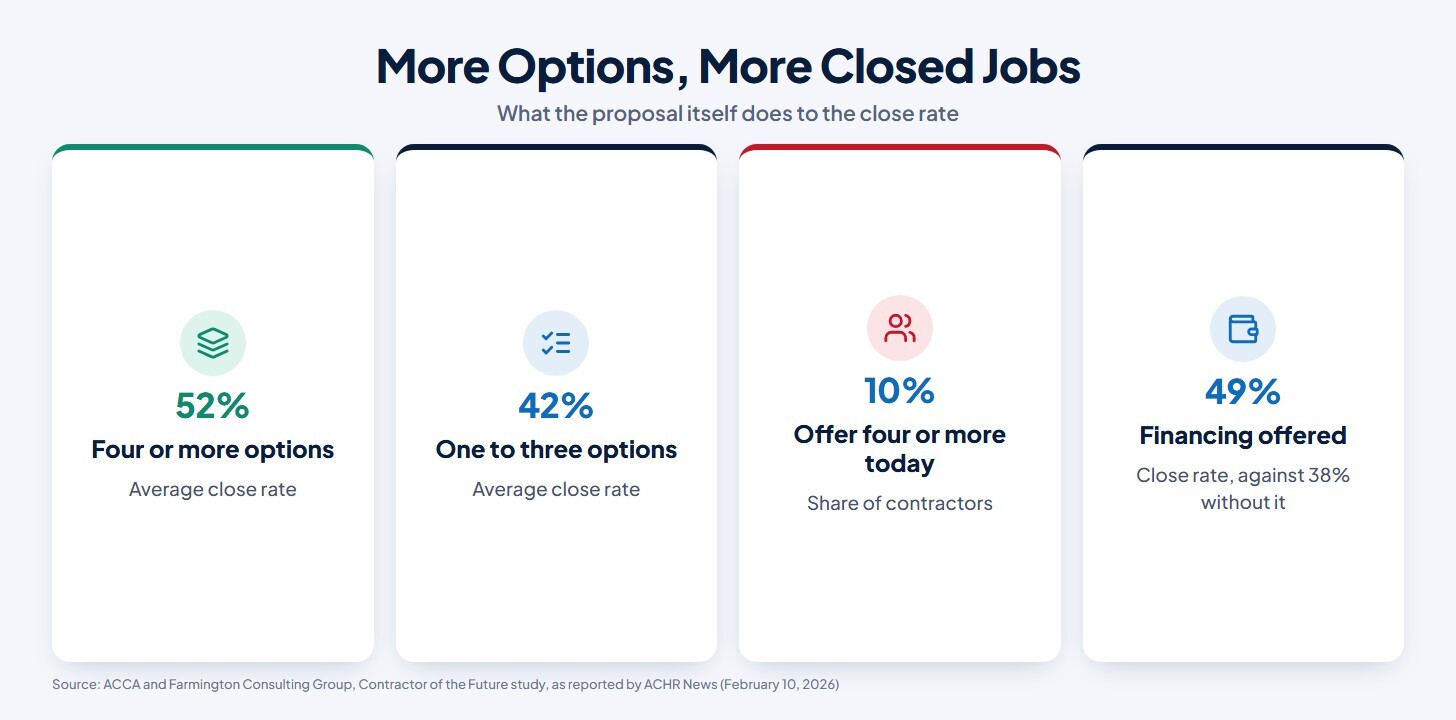
Put it in every option, and let the options differ on equipment, efficiency, and extras. ACCA recommends four options as the standard for a proposal. Contractors who offer four or more close 52% of the time, against 42% for one to three, yet only 10% of contractors offer four or more.
A common price-book pattern ties warranty length to the tier. ServiceTitan's guide describes a 10-year labor warranty that techs add to the Better or Best option, with limited warranties on basic options and extended ones on premium options. That works for a fixed-term labor warranty you sell by the year. A lifetime warranty that comes with every system you install isn't an upgrade, so it belongs in all of them, and the tiers compete on what the equipment does.
| Option | What changes | Coverage on the system |
|---|---|---|
| Good | Standard-efficiency equipment and a straight swap | Manufacturer warranty plus the lifetime warranty |
| Better | Higher efficiency and better comfort controls | The same coverage |
| Best | Top efficiency, variable speed, and indoor air quality upgrades | The same coverage |
| Fourth option | Best, plus a prepaid maintenance agreement | The same coverage, with the first year of visits paid |
One example of coverage built this way: a Noble Administration Network retailer enrolls every system it installs, so the lifetime warranty, which is A-rated insurance-backed, comes with the good option as well as the best one.
How you present the options changes which one people pick.
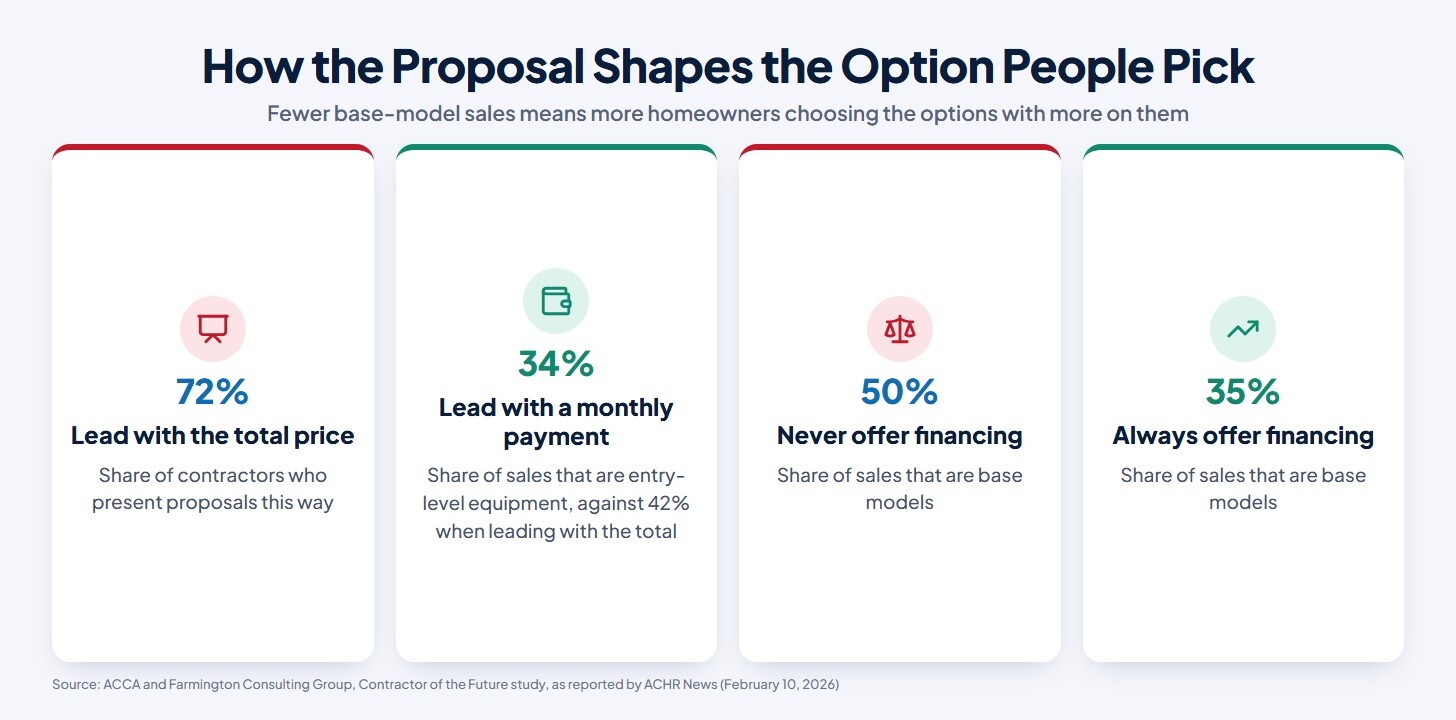
In the study, contractors who never offer financing see 50% of their sales as base models, against 35% for those who always offer it. The average close rate is 38% without financing and 49% with it, yet only 37% of contractors offer financing on every job. Put the monthly payment next to each option. Coverage also comes in more forms than these tiers show, from labor warranties to maintenance agreements. Our guide compares the protection plan options a shop can offer side by side.
Start with one change. Include the warranty in every option's price and description, then track three numbers for one quarter: attachment rate, close rate, and margin per job. If they hold or rise, keep the change. If close rate falls, adjust the price before you touch the coverage.
The study's numbers are averages across more than 1,000 contractors, and your shop isn't an average. Fill in the worksheet above with your own installs, price, and attachment rate, and let your numbers make the call. If you're still choosing which warranty program to put on the proposal, our guide to choosing a warranty program walks through the checks.
Noble offers the warranty program to only one residential HVAC retailer per territory. A retailer that proves its volume in its first 90 days holds the territory exclusively from then on.

We couldn't find a published industry benchmark, so your own last 12 months is the number to beat. Work it out by shop, by tech, and by option. When the warranty is included in the price of every option, every install carries it.
How do you calculate a warranty attachment rate?Divide the installs that left with an extended or lifetime warranty by all the installs you sold in the same period. Fifty installs with 20 warranties is a 40% attachment rate.
Do HVAC contractors earn more when the warranty is in the job price?On average, yes. In ACCA's Contractor of the Future study, reported by ACHR News in February 2026, warranties included in the total job price earned about a 30% margin, against about 24% for warranties sold as a separate add-on. ACCA recommends including it as the best practice.
Should a labor warranty go only in the better and best options?Many shops tie longer labor warranties to the upper tiers, and that can work for a fixed-term warranty sold by the year. A lifetime warranty that comes with every system you install isn't an upgrade, so it belongs in every option, and the options differ on equipment and extras.
How many options should an HVAC proposal include?ACCA recommends four. In its study, contractors offering four or more options closed 52% of the time, against 42% for one to three options, yet only 10% of contractors offer four or more.
Should you lead with the monthly payment or the total price?The ACCA study points to the monthly payment. 72% of contractors lead with the total price, but those who lead with a monthly payment finance 42% of their system sales, against 21%, and sell less entry-level equipment.
Does bundling the warranty raise the price the homeowner sees?The system price includes the coverage, so the homeowner sees one number per option instead of a system price plus a warranty line. Whether that changes your close rate is worth measuring on your own quotes for a full quarter before you decide.