New Home HVAC Warranty: What the Builder, the Manufacturer, and a Lifetime Warranty Each Cover
By Noble Administration Network · October 26, 2026 · How we research and compare
Noble Administration Network | Published on: October 26, 2026 | Time to read: 14 min | Updated on: October 26, 2026
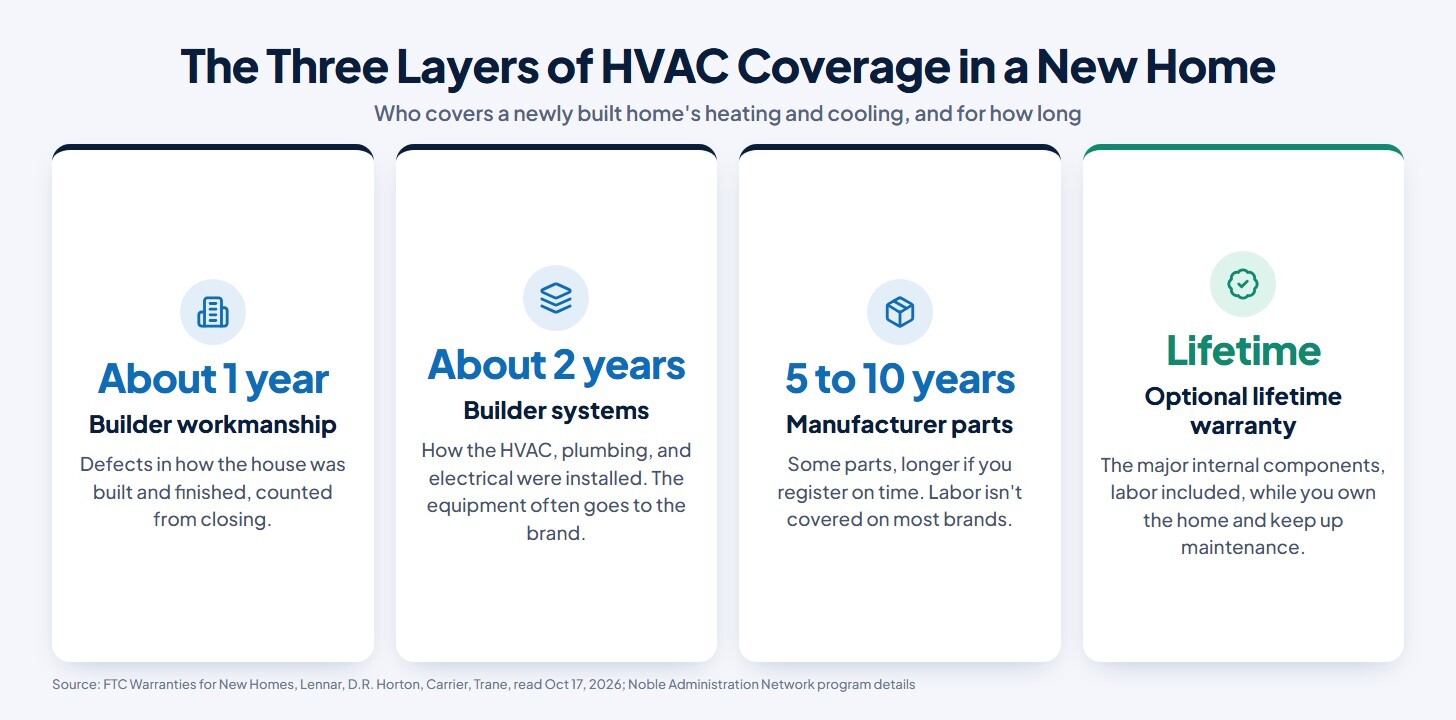
A new home HVAC warranty usually comes in three layers. Your builder covers workmanship for about one year and the heating and cooling system for about two. The manufacturer covers some equipment parts for 5 years, or usually 10 if you register on time, and most brands leave out labor. After that, repairs are yours unless you add coverage that includes labor, such as a lifetime warranty.
This guide is for two kinds of new homeowners: people who just closed on a newly built house, and people who bought an existing home with a heating and cooling system already in it. It shows who covers what, the registration deadline that starts at closing, a checklist for your first 30 days, what to check on a system you inherited, and whether each kind of coverage moves to the next owner. Every figure was checked against its source in October 2026.
Key Takeaways
Three layers cover a new home's heating and cooling system. The builder covers workmanship for about a year and the installed systems for about two. The manufacturer covers some equipment parts for 5 years, or usually 10 if you register on time. Once the builder's period ends, none of them usually pays the labor on a repair.
New single-family houses sold at a seasonally adjusted annual rate of 684,000 in August 2026, according to the U.S. Census Bureau's preliminary estimate released September 24, 2026. The table shows each layer, the two kinds of coverage you can add, and who you contact.
| Coverage | Who provides it | How long | Parts | Labor | Who you contact |
|---|---|---|---|---|---|
| Builder workmanship | Your builder | About 1 year from closing | Defects in how the house was built and finished | Yes, on covered defects | The builder, in writing |
| Builder systems | Your builder, sometimes through a third-party warranty | About 2 years from closing | Defects in how the HVAC, plumbing, and electrical were installed. Many builders leave the equipment to the manufacturer. | Yes, on covered defects | The builder or its warranty company, in writing |
| Manufacturer limited warranty | The equipment brand | 5 years, usually 10 if registered on time | Some parts that fail from a defect | Not on most brands | An HVAC company that services your brand |
| Home warranty (optional) | A company you buy a plan from | One year at a time | Covered repairs, with HVAC payouts often limited to $2,000 to $6,500 per system | Yes, after a $75 to $125 fee per visit | The plan company |
| Lifetime warranty (optional) | The HVAC retailer that installs a new system | While you own the home and keep up maintenance | The major internal components of the system | Included on covered repairs | Your installer, or the company that administers the warranty |
Usually workmanship for one year and the heating and cooling system for about two. The Federal Trade Commission's guide to warranties for new homes describes that pattern, and adds that some builders cover major structural defects for up to 10 years. What "covers HVAC" means changes from builder to builder, so read your own warranty document.
Large builders publish their terms. The Lennar 1-2-10 limited warranty lists 1 year for workmanship, 2 years for the performance of electrical, plumbing, and mechanical systems, and 10 years for structure, with shorter terms in Colorado and Utah. FHA and VA financing require the builder to buy a third-party warranty, the FTC notes, and 2-10 Home Buyers Warranty is one company that sells them. Its two-year coverage reaches behind-the-wall items such as ductwork, and it leaves outside-of-the-wall systems, which it says include HVAC systems, to the manufacturer's warranty.
D.R. Horton's one-year builder's warranty for Atlanta gives plumbing, HVAC, and electrical systems "some additional coverage through year two of ownership." The same document hands the owner "all rights under manufacturers' warranties covering consumer products" and excludes defects in items those warranties cover. So a bad installation is the builder's problem, and a failed part inside the equipment goes to the brand that made it.
So keep two lists. Installation problems, such as a duct or a condensate drain line, go to the builder in writing, as the FTC advises. A failed part inside the furnace, heat pump, or condenser goes to the manufacturer, through an HVAC company.
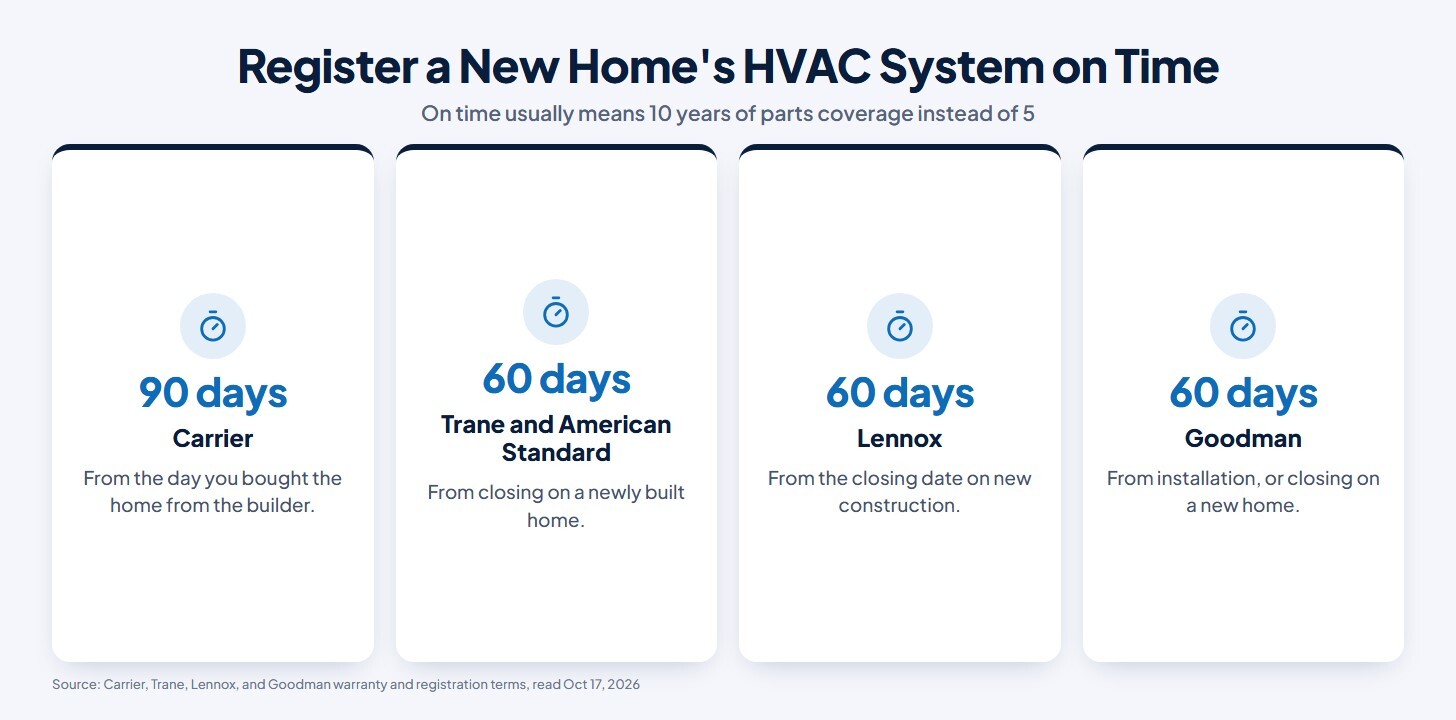
Within 60 to 90 days of closing. In a newly built home, the major brands count from the day you close, not the day the system went in. Registering is free, and on most brands it's what stretches 5 years of parts coverage to 10. Miss the window, and the shorter base term is usually all you get.
| Brand | Deadline in a newly built home | What on-time registration gets you |
|---|---|---|
| Carrier | 90 days, counted from the date you bought the home from the builder | 10 years on parts and the compressor instead of 5 |
| Trane and American Standard | 60 days from closing on the house | Usually 10 years on parts instead of 5, with labor covered under neither term |
| Lennox | 60 calendar days from the closing date on new construction | You get the extended limited warranty. In California, Florida, Georgia (units installed on or after January 1, 2026), and Quebec, it applies without registration. |
| Goodman | 60 days from installation, or from closing on a newly built home | You get the additional rights and remedies Goodman gives registered equipment. |
One detail applies only to new construction. Carrier's Consumer Choice warranty, which trades some parts coverage for labor coverage, isn't available on new residential construction installations. For each brand's full terms, see what HVAC manufacturer warranties actually cover.
Gather the paperwork, write down when each warranty ends, and register the equipment. Then put the first maintenance visit on the calendar and ask what covers labor while the builder's period is still running. The checklist below covers each step, and it works for a newly built house or one you just bought.
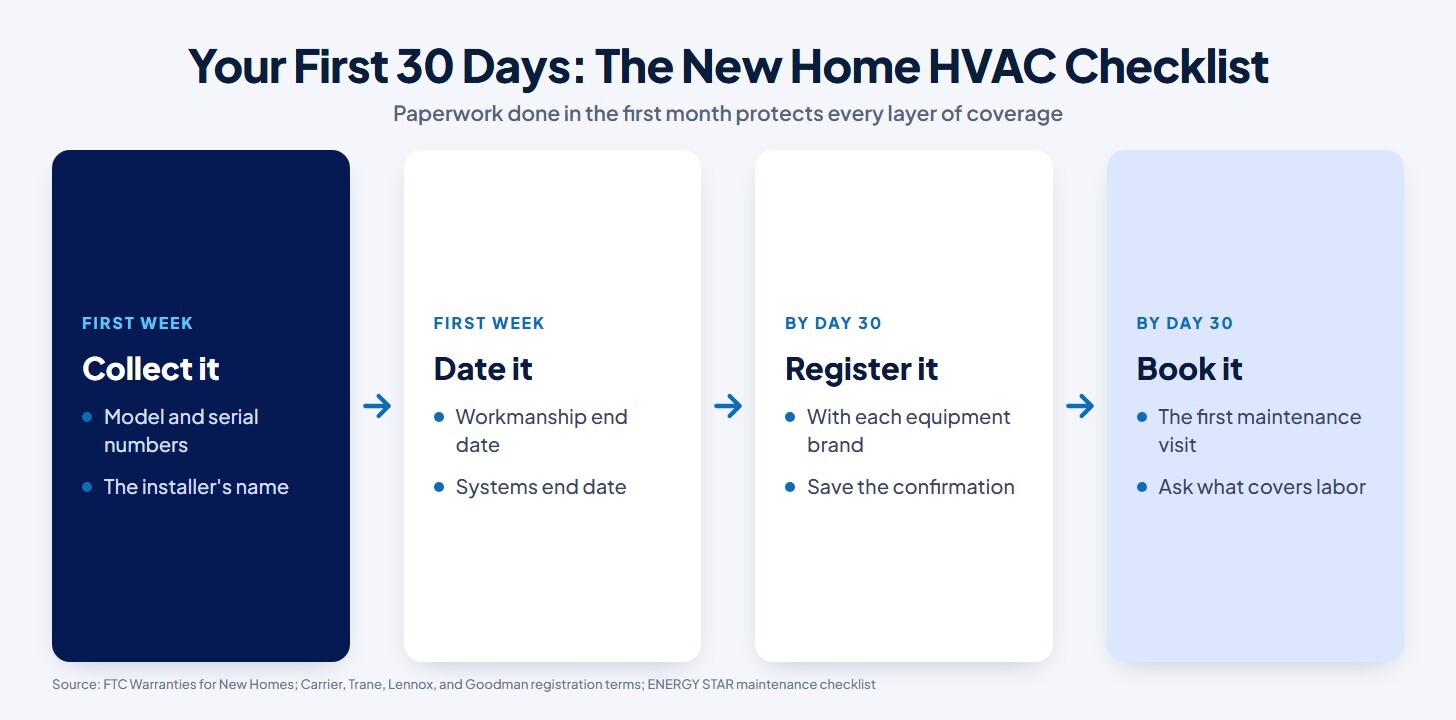
Print this page or save it as a PDF, and tick each box as you go.
After that, look at the air filter every month, which is what ENERGY STAR's maintenance checklist asks. Before month 11 and again before month 23, walk the system with your builder's list and send any repair request in writing, while each layer of builder coverage still applies.
For homeowners
Get coverage that lasts as long as you own the home.
The Noble lifetime warranty covers repairs on the major internal components of your system, labor included, and it's A-rated insurance-backed. See what it covers.
See what's coveredCheck the system's age, its warranty status, any transfer deadline, and the paperwork the seller left behind. Start with the model and serial numbers, then ask the seller for the install invoice and every warranty document. A system you inherited may be partway through its parts coverage, or past it, and you'll want to know which before the first repair.
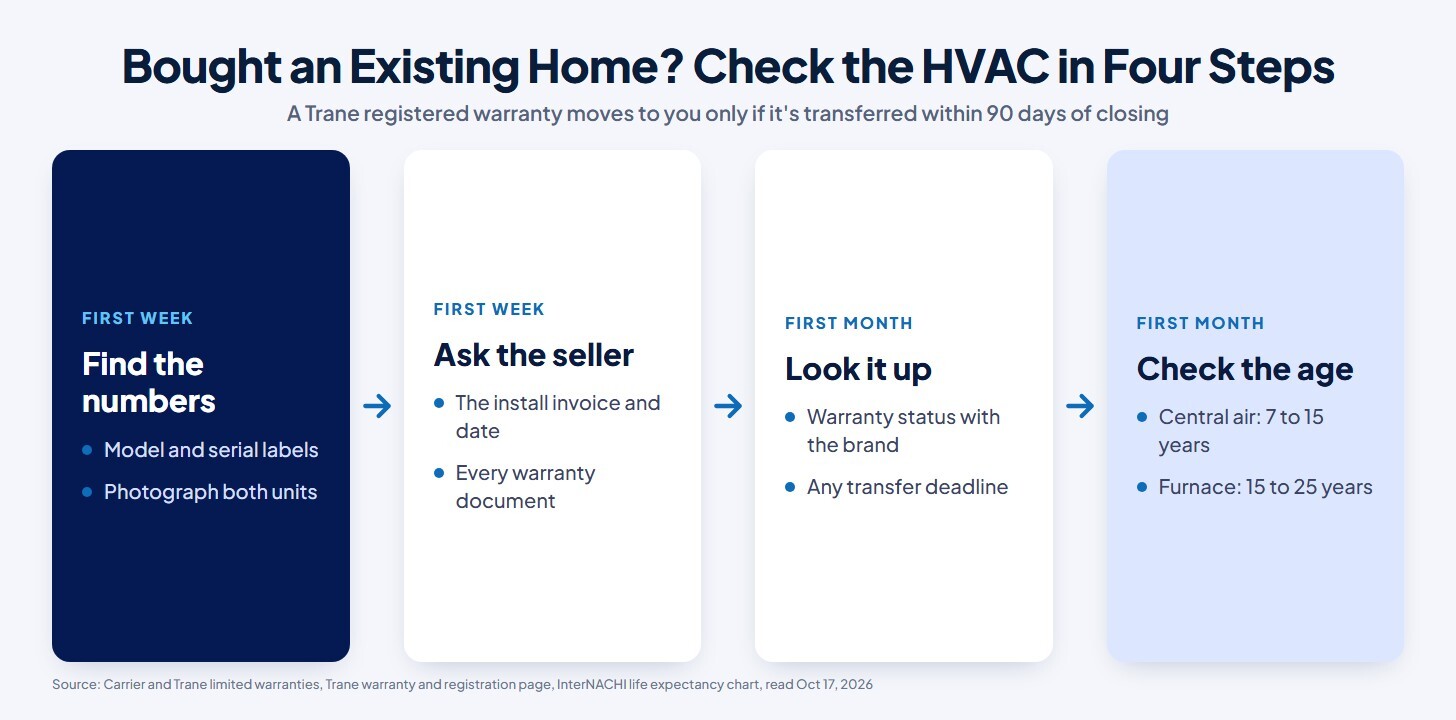
Some of it does, if someone acts before the deadline. A manufacturer's base warranty often stays with the equipment, while a longer registered warranty may need a transfer request and a fee. Builder warranties and lifetime warranties follow their own written terms, so read them before you count on coverage moving with the house.
| Coverage | Does it move to the next owner? | What to do |
|---|---|---|
| Trane base limited warranty | Yes. Trane says base limited warranties stay with the product. | Keep the paperwork with the house. |
| Trane registered limited warranty | Only if it's transferred within 90 days of closing, for a one-time $99 fee | The new owner calls Trane before day 90. |
| Carrier limited warranty | Later owners get 5 years on parts and the compressor without registering, and some states keep the original owner's term | Keep the original install date on file. |
| Builder warranty | It depends on the document. D.R. Horton's Atlanta one-year warranty, for example, is written to the original owner only. | Read the transfer clause before you list or buy a home inside the two-year window. |
| Home warranty | Usually, according to This Old House | Ask the plan company to move it at closing. |
| Lifetime warranty from an HVAC retailer | It depends on the terms. The Noble lifetime warranty doesn't transfer: it covers the original purchaser for as long as they own the home. | Read the terms before you count on it, whether you're buying or selling. |
Usually not in the first years. A home warranty is a separately paid service contract, and NerdWallet reports that most won't cover HVAC repairs while the system is still under the manufacturer's warranty. On a newly built house, that overlap can take up most of the years you'd be paying for the plan.
The FTC calls a home warranty "really a service contract," one that costs extra, and in a separate consumer alert it warns that a home warranty is only as good as the company behind it. NerdWallet puts HVAC payout limits at $2,000 to $6,500 per system, and This Old House puts the premium at $564 to $984 a year, plus $75 to $125 per visit. A plan fits better on an older system the manufacturer no longer covers. To weigh a home warranty against the other kinds of coverage, see our side-by-side comparison of HVAC warranty types.
Add one when the builder's system is replaced, or when you buy a new system for a home you just bought. A lifetime warranty like Noble's comes with the installation, so it fills the two gaps the manufacturer leaves: labor, and the years after the parts coverage ends. Ask who pays its claims before you count on it.
The Noble lifetime warranty is one example. It's included in the price of a system a participating HVAC retailer installs, it's A-rated insurance-backed, and it covers repairs on the major internal components, labor included, while you own the home and keep up a spring and a fall service every year. Before you rely on any lifetime warranty, read what a lifetime HVAC warranty covers and what a limited lifetime warranty really means. Who pays a covered repair is explained in our guide to insurance-backed HVAC warranties.
The repair bills become yours, labor and all. Angi puts a typical HVAC repair at $350, with a compressor at $800 to $3,000, and a full replacement averages $7,500, according to Angi's replacement cost guide. Our guide to HVAC repair versus replacement shows when a repair stops making sense, and our look at 10-year HVAC labor warranties shows how much of a repair bill is labor.
When the time comes to replace the system, ask every HVAC company one question: will the new system be covered for as long as I own the house? Then check your ZIP code to see whether a Noble retailer installs near you.
Enter your ZIP code to see whether a lifetime warranty can come with your next heating or cooling system, or read exactly what it covers first.

Usually not while the system is new. NerdWallet reports that most home warranties won't pay for HVAC repairs while the manufacturer's warranty applies, and the builder covers installation defects for about two years.
How long is the builder warranty on HVAC?Usually about two years. The FTC describes builder coverage for HVAC, plumbing, and electrical systems as generally two years, with workmanship covered for about one. Many builders leave the furnace, condenser, and other equipment to the manufacturer's warranty.
Does the HVAC warranty transfer to a new owner?Part of it often does. Trane's base warranty stays with the equipment, and its registered warranty moves only within 90 days of closing for a one-time $99 fee. Carrier gives later owners 5 years on parts. Builder and lifetime warranties follow their own written terms.
Do I need to register a new home's HVAC?Yes, to get the longer coverage. Carrier asks for registration within 90 days, and Trane, Lennox, and Goodman within 60 days, counted from closing on a newly built home. On most brands, registering on time stretches parts coverage from 5 years to 10. A few places, including California and Florida, don't let a brand tie the longer warranty to registration.
What should I check on the HVAC when I buy an existing home?Find the model and serial numbers, ask the seller for the install invoice and warranty documents, and look the warranty up with the brand. Then note any transfer deadline and check the system's age against its expected life.
Who do I call if the HVAC breaks in a new home?It depends on what failed. An installation problem, such as a duct or drain line, goes to the builder in writing during its coverage period. A failed part inside the equipment usually goes to an HVAC company that services your brand, under the manufacturer's warranty.