
HVAC Proposal Template: What Every Replacement Quote Should Show
By Noble Administration Network · November 23, 2026 · How we research and compare
Noble Administration Network | Published on: November 23, 2026 | Time to read: 11 min | Updated on: November 23, 2026
An HVAC proposal template is a fill-in layout for a replacement quote. A strong one names the system you found, the size and how you worked it out, the options, the warranty and who registers it, the scope, and the terms. This page shows the whole layout, with sample wording you can copy.
Most of the pages we read list what to include, and some put the file behind a form or a software trial. None of them shows a residential replacement proposal laid out block by block with sample wording. This one does, with no form to fill out.
An HVAC proposal template is a reusable layout your shop fills in for each replacement job. It holds the parts that stay the same, such as your terms, and leaves blanks for the parts that change. You may also hear it called an estimate template or a quote template, and each name points to the same document.
In this guide, an estimate is a rough number given before you've measured the job. A proposal is the written document that follows, with the options, the scope, and the terms. Your state's law may treat a signed proposal as a contract, so have your attorney read yours.
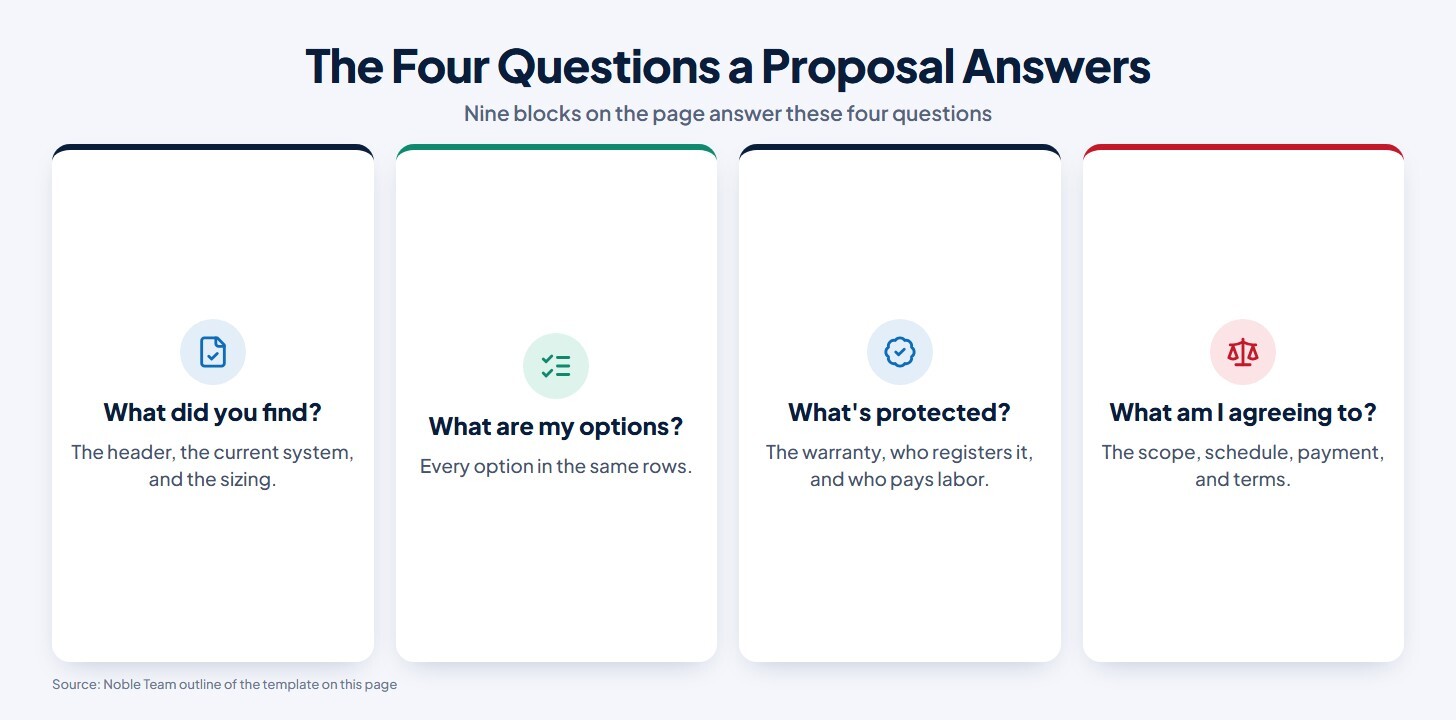
The other pages on this search are good at listing sections. Jobber and Housecall Pro put their files behind a form, while AroFlo and Quo link theirs directly. AroFlo's guide is written for commercial and mixed work. What's missing is a block-by-block example for a homeowner's kitchen table, so that's what follows.
A residential proposal should include nine blocks: a header, the current system, the sizing, the options, the warranty, the scope, the permit and schedule, the payment, and the terms. Each block answers a question a homeowner has at the table. Copy the wording below and replace every bracket with your own details.
| Block | Sample wording |
|---|---|
| 1. Header | [Company name], license [number]. Proposal for [customer] at [address]. Prepared by [name] on [date]. This price holds until [date]. |
| 2. Current system | Your [make and type], installed in [year], is [age] years old and [size] tons. We found [what you found]. |
| 3. Sizing | We ran a load calculation for your home on [date]. The calculation calls for [size] tons. We can give you a copy. |
| 4. Options | Your options are side by side below. Each one shows the equipment, the rating, the warranty, the total, and the monthly payment. |
| 5. Warranty | Parts: [years] years if registered by [date]. We'll register the equipment for you. Labor: [term]. Backed by: [company or type of company]. |
| 6. Scope | Included: removing and disposing of the old equipment, [list]. Not included: [list]. |
| 7. Permit and schedule | We'll pull the permit and book the inspection. The install takes about [number] days and starts on [date]. |
| 8. Payment | Total: $[amount]. Deposit: $[amount]. Balance due on [event]. |
| 9. Terms and signature | Any change to this scope needs a written change order signed by both of us. By signing, you accept option [number]. |
Keep the language plain, because the homeowner may read it alone after your tech leaves. If a block doesn't apply, cut it. If your state asks for specific contract wording, it goes in block 9, so check with your attorney or your state's licensing board before you use this layout.
The options block should show every option in the same rows, so a homeowner can compare them without doing math. List the equipment, the SEER2 rating, the refrigerant, the AHRI number, the parts warranty, the labor coverage, the total, and the monthly payment. Same rows, same order, in every column.
| Row | What to write | Why the row is there |
|---|---|---|
| Equipment | Make, model, and size of each part | So two quotes can be compared line by line |
| SEER2 rating | The rating of the matched system | It shows what the extra money buys |
| Refrigerant | R-454B, R-32, or another type | Homeowners are hearing about the change |
| AHRI number | The certificate for this exact pairing | It proves the rating of the combination |
| Parts warranty | Years, and the date to register by | It keeps a deadline from being missed |
| Labor coverage | Who pays, and for how long | Most quotes leave labor coverage out |
| Total | One number that includes everything in the scope | The total stops surprises on install day |
| Monthly payment | The payment, the term, and the lender | It helps the homeowner see what fits the budget |
Better option: a 3-ton split system at 16 SEER2 with R-454B, AHRI number on the certificate attached. Parts: 10 years if registered by March 1, and we'll register it for you. Labor: covered for as long as you own your home. Total: $9,200, including removal, permit, and start-up. Monthly: $129 for 84 months through our lender. These details are samples, so use your own equipment, price, and financing terms.
Our HVAC pricing guide shows how to build each number from your own cost, so the option a homeowner picks doesn't change the margin you keep.
Free tools for HVAC retailers
Get the free tools Noble built for HVAC shops.
The territory calculator, the homeowner close sheet, and the technician field card are free on the resources page, with no form and no sales call attached.
See the resourcesShow four options if you can. ACHR News reported that ACCA recommends four as the standard for proposals. In a survey of more than 1,000 HVAC companies, those offering four or more options closed 52% of the time, against 42% with one to three. Only 10% offered four or more.
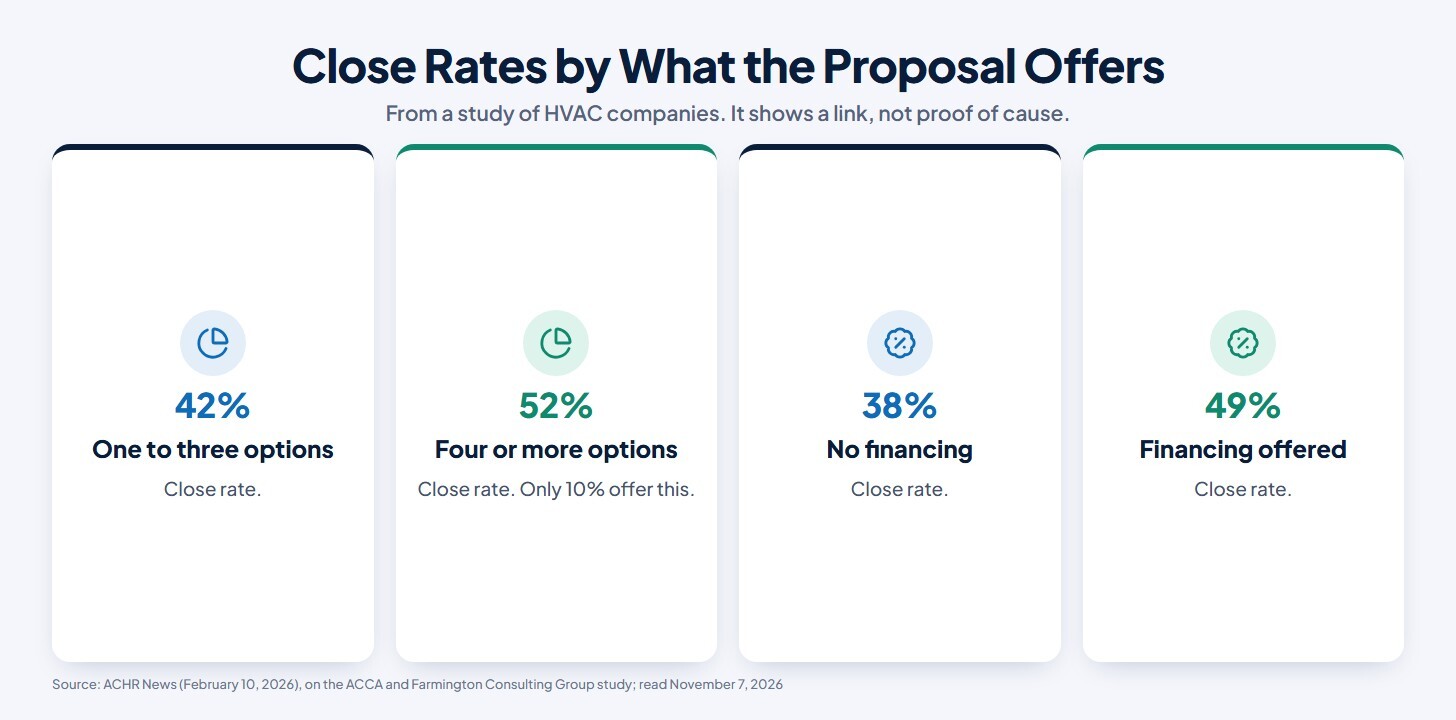
That ACHR News report from February 10, 2026 covers ACCA's work with Farmington Consulting Group, and it shows a link, not proof of cause. The same survey found a 49% close rate with financing and 38% without it. Our guide to warranty attachment rates walks through how to lay out good, better, best, and a fourth option, so we won't repeat that here.
What matters on the page is that the options are real. Each one should be a system you'd be glad to install, and the difference between them should fit on one row of the table above.
Give sizing and the AHRI match each its own line. The sizing line names the load calculation and the date you ran it, and the AHRI number proves the rating of the exact pairing you're quoting. A homeowner may never check either one, but a proposal that shows them looks different from the quote beside it.
ACCA says Manual J, Manual S, and Manual D are requirements found in the building codes. How your area enforces them on a replacement can vary, so ask your local permit office. Manual J covers the load, Manual S covers picking the equipment, and Manual D covers the ducts. Offer the homeowner a copy of the load calculation, because it explains why you didn't just match the old unit.
Carrier says actual system ratings depend on the specific AHRI-certified equipment combination, so print the certificate number for each option. Our guide to competing on more than price has a six-line check a homeowner can run on two quotes.
It should say what's covered, for how long, who registers it, who pays the labor, and who backs it. A manufacturer warranty covers some parts, with registration, and the deadlines are short at some brands. Put the date on the proposal, and say that you'll handle the registration.
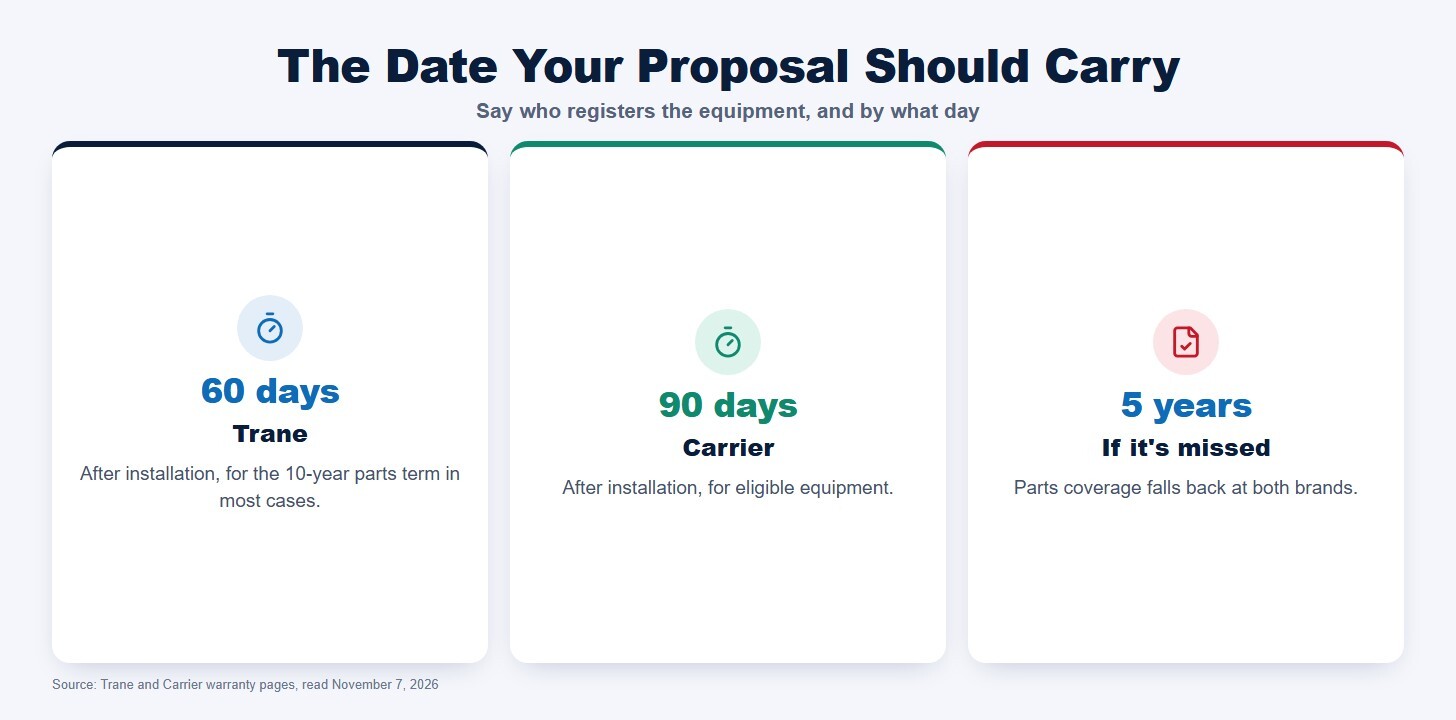
Carrier gives 90 days and says a late registration falls back to the standard 5-year parts warranty. Trane gives 60 days, and it says its registered warranty lasts 10 years in most cases, against about five for its base warranty. So one registration date on the proposal protects years of coverage for your customer. If the labor coverage row is blank, the homeowner will find out on the first repair bill.
When the same coverage comes with every option, put it in every column so nobody has to pay up to get it. Noble's program is one example. Noble offers the warranty to one residential HVAC retailer per territory, exclusively. Each homeowner books maintenance with you twice a year, a spring and a fall service, to keep the warranty active, and every claim is backed by a national, brand-name A-rated insurance company. Our guide to offering a lifetime warranty on every install shows how that works, and who pays a warranty claim explains the backing.
The scope should list what's included and what isn't, in plain words. The terms should cover the payment schedule, changes, the date the price ends, and the signature. Include removal and disposal of the old equipment, the permit, the thermostat, and any electrical or duct work, so nothing is left to guess.
The "not included" list matters as much as the "included" list. If you find rotted duct or an old panel, a written change order keeps that conversation calm. Say how long the price holds, too. Quo says most HVAC professionals use 15 to 30 days, and AroFlo calls 30 days a sensible default for residential work. That's their advice, not a rule.
If you sign the job at the home, check the FTC's Cooling-Off Rule, which gives buyers until midnight of the third business day on many sales made there. Your state may add rules on written contracts and deposits, so ask your attorney before you set your terms.
Walk through it at the table, then leave a copy. Start with what you found and why you sized the system the way you did. Then go through the options row by row. Follow up soon after: Quo suggests 24 to 48 hours, and Jobber suggests 48 to 72, so pick one and stick to it.
Print the proposal even if you send it by email, because a page on the table keeps the conversation on your numbers. Our guide on what to say about the warranty covers the talk track, and the homeowner close sheet is a free take-home for the same visit.
Noble offers the warranty to one residential HVAC retailer per territory, exclusively. Offer coverage an insurer stands behind, with no separate warranty fee for the homeowner.

It should include a header, the current system, the sizing, the options, the warranty, the scope, the permit and schedule, the payment, and the terms. Each option should show the same rows, so a homeowner can compare them.
What's the difference between an HVAC estimate and a proposal?In this guide, an estimate is a rough number given before you've measured the job. A proposal is the written document that follows, with the options, the scope, and the terms.
How many options should an HVAC proposal show?ACHR News reported that ACCA recommends four as the standard. In a survey, HVAC companies with four or more options closed 52% of the time, against 42% with one to three.
Should an HVAC proposal include financing?Yes, if you offer financing. The same survey found an average close rate of 49% with financing and 38% without, which shows a link, not proof of cause. Show the monthly payment beside the total on each option.
How long should an HVAC quote stay open?Quo says most HVAC professionals use 15 to 30 days, and AroFlo calls 30 a sensible default for residential work. That's advice, not a rule, so pick a number that fits how fast your equipment prices change.
Is a signed HVAC proposal a contract?It can be, and state law decides what it needs to say. Have your attorney read your proposal before you use it.