How to Sell an HVAC Extended Warranty: What to Say
By Noble Team · September 9, 2026
Noble Admin Network | Published on: September 9, 2026 | Time to read: 11 min | Updated on: October 17, 2026
An HVAC extended warranty or lifetime warranty closes deals when it comes up in three places: at the opening to set the stakes, at the price objection to change what's being compared, and at the close to take the risk out of a five-figure decision. Many sales teams mention it once, deep in the proposal.
Here's where it belongs, the words that work at each point, and what to say when the homeowner pushes back.
Because it shows up in the wrong place, in the wrong size, in different words every time. It lands on page six of the proposal in nine-point type, the advisor mentions it in passing, and the homeowner skims past because it looks like the warranty section in the other two proposals.
Three things go wrong at once.
The warranty is positioned as a feature. Features rarely change a buying decision. A closer does, and it has to be framed as one.
The team doesn't believe in it yet. An advisor who has never seen a claim paid reads the bullet points. Noble's coverage is summarized on the Warranty page, and the full terms are in the program details every retailer receives, so he can explain the coverage before he's seen a claim paid himself.
There's no script. Every advisor explains it his own way, and your close rate swings by who took the appointment. Customers pay to have their anxiety reduced (Harvard Business Review's Elements of Value), and you can't deliver that with a mumble.
The fix: the warranty comes up at three points in every conversation, and the words are the same every time.
Three places, in this order: the opening, the price objection, and the close. Each one does a different job, and skipping any of them leaves money on the table.
The opening sets the stakes. Before equipment, before price, before the homeowner has an opinion about your company, you frame what makes your install different. From then on every other quote she reads gets compared to that baseline.
The price objection is where it earns its keep. It's coming, because the three quotes carry the same major brands. The warranty changes what's being compared, from your price to their gap.
The close takes the risk out. A homeowner about to spend ten thousand dollars or more is buying peace of mind as much as tonnage. The warranty turns “a big purchase” into “a protected purchase”, and that's the sentence she signs on.
Why price becomes the only comparison when quotes look identical is its own post. This one is about what you say once you have something structural to say.
You tell her what's different before she's heard a number. These aren't scripts to read out loud. They're the shape of the conversation when the warranty is placed correctly.
“Before we get into equipment options, I want to tell you what makes our installs different from the other quotes you'll see. Every system we install is enrolled in a lifetime warranty. Covered repairs on the major internal components, labor included, for as long as you own the home. There's no separate warranty fee for it. And the other quotes you'll see don't include it, so keep that in mind as you compare.”
Notice the order. Exclusivity first, because it's the one thing the other quotes can't answer. What's covered second. What it costs her last, because “no separate fee” only matters once she wants it. From here, every other quote is measured against a baseline they can't reach.
The Noble lifetime warranty
Offer a warranty your competitors can't match.
A lifetime warranty on the major internal components of the system, with possible territory exclusivity for your shop. There's no separate warranty fee for the homeowner.
See the warrantyYou stop defending the number and show what's missing from the other proposal. The homeowner isn't being difficult when she asks why you're $600 more. She's asking the only question the quotes let her ask.
“I understand the other quote is lower. Let me show you what's not in it. Their warranty is the manufacturer's parts coverage. If a part fails in year five, the part might be covered, but the labor isn't, and labor can be a big share of the bill. If it fails after the parts term ends, you're paying for both. Ours includes a lifetime warranty on the system: covered repairs on the major internal components, labor included, as long as you own the home. The difference between our quotes is a few hundred dollars once. The difference on the day something fails can be much more than that.”
That answers the objection without running the competitor down. It names what isn't in the comparison. Federal law requires a written warranty to be available before the sale (the FTC's pre-sale availability rule), which is why a warranty carries a sale where “our installs are better” can't: she can hold the paper.
The gap you're pointing at is real. What a manufacturer warranty actually covers surprises most homeowners the first time they use one, and the labor line is the surprise that costs them.
You put her five years into the future, on a hot day, with a dead blower motor. Then you walk her through the two versions of that afternoon.
“Let's talk about five years from now. The blower motor fails on a Saturday in July. With the other quote, you're calling around for a technician, paying a service call, paying for the part, paying for the labor. With this system, you call us, and the covered repair, labor included, is paid for under the warranty. Same equipment. Different afternoon.”
She's no longer comparing $9,800 to $10,400. She's comparing two ways of owning the system for as long as she has it, and that's the comparison you win.
The technician gets one sentence for the day itself: “This system's covered.” The one-page close sheet is free to print for whoever sits at the kitchen table, and every technician handling refrigerant already carries EPA Section 608 certification, so the credential isn't the differentiator. The warranty is.
You ask two questions and point at the gap, without running their program down. A ten-year extended plan is a real step up from manufacturer coverage, and saying so makes the next sentence land harder.
“They offer a ten-year extended warranty, and that's a real upgrade over the standard manufacturer coverage. Two questions to ask them. Is it parts and labor, or parts only? And what happens in year eleven? Ours covers the system for as long as you own the home, labor included. There's no year eleven problem, because it doesn't run out after a set number of years. It lasts as long as you own the home and keep up the maintenance.”
If she brings up a “limited lifetime” manufacturer warranty, answer it straight: that usually covers one component, often the furnace heat exchanger, and usually parts only. We covered how a shop chooses a warranty program and how a lifetime workmanship guarantee differs from a lifetime warranty in their own posts.
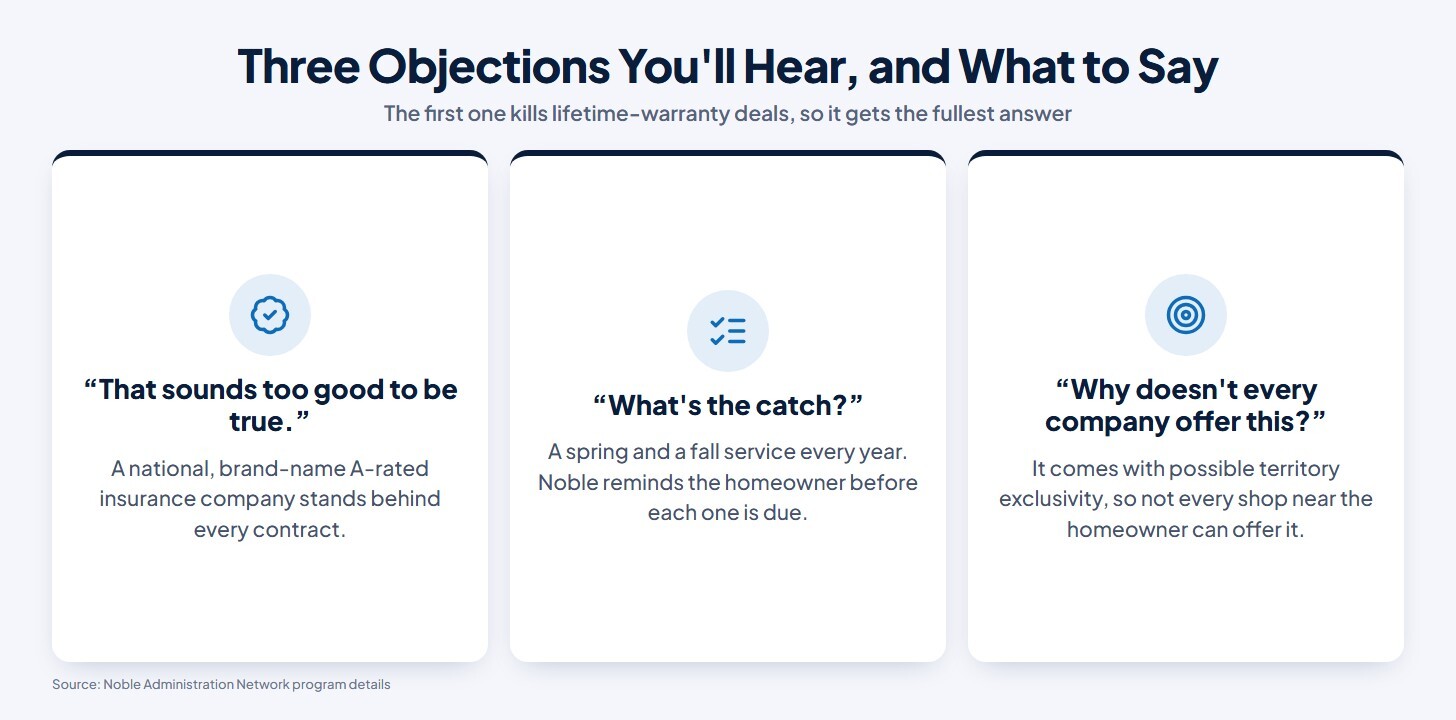
Three come up again and again. The first is the one that kills lifetime-warranty deals, and it has a guide of its own.
Answer it with what stands behind the warranty: a national, brand-name A-rated insurance company, in writing she can read before she signs (who pays a claim if a company closes has its own guide). The full answer, word for word, is in how to answer a homeowner who doubts your warranty.
“Maintenance. The system needs a spring and a fall service every year, and Noble reminds you before each one is due. Most people who care about their equipment do that anyway. The warranty makes it official.”
“Because it isn't sold to every installer, and we're the company that offers it here. Most warranties any installer can buy aren't built that way. This one is.”
Once the team has the words, the warranty has to show up in three more places, or the homeowner meets it for the first time at the kitchen table.
On your website. A page of its own, not a paragraph on the About page, answering what homeowners ask: what's covered, what happens on the day a system fails, and what maintenance keeps it active. Noble's own homeowner page is a model for the shape.
In your proposals. A warranty section, not a fine-print line, with the comparison against the manufacturer warranty on the page so the gap is visible without anyone explaining it.
In your follow-up. When the proposal goes out, the warranty is in the subject line and the first paragraph. Don't make her dig for the one thing the other quotes don't have.
It gives the customer a reason to come back: a required spring and fall service every year for as long as the homeowner owns the home, with Noble sending a reminder before each one is due.
That's the part most retailers forget to sell, and it's the second-largest benefit of the program to your company: two paid maintenance visits a year, from a customer with a reason to call you first, in the months the phone goes quiet. Homeowners keep spending on the homes they own (Harvard's Joint Center tracks that spending), and demand for technicians keeps growing (the Bureau of Labor Statistics projects 11 percent job growth from 2025 to 2035), so paid shoulder-season work is real money. The territory value calculator takes your own installs and your own maintenance price.
A warranty doesn't close deals on its own. The person at the table does, when the warranty comes up in the right three places, in the same words, every time. If your territory is still open, the checker on the Territories page says so in ten seconds.
Check whether your territory is still open, then apply in about two minutes or tell us what you want to know. A person who knows the program calls you back.

No. They're the shape of the conversation, not a script. What has to stay the same is the order (exclusivity, then what's covered, then what it costs the homeowner) and the three places it comes up. The words can be the advisor's own.
What if the homeowner asks who the insurance company is?Tell her it's a national, brand-name A-rated insurance company, and that the program details she can read before she signs name the insurer.
What does the homeowner have to do to keep the warranty?A spring and a fall service every year, with proof of each sent to Noble within 30 days, and Noble reminds her before each one is due. Those are the visits that keep the system healthy anyway, and they give her a reason to call you.
Does the warranty cover labor?Yes. After your shop's own installation warranty ends, covered repairs on the major internal components include labor. That's the gap in a manufacturer's parts warranty, and it's the line that answers the price objection.
How do I find out if I can offer it?Enter your ZIP code or county on the Territories page. It tells you in ten seconds whether your territory is open, and if it is, the application takes about two minutes and a person who knows the program calls you back.