What Happens to an HVAC Warranty if the Company Closes?
By Noble Team · September 9, 2026
Noble Admin Network | Published on: September 9, 2026 | Time to read: 12 min | Updated on: October 17, 2026
It depends on who is obligated to pay the claim and what backs that promise. A self-funded provider pays from its own reserves, so the coverage can end with the company. An insurance-backed provider has an insurer that pays if the provider fails. If the insurer fails too, a state guaranty fund often won't cover warranty insurance.
That answer matters to an HVAC shop because your name is on the invoice, and the homeowner calls you when a covered repair goes unpaid. Here's who pays at each layer, what changes when a warranty company or an installer closes, and how to check a provider's backing.
The company named as the obligor in the contract pays: the manufacturer for its parts warranty, the installer for its own labor guarantee, and the provider for a service contract or third-party warranty. What stands behind that company decides whether a claim still gets paid in year 12, after the company that sold it has closed.
A written warranty is the warrantor's promise to stand behind its product, and it comes with the product, inside the purchase price (the FTC's guide to federal warranty law). A service contract is a separate agreement that costs a fee beyond the purchase price. The company responsible for it isn't always the one that sold it, and the FTC warns consumers that it might be a company they don't know.
For a lifetime HVAC warranty, the gap between the sale and the claim can run for decades. The FTC's consumer advice says a service contract is only as good as the company responsible for it, and that company might not be in business when the homeowner needs it (FTC consumer advice). So the question for your shop is who pays, and what pays them.
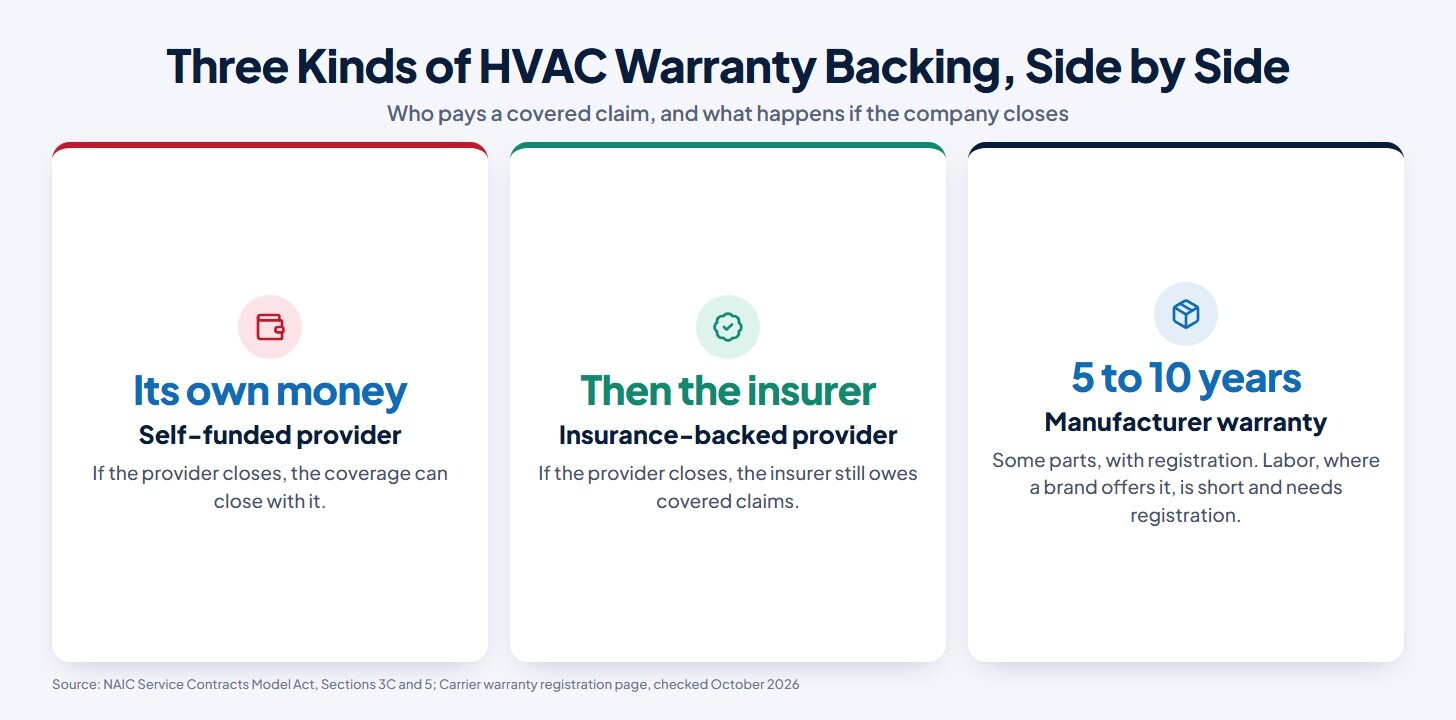
A self-funded provider pays claims from its own reserves, so the coverage is only as strong as that one company. An insurance-backed provider buys a reimbursement insurance policy, and the insurer agrees to pay the provider's obligations to contract holders if the provider doesn't perform. The second puts a regulated insurer between your customer and a failed company.
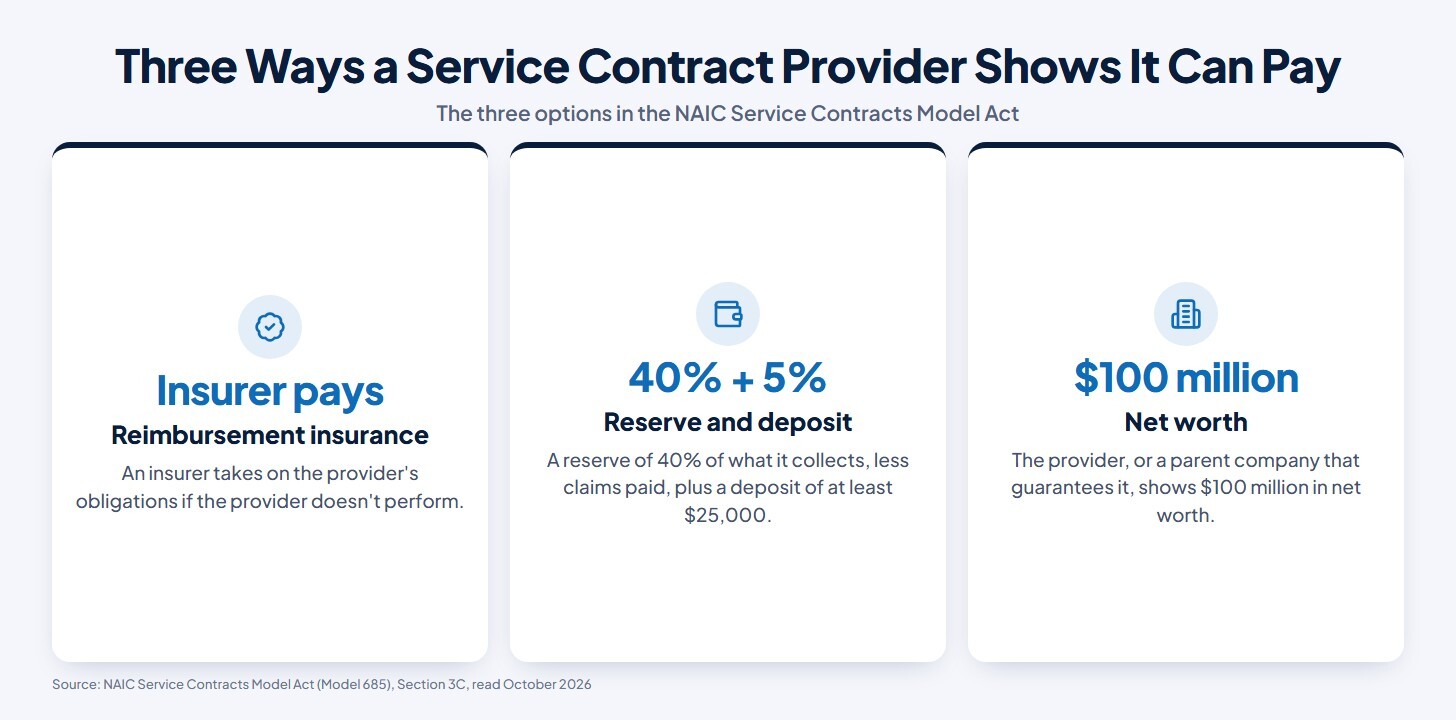
The National Association of Insurance Commissioners (NAIC) wrote a model law for these contracts, the Service Contracts Model Act, adopted in 1995 (NAIC Model 685, Section 3C). It gives a provider three ways to show it can pay. It can insure every contract under a reimbursement insurance policy. It can keep a funded reserve of at least 40% of the money it collects, less claims paid, plus a security deposit held in trust with the state of at least 5% and never less than $25,000. Or it can show a net worth of $100 million, its own or a parent company's that guarantees its obligations.
Under the model act, an insured contract has to say the provider's obligations are guaranteed under a reimbursement insurance policy, and it has to give the insurer's name and address. A contract with no insurance behind it has to say its obligations are backed only by the full faith and credit of the provider. Look for one of those two sentences in any contract you're asked to sell.
States add their own rules. California, for example, requires service contract administrators to register and to file a copy of a reimbursement insurance policy covering the contracts (California BHGS registration form).
It depends on the backing. If an insurer stands behind the contracts, under the model act the homeowner can claim directly against the insurer when the provider doesn't pay within 60 days after proof of loss. If the provider was self-funded, the homeowner has a claim against a failed company and whatever reserve or state deposit it left behind.
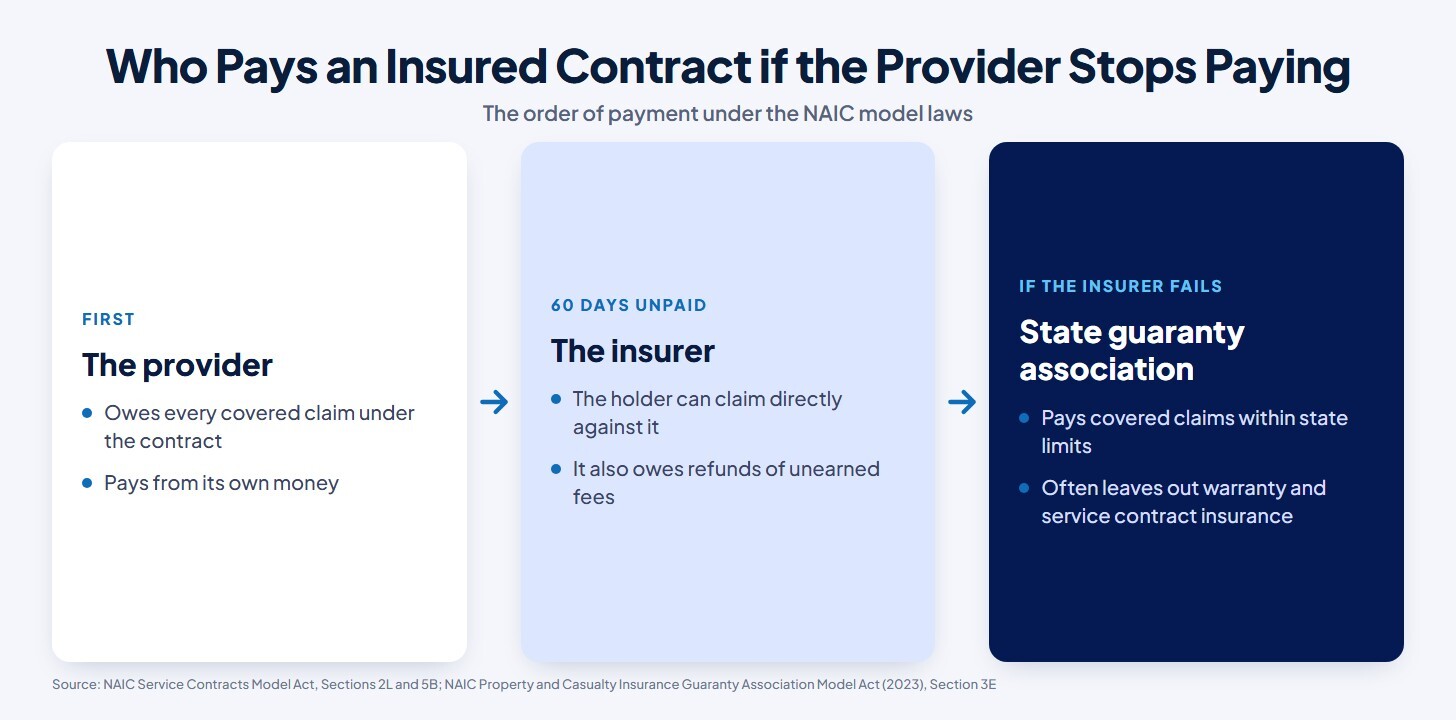
Under the model act, the reimbursement insurer's promise covers all of the provider's obligations under the contracts, including refunds of unearned fees the provider can't pay. Canceling the policy later doesn't reduce the insurer's responsibility for contracts sold before the cancellation (NAIC Model 685, Sections 2L and 8).
Noble Administration Network, which administers an A-rated insurance-backed lifetime warranty that participating retailers include with the systems they install, is one example of an insurance-backed program: an A-rated insurance company insures the warranty, and the warranty document names it. Whether the model act's service contract rules apply to a warranty included in the system price is a question of state law. The program page sets out what the warranty covers.
A covered compressor fails nine years after the install, and the company that issued the coverage closed last spring. If the contract was insured under the model act's rules and the provider hasn't paid within 60 days after proof of loss, the homeowner can claim directly against the insurer. If the contract was self-funded, its only backing was the provider's full faith and credit, and the provider is gone. In both cases, the homeowner's first call goes to the shop whose name is on the invoice.
The manufacturer's parts warranty stays with the manufacturer, because the manufacturer is the warrantor. Any coverage the installer promised on its own, such as a labor or workmanship guarantee, usually ends with the installer unless an insurer or a third-party provider stands behind it.
Manufacturer warranties cover some parts, with registration, usually for 5 to 10 years, and labor coverage, where a brand offers it, is short and needs registration. Carrier, for example, offers a 10-year parts-only limited warranty or a 5-year parts plus 3-year labor limited warranty when eligible equipment is registered within 90 days of installation, and a 5-year parts warranty without labor coverage when it's registered later (Carrier's warranty registration page, checked October 2026). Carrier's labor option is available only when the installing contractor has elected to take part. Brand-by-brand terms are in our guide to manufacturer warranties.
So when an installer closes, the homeowner still has the parts warranty but needs another licensed shop to do the work, and, once any factory labor option ends, pays that shop's labor. A workmanship guarantee is a promise from one company, and the difference between a workmanship guarantee and a warranty is easier to explain before the sale than after a failure.
The Noble lifetime warranty
See what an A-rated insurance-backed lifetime warranty covers.
Covered repairs on the major internal components of the system, labor included, for as long as the homeowner owns the home and keeps up a spring and a fall service every year.
See the warrantyThen the insurer's own financial strength is usually all that's left. State guaranty associations pay some claims when a licensed insurer fails, within limits, but the NAIC model guaranty act and states such as Florida and Alaska leave out insurance of warranties and service contracts. That makes the insurer's rating the thing to check.
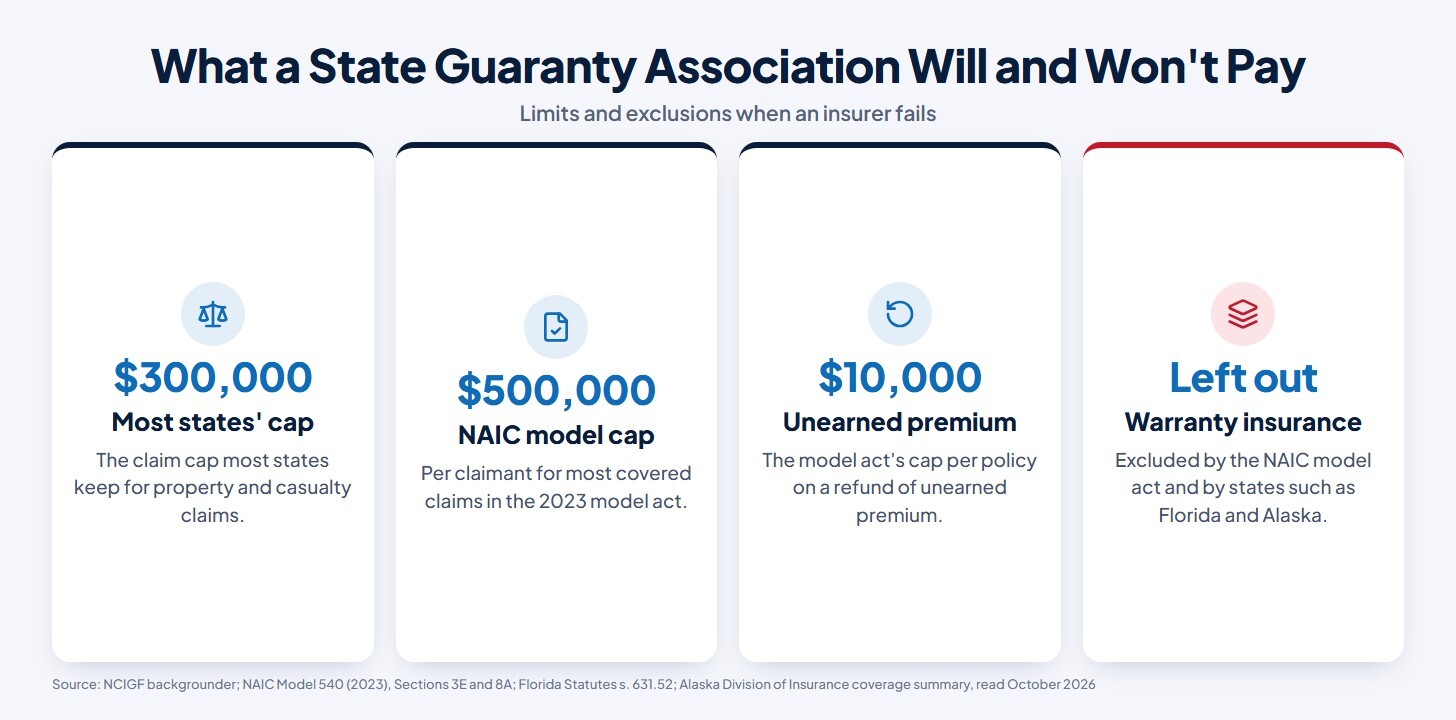
A licensed property and casualty insurer has to belong to its state's guaranty fund to write business there. When an insurer is liquidated, the state guaranty association helps pay its unpaid covered claims. Most states cap property and casualty claims at $300,000, and state statutes set the coverage types and limits (NCIGF backgrounder).
The NAIC model for these associations, the Property and Casualty Insurance Guaranty Association Model Act, caps most covered claims at $500,000 per claimant and refunds of unearned premium at $10,000 per policy. It pays claims that exist before the liquidation order or arise within 30 days after it, so it works as a bridge to a new insurer, not as lifetime coverage (NAIC Model 540, Section 8A).
Scope matters more. Section 3E of that model act leaves out insurance of warranties or service contracts, including insurance that reimburses the company that issues them. Florida's guaranty law excludes warranties, including home warranties and service warranties (Florida Statutes section 631.52), and Alaska's Division of Insurance lists insurance of warranties or service contracts among the lines its association doesn't cover (Alaska coverage summary). Check your own state's guaranty act, and ask any provider that cites a guaranty fund which state law puts its policy inside that fund's coverage.
That makes the insurer's rating the layer you can check yourself. AM Best's Excellent grades, A- and A, go to insurers with, in its opinion, an excellent ability to meet their ongoing insurance obligations. Its Superior grades, A+ and A++, rank one step higher (AM Best's guide to its ratings).
The table below lines up who pays a covered claim, what happens if the company that sold the coverage closes, and the question to ask about each kind of backing. In short, a manufacturer pays for parts, a self-funded provider pays from its own money, and an insurance-backed provider has an insurer behind it.
| Kind of backing | Who pays a covered claim | If the seller or installer closes | What to ask |
|---|---|---|---|
| Self-funded provider | The provider, from its own reserves | Coverage can end; the contract is backed only by the provider's full faith and credit | How big is the reserve, and who holds the deposit? |
| Insurance-backed provider | The provider, then, under the model act, its insurer if the provider doesn't pay within 60 days after proof of loss | The insurer still owes covered claims and refunds of unearned fees | Which insurer issued the policy, and how does AM Best rate it? |
| Manufacturer warranty | The manufacturer, for covered parts | The parts warranty continues; another licensed shop does the work | Was the system registered on time, and is any labor covered? |
| Installer's own labor guarantee | The installing shop | Usually ends with the shop | Does an insurer or a third-party provider stand behind it? |
How to choose an HVAC warranty program for your shop covers the full checklist, and our comparison of warranty programs for contractors lines up named programs.
Ask for documents, not a sales pitch. Read the obligor and insurer sentences in the contract, look up the insurer's rating on AM Best's online search, and check that the provider is registered where your state requires it. A provider with real backing can answer every question below in writing before you sign.
For the rating, AM Best's company and rating search looks up insurers by company name or NAIC number. If a provider describes its insurer without naming it, ask to see the contract itself.
When a homeowner asks what happens if the warranty company goes under, answer only with what the contract and the insurance policy say in writing, and show her where they say it. The words for the rest of that conversation are in our sales guide.
That depends on which promise covers the repair. The manufacturer pays for a covered part, and unless a factory labor option still applies, the homeowner pays your labor. Your own workmanship guarantee is paid by your shop. A service contract or third-party warranty is paid by its obligor, and by its insurer if the obligor fails.
That's why the backing matters to your shop as much as to the homeowner. When a contract includes labor, the labor on a covered repair is paid by whoever is obligated under it. If that company is gone and nothing stands behind it, the homeowner expects your shop to make it right, and your shop absorbs the cost or the bad review. Before you put your name on any warranty, find out who pays the repair you'll be asked to do in year 12.
Noble offers the warranty program to only one residential HVAC retailer per territory. A retailer that proves its volume in its first 90 days holds the territory exclusively from then on. The application takes about two minutes, and a person who knows the program calls you back.

Yes, at least in the contract. Under the NAIC Service Contracts Model Act, a service contract insured under a reimbursement insurance policy has to state the insurer's name and address. Some providers describe the insurer in their marketing rather than naming it, so ask to read the contract and the policy documents before you sign.
Does a state guaranty fund cover an HVAC warranty?Often not. The NAIC guaranty association model act leaves out insurance of warranties and service contracts, and Florida and Alaska exclude them too. Where a line is covered, most states cap property and casualty claims at $300,000. Check your own state's guaranty act before you rely on it.
What happens if the insurer cancels the provider's policy?Under the NAIC model act, canceling a reimbursement insurance policy doesn't reduce the insurer's responsibility for contracts the provider sold before the cancellation. Contracts sold after it need new backing, so ask a provider whether every contract it has sold is still insured.
Is a warranty that comes free with the install a service contract?Not when the seller makes it. Under the NAIC model act's definitions, a warranty made solely by the manufacturer, importer, or seller without charge, and not separated from the sale, counts as a warranty, and the act doesn't apply to warranties. A warranty from a third party is a closer call that state law decides, so read the terms and any insurance behind them.
Does insurance backing change what's covered?No. It changes who pays. The contract sets what's covered, for how long, and what the homeowner has to do to keep it. The insurance decides whether covered claims still get paid if the provider can't pay them.