HVAC Repair vs. Replacement Cost: A Complete Financial Guide
By Noble Team · September 30, 2026
Noble Admin Network | Published on: September 29, 2026 | Time to read: 21 min | Last Updated on: September 29, 2026
Replacing an HVAC system typically costs between $8,000 and $15,000 for most homeowners in 2026, though the national range spans from $5,000 to $28,000 depending on system type, home size, and installation complexity.
This article explains how to evaluate repair versus replacement decisions using the 50 percent rule, breaks down the key cost drivers including efficiency ratings and hidden expenses like permits and ductwork, and analyzes the total lifetime cost of ownership to help homeowners make informed financial decisions.
Replacing your HVAC system typically costs between $8,000 and $15,000 for most homeowners in 2026, with the broader national range spanning from about $5,000 to $28,000 depending on system type, home size, and installation complexity. The most typical full-system installed price lands between $11,590 and $14,100.
That is a big number. But knowing what drives it helps you plan smarter.
When a contractor hands you a replacement quote, it is not just the equipment. A standard quote usually covers several things at once.
Here is what is typically bundled in:
Some quotes also include a new thermostat or duct sealing. Always ask what is in and what is not.
Here is where many homeowners get stuck. A full replacement feels expensive today. But an aging system that keeps breaking down costs money too, and those repair bills add up fast.
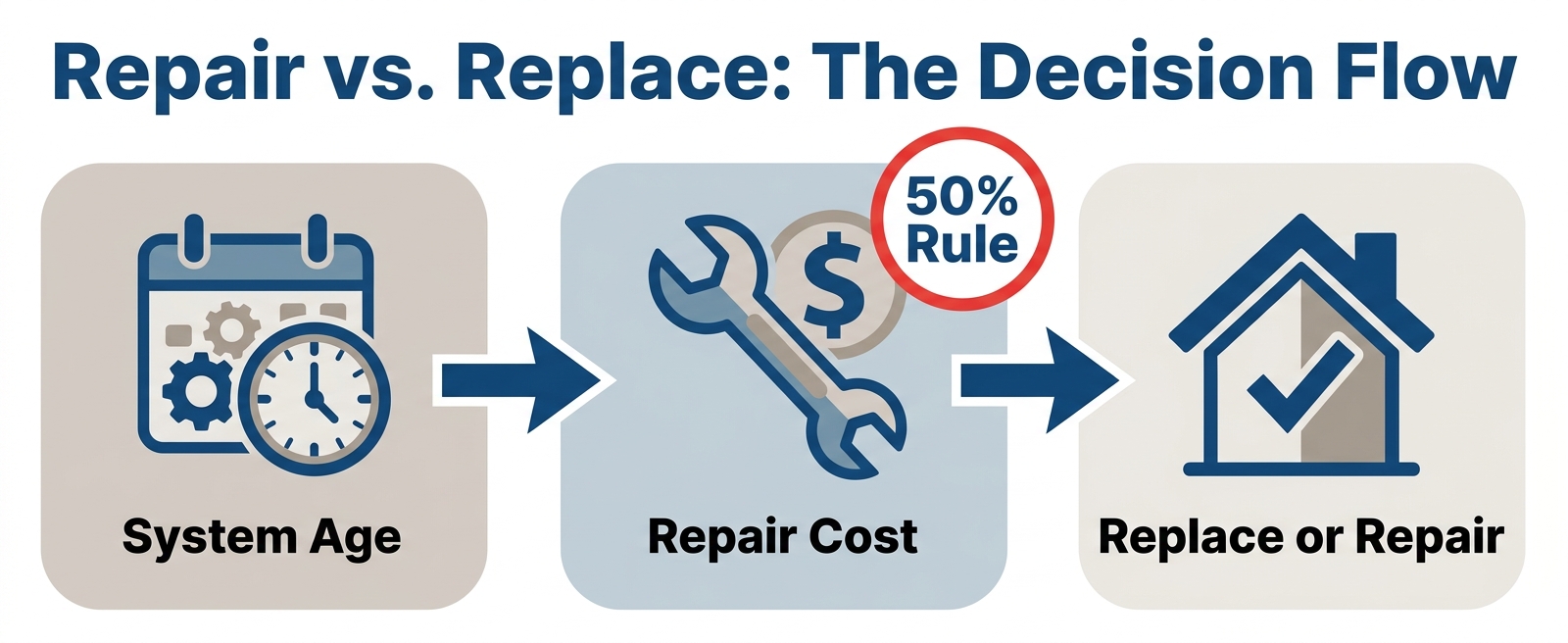
The HVAC industry often references a 50 percent rule as a practical guide. If a repair quote comes in at 50 percent or more of what a full replacement would cost, replacement is usually the smarter financial move. Paying $4,000 to fix a system that is worth $8,000 as a replacement rarely makes sense.
Age matters here as well. Central air conditioners typically last 12 to 15 years on average, while furnaces often reach 15 to 20 years with good maintenance. Once a system passes that window, repair costs tend to climb while reliability drops.
So the real question is not just what replacement costs today. It is what keeping the old system costs you over the next few years.
The decision to repair or replace your HVAC system comes down to one core question: at what point does fixing the old system cost more than moving on? Understanding this tipping point can save you thousands of dollars and a lot of frustration.
The HVAC industry widely uses a practical benchmark called the 50% Rule. The idea is straightforward: if a repair quote comes in at 50% or more of what a full replacement would cost, you should replace the system instead.
For example, if a new system costs around $10,000 and a repair quote comes in at $5,000 or more, replacement is usually the smarter financial move. You're spending half the cost of a new unit just to keep an aging system alive a little longer.
According to HVAC industry guides on the repair vs. replace decision, this rule exists because older systems often have multiple failing parts. One expensive repair frequently leads to another within the same season.
How old your system is matters just as much as the repair cost. According to Carrier's HVAC resource guide, central air conditioners typically last about 12 to 15 years on average.
Furnaces tend to last a bit longer, usually 15 to 20 years with regular maintenance. Heat pumps fall in the 10 to 15 year range.
Once a system passes these windows, parts become harder to find and efficiency drops noticeably. A 15-year-old unit running at reduced capacity costs you money every single month.
Two warning signs often show up before a system fully fails: more frequent repairs and higher energy bills.
If you've called a technician two or three times in one year, that's a pattern worth taking seriously. Each visit adds up, and the root cause is usually a system that's simply worn out.
Higher energy bills tell a similar story. An aging HVAC system has to work harder to deliver the same heating or cooling output. That extra effort shows up directly on your monthly utility statement.
When you add up recurring repair costs plus elevated energy bills over two or three years, replacement often looks like the more affordable option after all.
Several things determine what you'll pay when replacing an HVAC system. It's not a one-size-fits-all number. Your system type, efficiency rating, brand choice, and local labor rates all push the final quote up or down. Understanding each factor helps you compare bids more confidently.
The type of system you need makes a big difference in price. A standalone furnace replacement costs less than swapping out a full central air system. Replacing both a furnace and an air conditioner at the same time costs more upfront, but often saves on labor compared to doing each job separately.
System size is measured in tons for cooling equipment. A 2-ton unit cools a smaller home, while a 5-ton unit handles a larger one. Bigger equipment costs more, both for the unit itself and for the labor to install it.
Getting the right size matters a lot. An oversized system short-cycles, meaning it turns on and off too quickly, which wastes energy and wears out parts faster. An undersized system runs constantly and still can't keep up. A proper load calculation from your contractor should drive the size selection.
Efficiency ratings measure how well a system converts energy into heating or cooling. Higher ratings mean lower monthly utility bills, but they also mean a higher purchase price.
For central air conditioners, the current standard is the SEER2 rating. Here's a general breakdown of installed cost ranges by efficiency tier, based on HVAC project cost data:
| Efficiency Tier | SEER2 Range | Typical Installed Cost |
|---|---|---|
| Standard | 13–14 SEER2 | $3,800 to $5,500 |
| Mid-efficiency | 15–17 SEER2 | $4,500 to $8,500 |
| High-efficiency | 18–20 SEER2 | $6,000 to $12,700 |
The jump from standard to mid-efficiency is often the best value. You get real energy savings without paying a huge premium. Going all the way to ultra-high efficiency takes much longer to pay back through lower bills.
Furnaces use AFUE ratings instead of SEER2. A 95% AFUE furnace converts 95 cents of every dollar of fuel into heat. Standard units run around 80% AFUE. The higher-efficiency option costs more upfront but trims heating bills noticeably over time.
You can model your potential savings using the Energy Star savings calculator to see how different efficiency levels affect your annual costs.
HVAC brands generally fall into a few price tiers. Budget-friendly brands tend to cost less upfront but may have fewer warranty options. Premium brands carry higher price tags but often include longer coverage and more features.
That said, brand choice is only part of the equation. Labor rates vary widely by region. A contractor in a high-cost metro area may charge two or three times more per hour than one in a rural market. Installation complexity also plays a role. Tight attic spaces, long refrigerant line runs, or older duct systems can all add hours to a job.
According to permit cost data compiled across U.S. cities, the average HVAC replacement permit fee is around $139 nationally, with a median of $125. But fees range from about $49 in lower-cost cities to over $550 in high-cost markets like Phoenix. That's a detail worth confirming before you sign a contract.
Always get at least three quotes from licensed contractors. Compare not just the price but what each quote actually includes.
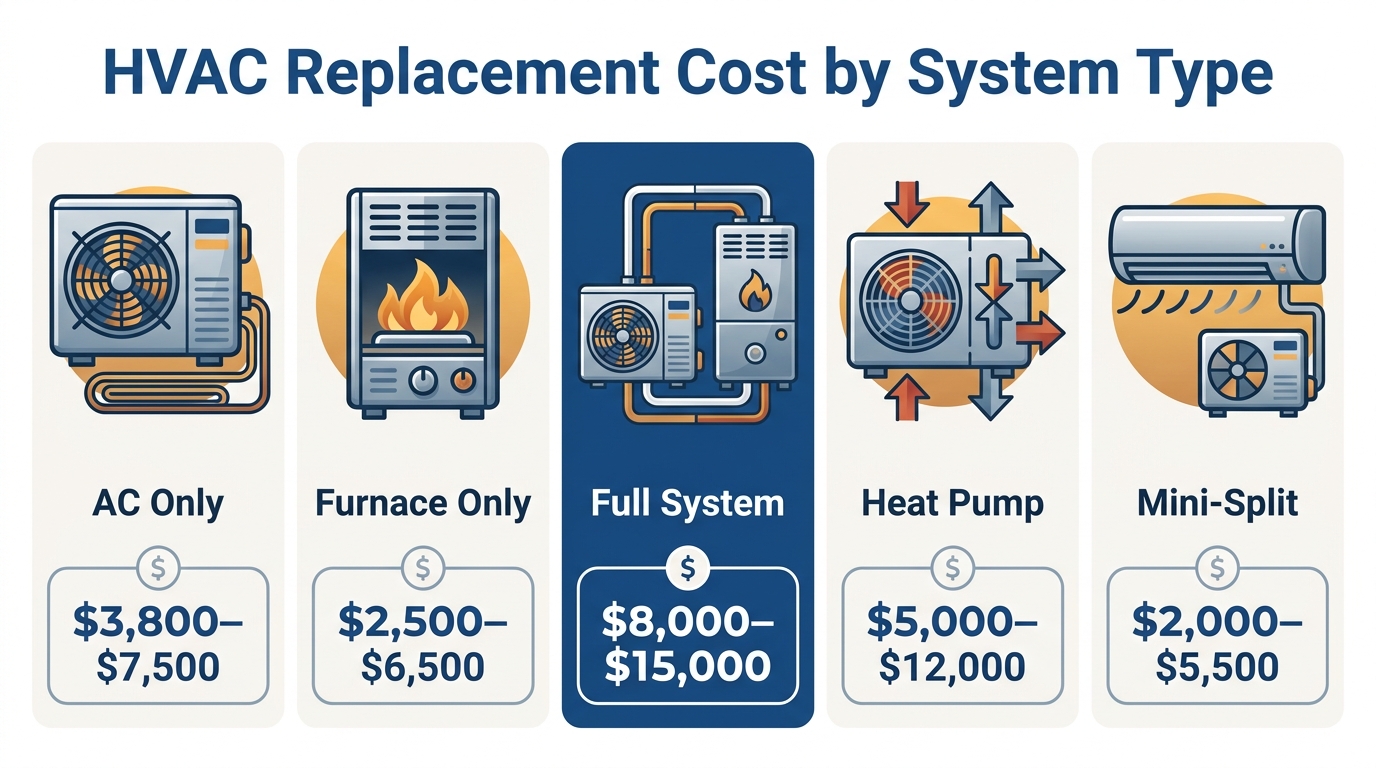
Not every HVAC replacement costs the same. What you pay depends a lot on which part of your system needs replacing. Here's a simple breakdown by system type so you can get a realistic sense of what to expect.
| System Type | Typical Installed Cost Range |
|---|---|
| AC unit only | $3,800 to $7,500 |
| Furnace only | $2,500 to $6,500 |
| Full system (AC + furnace) | $8,000 to $15,000 |
| Heat pump (air-source) | $5,000 to $12,000 |
| Ductless mini-split (per zone) | $2,000 to $5,500 |
Replacing just one component costs less upfront. But if both your AC and furnace are aging, doing them together often saves on labor since the contractor is already on site.
Heat pumps work differently from a standard AC and furnace combo. They handle both heating and cooling in one unit. That dual function makes them a popular option for homeowners looking to simplify their system. According to ConsumerAffairs HVAC cost data, heat pump installed costs typically fall between $5,000 and $12,000 for most homes, depending on size and efficiency.
Ductless mini-splits are worth knowing about if your home has no existing ductwork. They're also useful for additions, garages, or rooms that need independent climate control. You pay per zone, so a single-zone system runs cheaper than a whole-home multi-zone setup. Most single-zone installations land in the $2,000 to $5,500 range fully installed.
Always confirm which system type fits your home before comparing quotes. A contractor should do a proper load calculation before recommending a size or system type.
The sticker price on a new HVAC system is only part of what you'll actually pay. When you add up energy bills over 15 years, the cheaper unit often ends up costing more in total. Understanding the full lifetime cost helps you make a smarter buying decision from day one.
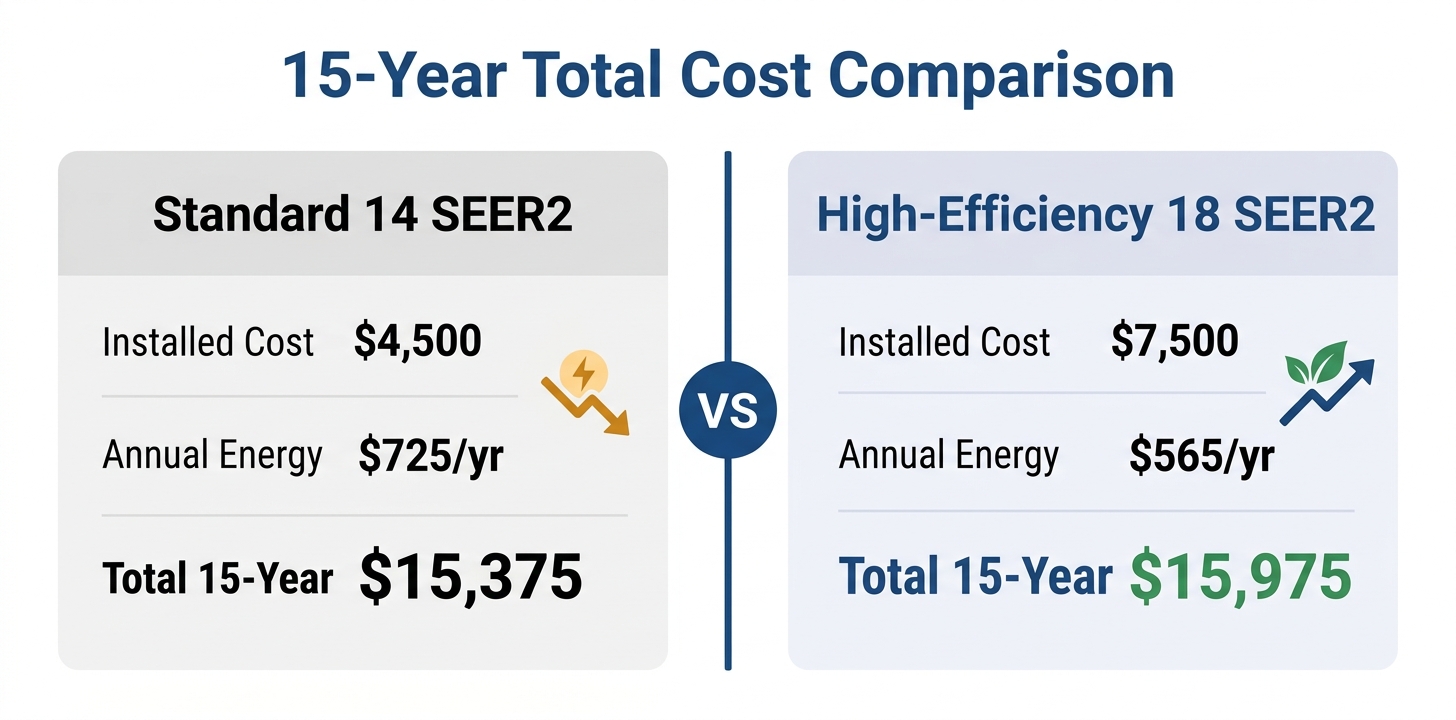
Let's look at a real comparison. Say you're choosing between two 3-ton central AC units. One is a standard 14 SEER2 model. The other is a high-efficiency 18 SEER2 model.
The 14 SEER2 unit might cost around $4,500 installed. The 18 SEER2 unit could run closer to $7,500 installed. That's a $3,000 difference upfront, which feels significant.
But here's what changes when you zoom out.
Using a SEER energy savings calculator and average U.S. electricity rates, you can estimate annual energy costs for each option. A 14 SEER2 unit in a typical climate runs about $700 to $750 per year in cooling costs. A comparable 18 SEER2 unit runs closer to $550 to $580 per year.
That gap is roughly $150 to $175 per year in savings.
| Cost Factor | 14 SEER2 Unit | 18 SEER2 Unit |
|---|---|---|
| Installed cost | ~$4,500 | ~$7,500 |
| Est. annual energy cost | ~$725/year | ~$565/year |
| Energy cost over 15 years | ~$10,875 | ~$8,475 |
| **Total 15-year cost** | **~$15,375** | **~$15,975** |
At average electricity rates, the two options come out close over 15 years. But in hotter climates or higher-rate utility markets, the high-efficiency unit pulls clearly ahead.
With a $3,000 upfront premium and $160 in annual savings, the break-even point on the 18 SEER2 unit lands around year 18 to 19 at average rates.
But that math shifts quickly if you live somewhere hot. In states like Texas, Florida, or Arizona, a central AC runs far more hours per year. Annual savings can jump to $250 or more, pushing the break-even closer to year 12.
According to Trane's guide on SEER ratings, climate and local electricity rates are the two biggest factors that determine whether a high-efficiency unit pays back faster. The hotter your summers and the higher your utility rates, the stronger the case for going with a higher SEER2 model.
If you plan to stay in your home for 10 or more years and live in a warm climate, the high-efficiency unit is worth serious consideration. The long-term energy savings can offset most or all of the upfront premium.
If you're in a mild climate or planning to sell within five years, the standard-efficiency unit may be the more practical choice. You spend less now and won't be in the home long enough to collect the full energy savings.
Either way, running the numbers before you sign a contract is worth the time. The upfront HVAC replacement cost is just the starting point.
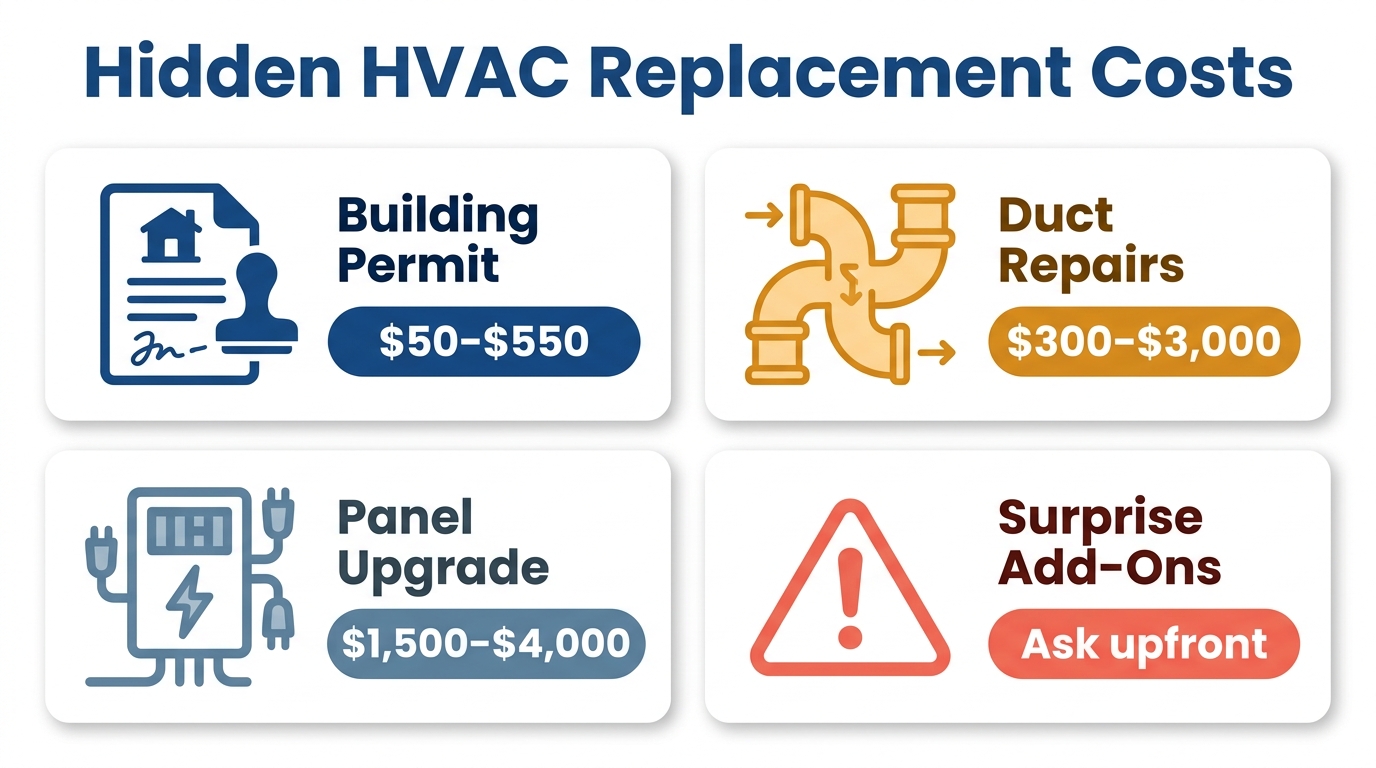
The quote your contractor hands you often looks straightforward. But there are several real costs that don't always show up on that first page. Knowing what to watch for before you sign can save you from an unpleasant surprise once the work begins.
Most municipalities require a building permit for any HVAC replacement work. This isn't just red tape. Permits exist so a licensed inspector can verify the installation meets local safety and energy codes.
Permit fees vary widely by location. According to permit cost data from PermitCalculator, residential HVAC permit fees across the U.S. range from around $50 in lower-cost markets to over $500 in cities with stricter review requirements. Always ask your contractor whether the permit is included in their quote or billed separately.
Skipping the permit is never worth it. Unpermitted work can create problems when you sell the home or file an insurance claim.
A new HVAC system sometimes reveals problems with the existing ductwork. Old ducts may be undersized, leaky, or simply incompatible with the new equipment's airflow requirements.
Duct sealing or minor modifications can add $300 to $1,000 to your project. A partial duct replacement in one section of the home can run $1,000 to $3,000. Full duct replacement, which is less common but sometimes necessary in older homes, can push costs significantly higher.
Ask your contractor to inspect the ductwork before finalizing the quote. Some contractors include a basic duct inspection. Others charge extra for it.
Modern high-efficiency HVAC systems, especially heat pumps, sometimes require a dedicated electrical circuit or more amperage than an older panel can provide.
If your home has an older 100-amp panel, upgrading to 200 amps can cost $1,500 to $4,000 depending on your location and the complexity of the work. This cost is typically handled by a licensed electrician, not your HVAC contractor, so it may not appear in the HVAC quote at all.
According to Modernize's HVAC cost guidance, electrical upgrades are one of the most commonly overlooked add-on costs in a full HVAC replacement project. It's worth asking your contractor upfront whether the new system requires any electrical work before the quote is finalized.
| Hidden Cost Item | Typical Added Cost |
|---|---|
| Building permit | $50 to $550+ |
| Duct sealing or minor repairs | $300 to $1,000 |
| Partial duct replacement | $1,000 to $3,000 |
| Electrical panel upgrade | $1,500 to $4,000 |
These items won't always apply to your project. But when they do, they can add thousands of dollars to the total. Getting a complete scope of work in writing before any work starts is the best way to avoid sticker shock once the job is done.
HVAC replacement cost can be reduced significantly with the right incentives and planning. Federal tax credits, manufacturer rebates, utility programs, and smart shopping habits can collectively shave hundreds or even thousands of dollars off your total project cost. Here's where to look.
The federal 25C Energy Efficient Home Improvement Credit covered qualifying HVAC installations in 2025. For equipment placed in service in 2025, the credit covered 30% of qualified costs, up to $600 for high-efficiency central air conditioners and up to $2,000 for qualifying heat pumps.
For 2026 installations, the credit has expired under current law. But check with a tax professional, since Congress periodically extends or revives these programs. According to IRS guidance on home energy tax credits, eligibility rules and caps can shift year to year.
Even without a federal credit in 2026, many utility companies and state programs still offer cash rebates for upgrading to a high-efficiency system. These vary a lot by location, but they can run anywhere from $100 to over $1,000 depending on the equipment and your provider.
Two places to check:
Always check your utility company's website directly too. Some programs aren't listed in third-party databases.
Getting at least three quotes from licensed contractors is one of the simplest ways to avoid overpaying. Prices can vary by $1,000 or more for the same job depending on the contractor.
When comparing quotes, look at what's included. One bid may cover permits and haul-away. Another might not. Ask each contractor to itemize the quote so you're comparing the same scope of work.
Many contractors also offer financing options, often through third-party lenders. A zero-interest promotional period can make a higher-efficiency system easier to afford upfront. Just read the terms carefully before signing, especially what happens after the promotional period ends.
Smart shopping, available incentives, and the right financing can take a big bite out of your total hvac replacement cost.
Replacing an aging HVAC system is one of the smartest financial moves a homeowner can make. When repairs are piling up and energy bills keep climbing, the upfront hvac replacement cost quickly becomes the more affordable path. The key is looking at the full picture, not just the price tag on the quote.
An old, failing system costs you money every month. Higher utility bills, recurring service calls, and reduced comfort all add up. When your system is past its useful life and repairs are getting expensive, replacement stops being an expense and starts being a way to stop the bleeding.
The total cost of ownership tells a more complete story than the sticker price alone. A higher-efficiency unit may cost more upfront, but lower energy bills over 10 to 15 years can offset much of that difference. That long-term math matters, especially if you plan to stay in your home.
Utility rebates and state programs are still available in many areas, even as federal tax credits shift from year to year. According to CBS News coverage of HVAC costs in 2026, homeowners who take time to research local rebates and financing options often reduce their net project cost meaningfully. A few hours of research can translate into real savings.
The best move you can make right now is simple. Schedule consultations with at least three licensed local HVAC contractors to get detailed quotes tailored to your home. Compare what's included in each quote, ask about permits, ductwork, and any electrical work that might be needed, and run the long-term cost numbers before you decide.
Armed with that information, you'll be in a strong position to make a confident, well-informed decision.
How much should a new HVAC system cost? A new HVAC system typically costs between $5,000 and $12,000 for a full replacement, with most homeowners paying in the $8,000 to $15,000 range. The final price depends on system size, efficiency rating (SEER2), brand choice, and local labor costs, with simple AC or furnace-only replacements running less at $3,000 to $7,000.
Is it cheaper to repair or replace an HVAC unit? It depends on the repair cost and system age. Use the 50 percent rule: if a repair costs more than 50 percent of replacement cost, replacing is usually cheaper long-term. If your system is over 10 to 15 years old and needs frequent repairs, replacement becomes more economical due to improved efficiency and reliability.
How long does an HVAC system last? Most modern HVAC systems last 15 to 20 years with proper maintenance. Central air conditioners typically last 12 to 15 years, furnaces often reach 15 to 20 years (sometimes longer), and heat pumps generally last 10 to 15 years. Regular annual maintenance is essential for maximizing lifespan.
Can I just replace my outside AC unit? While technically possible, replacing only the outdoor AC unit is rarely recommended. Modern AC systems are designed as matched sets with the indoor air handler or furnace coil. Mismatching an old indoor unit with a new outdoor unit can lead to poor efficiency, reduced performance, premature failure, and often voids the manufacturer warranty.
Does homeowners insurance cover HVAC replacement cost? Generally no. Homeowners insurance typically excludes replacement due to old age or normal wear and tear. However, if your system is damaged by a covered peril such as lightning strike, fire, or a fallen tree, your policy may cover repair or replacement costs.
What is the best month to replace an HVAC system? The best time to replace your HVAC system is during the shoulder seasons in spring and fall. HVAC contractors are less busy during these mild-weather months, which can lead to more flexible scheduling, faster service, and potentially better pricing or off-season discounts.