
Lifetime Workmanship Guarantee vs. Lifetime HVAC Warranty
By Noble Team · September 9, 2026
Noble Admin Network | Published on: September 9, 2026 | Time to read: 10 min | Updated on: October 17, 2026
A lifetime workmanship guarantee is the installing company's own promise to fix problems caused by its installation work, and only that company backs it. A lifetime warranty on the equipment covers repairs to the system's components, and it's only as strong as whoever pays the claims: the installer, a warranty company, or an insurer.
Both promises use the word lifetime, and homeowners can easily hear them as one. This guide shows HVAC shops what each promise includes, who stands behind it, what the FTC expects in an ad, and how to decide which to offer.
It's an installing company's written promise that if its own work fails, it will come back and fix it at no charge for as long as the guarantee runs. It covers how the system was put in, not the equipment itself, and the company that did the work is the one that pays for the fix.
Here's how two HVAC companies word theirs. TE Certified, an electrical, plumbing, and HVAC company serving the Atlanta metro, offers a Lifetime Workmanship Warranty. Its page says its employees' work will meet local building codes and professional standards “for the life of the installation,” that if the work fails, “our team will correct the issues at no cost to you,” and that terms and conditions apply (TE Certified's warranty page).
Watson Heating + Cooling, in Kentucky, puts it in one line: “If we installed it and it leaks, rattles, or fails because of our install work, not the equipment,” the company comes back and makes it right (Watson's warranties page).
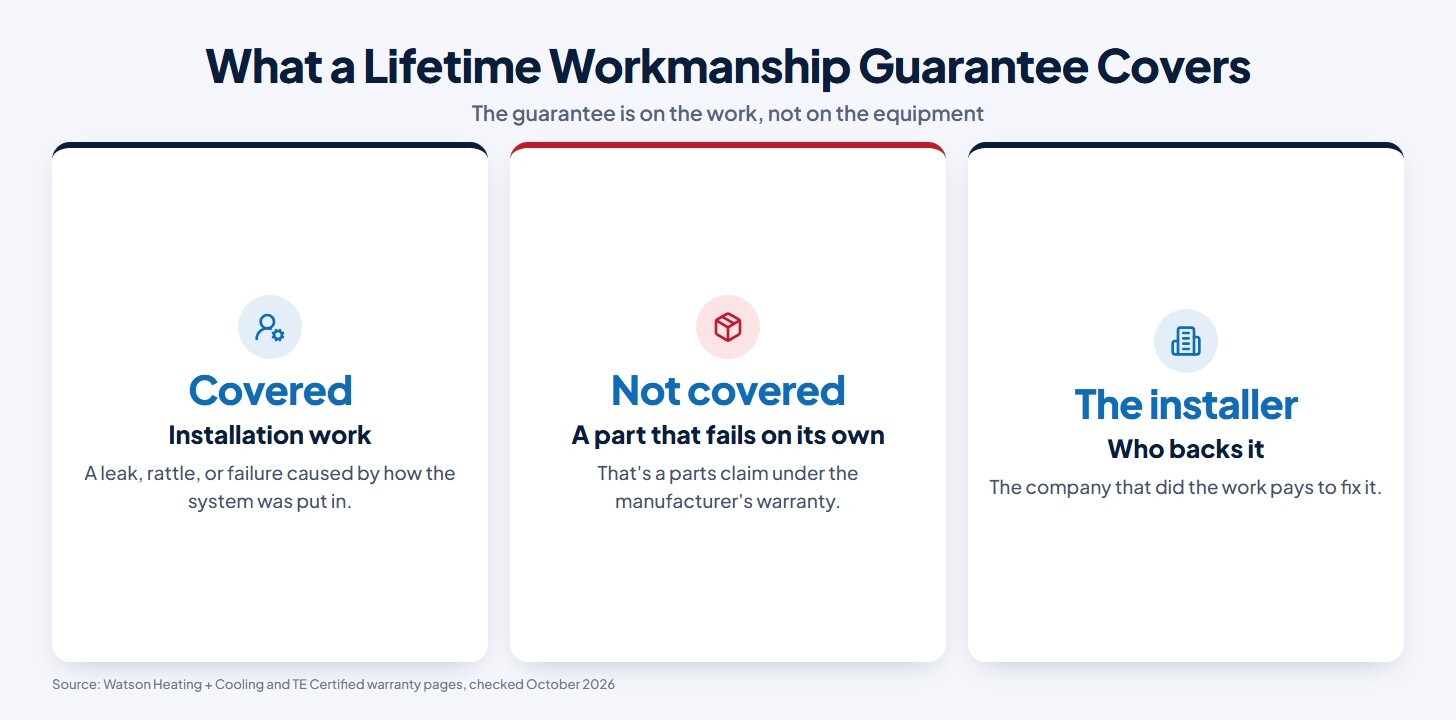
A compressor or a control board that fails on its own isn't workmanship. That's the equipment, and a different promise has to pay for it.
No. A workmanship guarantee covers the installer's work and is backed only by the installer. A lifetime warranty on the equipment covers repairs to the system's components when they fail, and it can be backed by the manufacturer, the installer, a warranty company, or an insurer. Homeowners can easily hear both as a single promise.
If a homeowner wants to know what “limited lifetime” means on an equipment warranty, that's a separate question, and our homeowner guide to limited lifetime warranties answers it. Here, the question is which promise your shop is making.
Three common promises can carry the word lifetime in an HVAC sale. Here's how they compare.
| Question | Workmanship guarantee | Manufacturer warranty | Installer-offered lifetime warranty |
|---|---|---|---|
| What it covers | Problems caused by the installation work | Some parts, with registration; labor, where a brand offers it, is short and needs registration | Repairs to the system's components, often parts and labor, as its terms define them |
| Who backs it | The installing company, from its own money | The manufacturer | Whoever pays the claims: the installer, a warranty company, or an insurer |
| How long it lasts | Set by the installer, from 1 year to the life of the installation | Usually 5 to 10 years on parts | Whatever the contract says lifetime means: the system, the owner, or the company |
| What the homeowner must do | Often nothing, though some lifetime versions require a maintenance plan | Register in time, such as within 90 days of installation for Carrier | Usually keep up annual maintenance |
| If the installing company closes | Nobody is left to honor it unless something else backs it | The manufacturer still stands behind it | That depends on who pays the claims, which is why insurance backing matters |
The manufacturer column is the one most shops know. Carrier, for example, lets homeowners choose “a 10-year parts-only limited warranty or a 5-year parts plus 3-year labor limited warranty” if they register within 90 days of installation, and the labor option is available only if the installing contractor takes part in its program (Carrier's warranty registration page). Other brands set their own terms, and we compare manufacturer warranties brand by brand.
The third column is where a lifetime labor warranty usually sits. Coolray, a Marietta, Georgia, company, offers a Lifetime Parts and Labor Warranty with a qualifying new Carrier system. Its page says the customer must keep a maintenance agreement on the equipment, that missing annual maintenance voids the warranty, and that the warranty can transfer to a new owner for a $250 fee within 30 days of the home's purchase (Coolray's lifetime warranty page). As with any warranty in this column, what it's worth in year fifteen depends on who pays the claims.
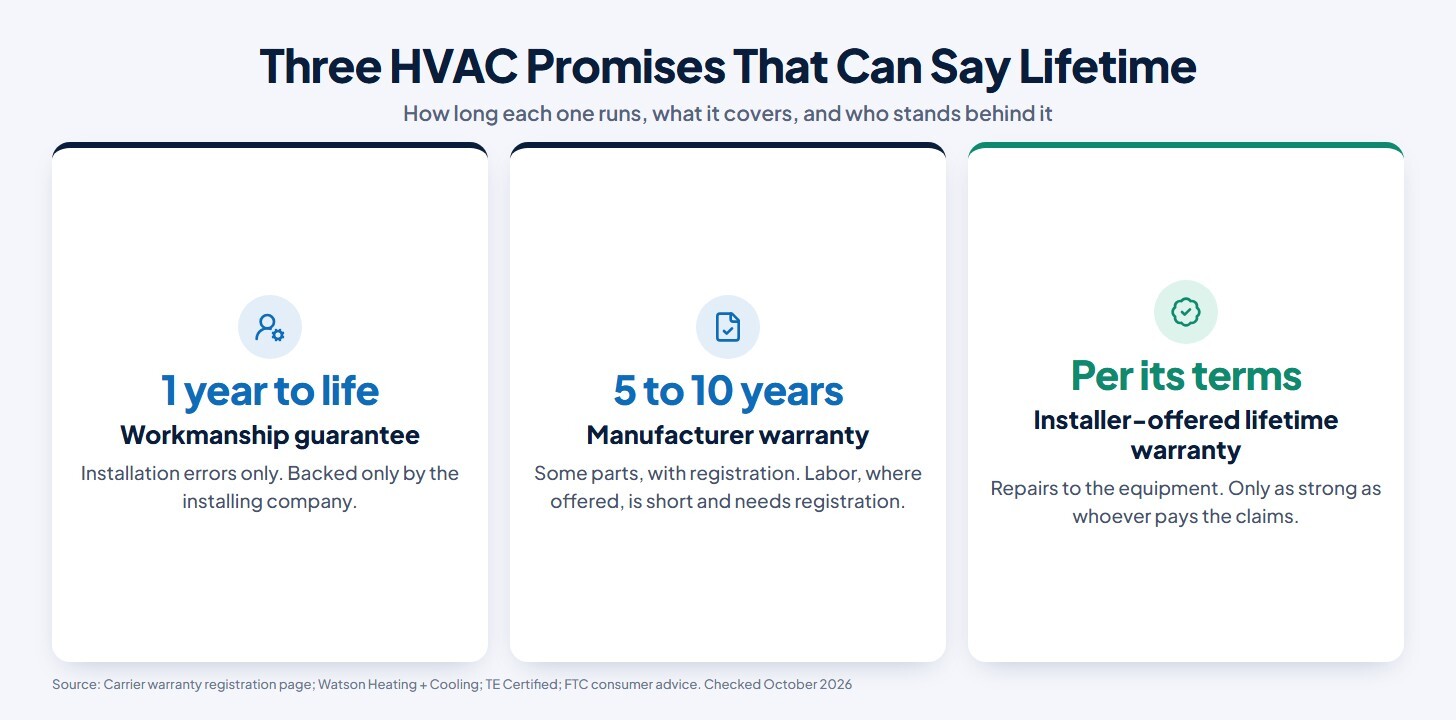
It covers failures caused by the installation, meaning work that wasn't done to code or to the standard the company promised. It leaves out parts that fail on their own, damage from outside causes, and repairs by another company, and some lifetime versions last only while the homeowner stays on a maintenance plan.
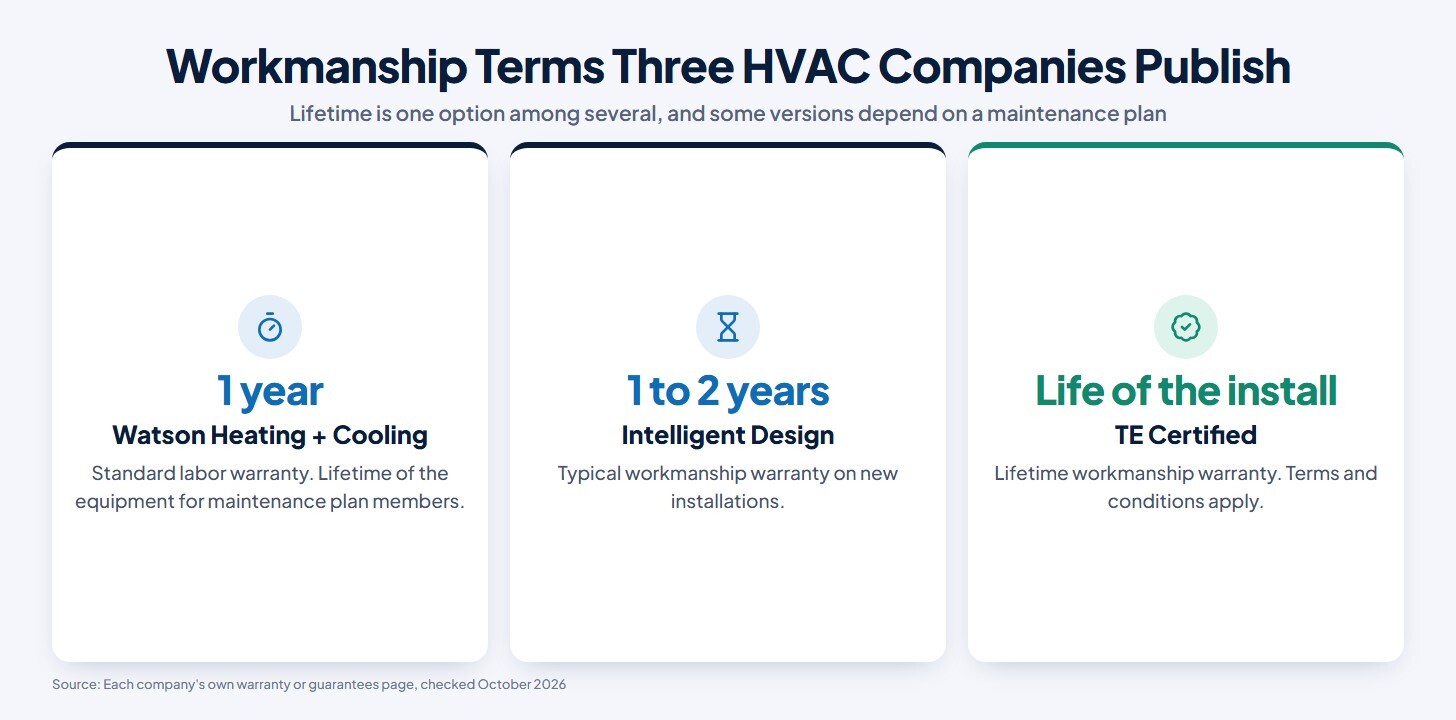
Published terms vary more than the word lifetime suggests. Watson's standard labor warranty is 1 year, and for customers enrolled in a maintenance plan, “we extend labor coverage to the lifetime of the equipment on work we installed” (Watson Heating + Cooling). Intelligent Design, in Tucson, says new installations “typically include 1-2 year workmanship warranties” and that most repairs carry at least a 1-year workmanship guarantee. Its page also says warranties generally exclude damage from misuse, lack of maintenance, natural disasters, and repairs by other companies (Intelligent Design's guarantees page).
A homeowner calls about water under the indoor unit. The condensate line the crew installed was never sloped to drain. That's workmanship, so the installer pays for the fix under its lifetime workmanship guarantee.
A month later, the compressor fails on its own. The workmanship guarantee doesn't apply. If the parts warranty has run out and no lifetime warranty covers the equipment, the homeowner pays for the repair, and the installer is the one who explains why.
A workmanship guarantee answers the question “What if you put it in wrong?” It doesn't answer “What if it breaks?” Homeowners ask both.
The Noble lifetime warranty
Pair your workmanship guarantee with an insurance-backed lifetime warranty.
It covers repairs on the major internal components, labor included, for as long as the homeowner owns the home. There's no separate warranty fee for the homeowner, and a national, brand-name A-rated insurance company stands behind every contract.
See the warrantyUsually it ends with the company, because the installer was the only one standing behind it. The FTC says the value of an extended warranty is “only as good as the company that's responsible for coverage,” and we answer who pays the claims when a company closes in its own guide.
Both, if each one is backed by the party that controls the risk. Your shop controls the quality of its own work, so a workmanship guarantee is a promise you can keep. You don't control whether a compressor fails in year twelve, so a lifetime warranty on the equipment works best when someone with reserves stands behind it.
Extended labor coverage is already common. In a survey ACHR News reported in February 2026, “About 58% of HVAC contractors offer extended labor warranties,” and the most common length is 10 years (ACHR News, February 2026). Lifetime coverage is the next step, and each kind carries a different cost.
The workmanship guarantee costs you callbacks on your own mistakes, so a shop that installs well pays little on it. A lifetime warranty you fund yourself means paying for parts you didn't make, for as long as the homeowner owns the home, out of your own reserves. That's the case for pairing your own workmanship guarantee with a lifetime warranty that a third party administers and an insurer backs. How to choose that program and how the named programs compare each have their own guide.
Noble Administration Network's lifetime warranty is one example of the insurance-backed kind. It covers repairs on the major internal components of the residential system a participating retailer installs, labor included, for as long as the homeowner owns the home and keeps up a spring and a fall service every year. A national, brand-name A-rated insurance company stands behind every contract.
Once you offer both, present them as two promises. “We guarantee our installation for life, and the equipment carries a lifetime warranty that an insurance company stands behind” is a sentence a homeowner can repeat. See what to say in the rest of the sales conversation and how an offer like this helps you stop competing on price.
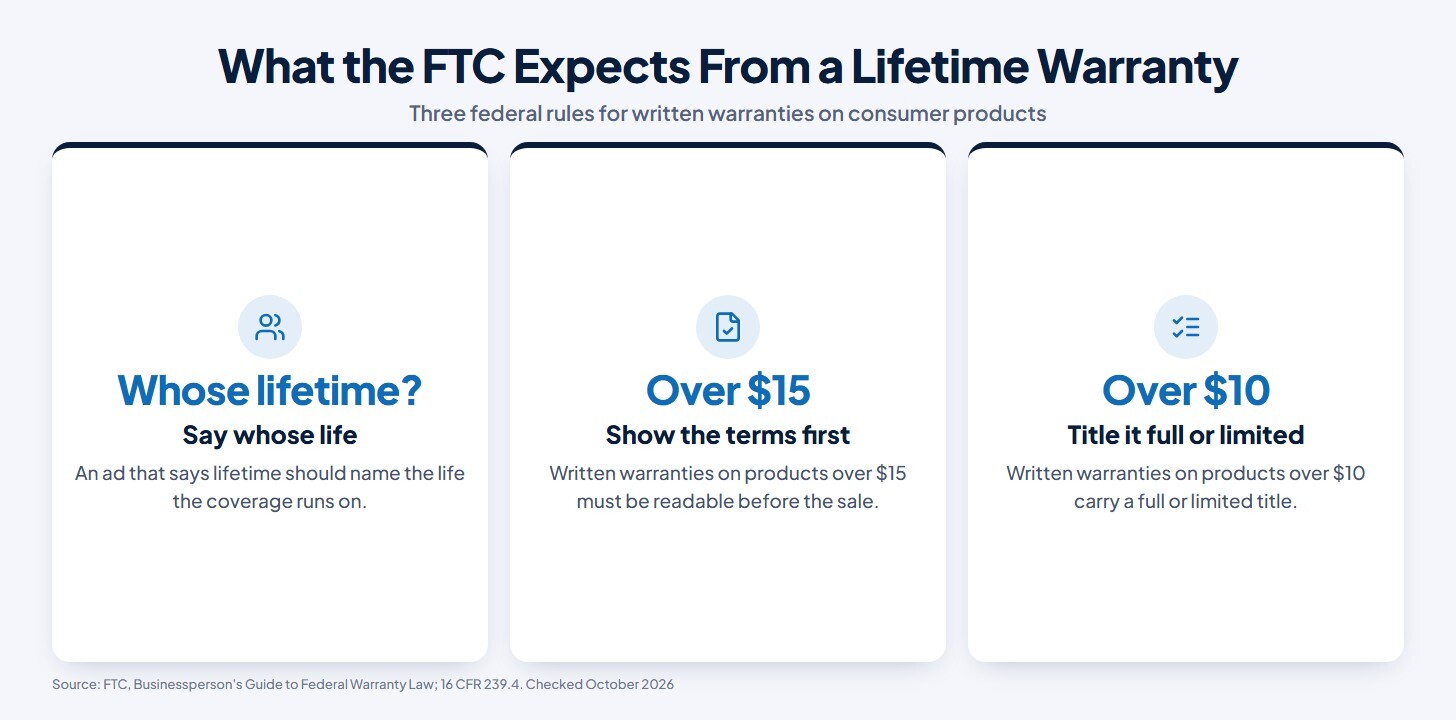
Whose life the promise runs on, what it covers, what the homeowner has to do, and who pays if your company isn't there. The FTC's advertising guides say an ad that uses the word lifetime should disclose “the life to which the representation refers,” clearly enough that buyers notice and understand it.
The FTC's guide for businesses puts it plainly: “Clarify what you are talking about when you advertise a ‘lifetime’ warranty,” because “it is often difficult to tell just whose life measures the period of coverage” (the FTC's Businessperson's Guide to Federal Warranty Law). The guides' own example is a battery warranty that lasts as long as the original buyer owns the car, advertised as “Good for as long as you own the car!” (16 CFR 239.4).
Two more federal rules apply to written warranties on consumer products. Warranties on products that cost more than $15 must be available to read before the sale, and written warranties on products that cost more than $10 must be titled “full” or “limited.” The FTC's rule counts “air conditioners, furnaces, and water heaters” as consumer products, and it says “warranties which apply solely to a repairer's workmanship in performing repairs are not subject to the Act” (16 CFR 700.1). The rule doesn't speak to installation work directly, so ask your attorney how your written guarantee is treated.
Transfer is the question homeowners raise at closing, and how coverage moves with a home sale has its own guide. Write the answers into the proposal, and hand the homeowner both documents before the contract is signed.
Noble offers the warranty program to only one residential HVAC retailer per territory. A retailer that proves its volume in its first 90 days holds the territory exclusively from then on. The application takes about two minutes, and a person who knows the program calls you back.

No. It covers problems caused by the installation work. A part that fails on its own falls to the manufacturer's warranty or to a lifetime warranty on the equipment, if the system has one.
How long do HVAC workmanship warranties usually last?Published terms range from 1 year to the life of the installation. One Tucson company says 1 to 2 years is typical on new installations, and some companies offer a lifetime workmanship warranty with conditions attached.
Does a lifetime workmanship guarantee require a maintenance plan?Sometimes. Watson Heating + Cooling extends labor coverage to the lifetime of the equipment only for customers enrolled in a maintenance plan. Read the written terms, because the condition is often in the fine print.
Is a workmanship guarantee covered by the Magnuson-Moss Warranty Act?The FTC's rule says warranties that apply solely to a repairer's workmanship in performing repairs aren't subject to the Act, while air conditioners and furnaces count as consumer products. Ask your attorney how the rule treats your written installation guarantee.
What does the FTC say about advertising a lifetime warranty?Its advertising guides say an ad that uses the word lifetime should clearly disclose whose life it refers to, such as the life of the equipment or the time the original buyer owns the home.