
Does a Home Warranty Cover HVAC? What a Plan Pays For
By Noble Administration Network · November 11, 2026 · How we research and compare
Noble Administration Network | Published on: November 11, 2026 | Time to read: 13 min | Updated on: November 11, 2026
Yes. Most home warranty plans cover central heating and air conditioning, but only up to a dollar limit per system, and you pay a service fee each time a technician comes out. They usually pay to repair failed parts first and replace a system only when it can't be fixed. Window units, poor maintenance, and pre-existing problems are common exclusions.
A renewal notice, a home purchase, or a repair quote is sitting on your kitchen table, and you want to know: does a home warranty cover HVAC? This guide shows which parts and systems these plans cover, the limits and fees with dated figures, what they leave out, and how a home warranty compares with the other coverage your system can carry.
Most home warranty plans cover HVAC, within limits. The plan pays to repair covered parts of your central heating and cooling system, up to a dollar cap per system. You pay for the plan, plus a service fee each time a technician visits. If a covered system can't be repaired, some plans replace it up to the cap.
Start with what a home warranty is. The Federal Trade Commission explains that a "home warranty" is really a service contract, something you buy separately, unlike a builder warranty or the warranty that comes with a product. The FTC says these plans "typically cover replacements and repairs for things like appliances or air conditioning systems," and it warns that a plan may cover only part of a product.
That last point deserves the most attention. The question isn't whether HVAC is on the list. It's how much the plan will pay, for which parts, and after which fees.
Plans that include heating and cooling cover the parts of permanently installed central systems, up to the plan's limit. The details vary by company, so the coverage list in your contract is what counts. Look for three things on it: which system types are named, any size limit, and the exclusions, such as window units.
American Home Shield's air conditioner coverage page is a useful example because it spells all three out. It covers "all parts and components of permanently installed air conditioning systems up to a 5-ton capacity," including ducted central split and package units, geothermal units, evaporative coolers, wall units, and mini splits. It excludes window and portable units, ultraviolet lights, humidifiers, and dehumidifiers. It also caps glycol, hot water, and steam heating systems, along with geothermal and water source heat pumps, at $1,500.
Other companies draw these lines differently, so read the coverage list in the actual contract. Look for the words "permanently installed," the tonnage limit, and whether ductwork, refrigerant, and the thermostat are named. If your house has two systems, check whether each one gets its own limit.
A home warranty pays up to the plan's limit for HVAC, and you pay anything above it. Across four large providers This Old House reviewed in October 2026, the HVAC limit ran from $2,000 to unlimited. American Home Shield lists $5,000 and replaces a covered system when it can't be repaired.
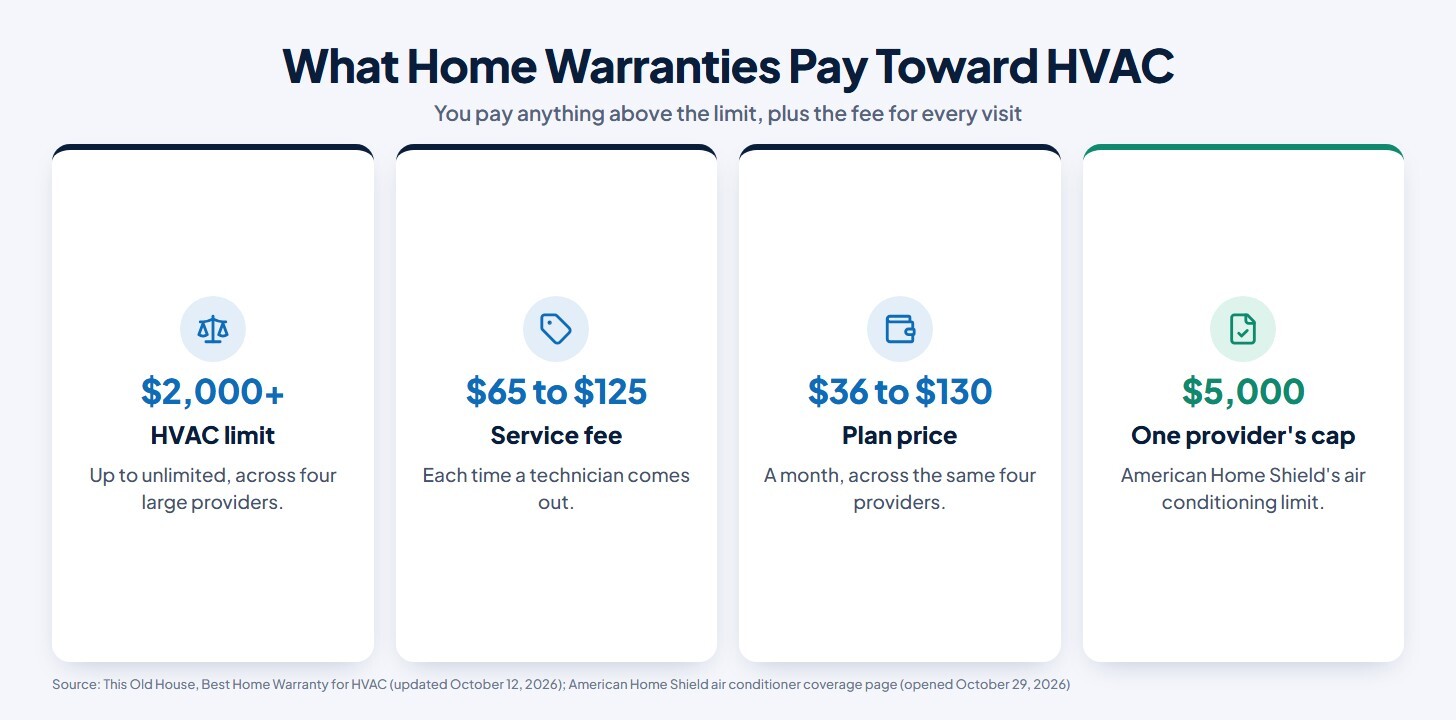
The This Old House comparison, updated October 12, 2026, found HVAC limits of $2,000 at one provider, $3,000 per covered item at another, $5,000 at a third, and unlimited caps on heating and air conditioning at a fourth. CBS News puts it plainly: if your policy has a $2,000 or $3,000 limit for HVAC, any cost above that limit is yours, and the company may choose to repair a system rather than replace it.
Say your plan caps HVAC at $2,000 and charges a $100 service fee. A covered repair on your air conditioner comes to $2,600. The plan pays $2,000, and you pay the $100 fee plus the $600 above the cap, $700 in all. If the system has to be replaced instead, the same $2,000 cap applies, and the rest of the new system's price is yours. These inputs are assumptions, so put in the numbers from your own contract.
That's why the cap matters more than the coverage list. Compare it with what a new system costs for a home your size, which our HVAC cost by square footage guide breaks down, before you count on a plan to pay for a replacement.
For homeowners
Replacing your system? Ask for a lifetime warranty with labor included.
See what a lifetime warranty with labor included covers, and what keeps it valid.
See what's coveredExpect to pay a monthly or yearly price for the plan plus a service fee for every visit. NerdWallet puts the average plan at $73 a month. Across the four providers This Old House reviewed, plans ran $36 to $130 a month and service fees ran $65 to $125, so two visits a year add $130 to $250.
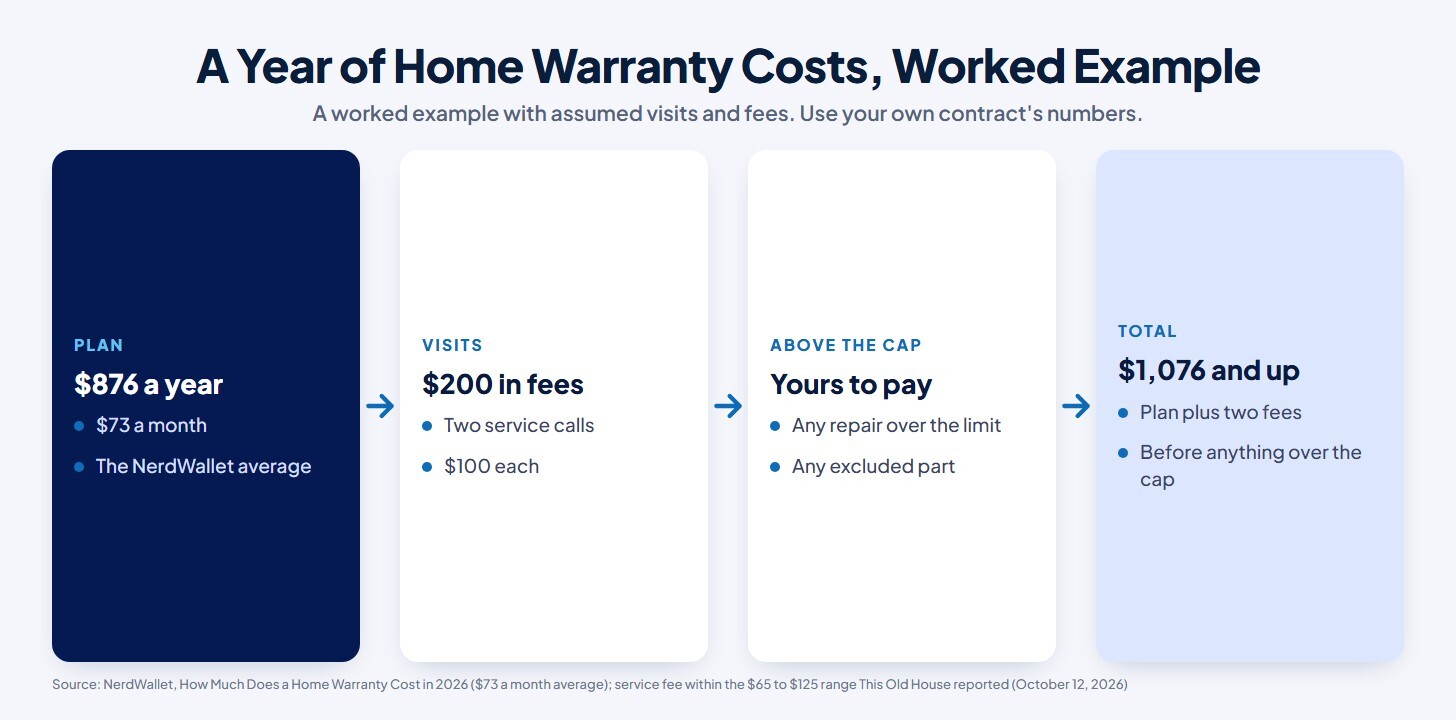
The NerdWallet 2026 cost guide gives the $73 average, and This Old House lists each provider's plan prices and fees. At one provider on that list, a systems plan cost $63 a month and a plan adding appliances cost $68.
The FTC's advice on cost is short: look for "costs that may be hidden, like deductibles or fees you need to pay each time products are serviced," and ask whether there are restrictions or fees for cancellation. A plan's monthly price is only part of what you'll pay in a year with two or three service calls.
The common exclusions are window and portable units, damage from storms and other severe weather, breakdowns caused by poor maintenance, and problems that existed before the plan started. A few providers do cover pre-existing problems, so check yours in writing.
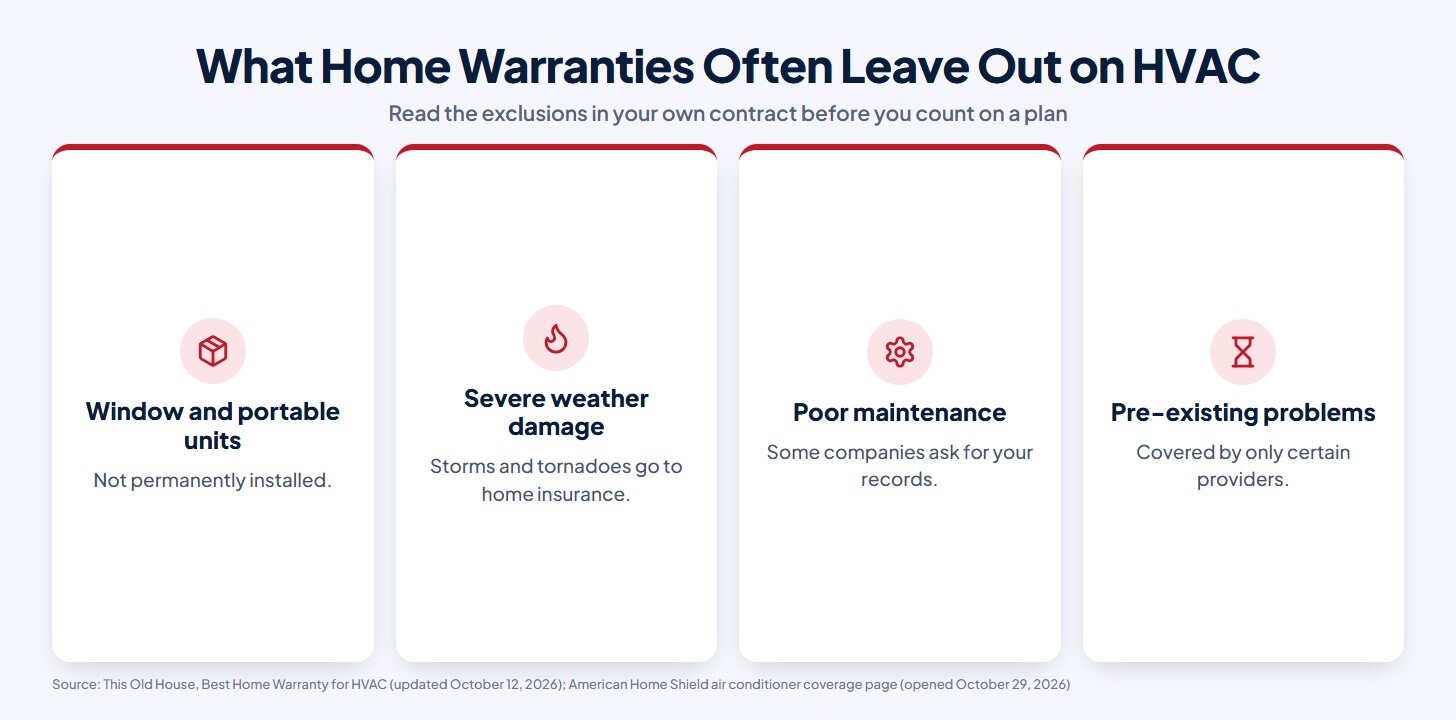
This Old House lists the usual ones. Damage from severe weather, such as storms or tornadoes, is excluded, and This Old House points to homeowners insurance for it. Personal heating and cooling devices like space heaters, humidifiers, and dehumidifiers aren't covered. Some companies ask for maintenance records and refuse to pay for neglected equipment. And only certain providers cover pre-existing conditions.
Maintenance is the exclusion you can control. Florida's Department of Financial Services reminds buyers that "some warranties require maintenance records for the item being covered." Keep every tune-up invoice, with the date, the technician's notes, and the system it covered. The same records help with your equipment warranties, which our guide to what a lifetime HVAC warranty covers explains.
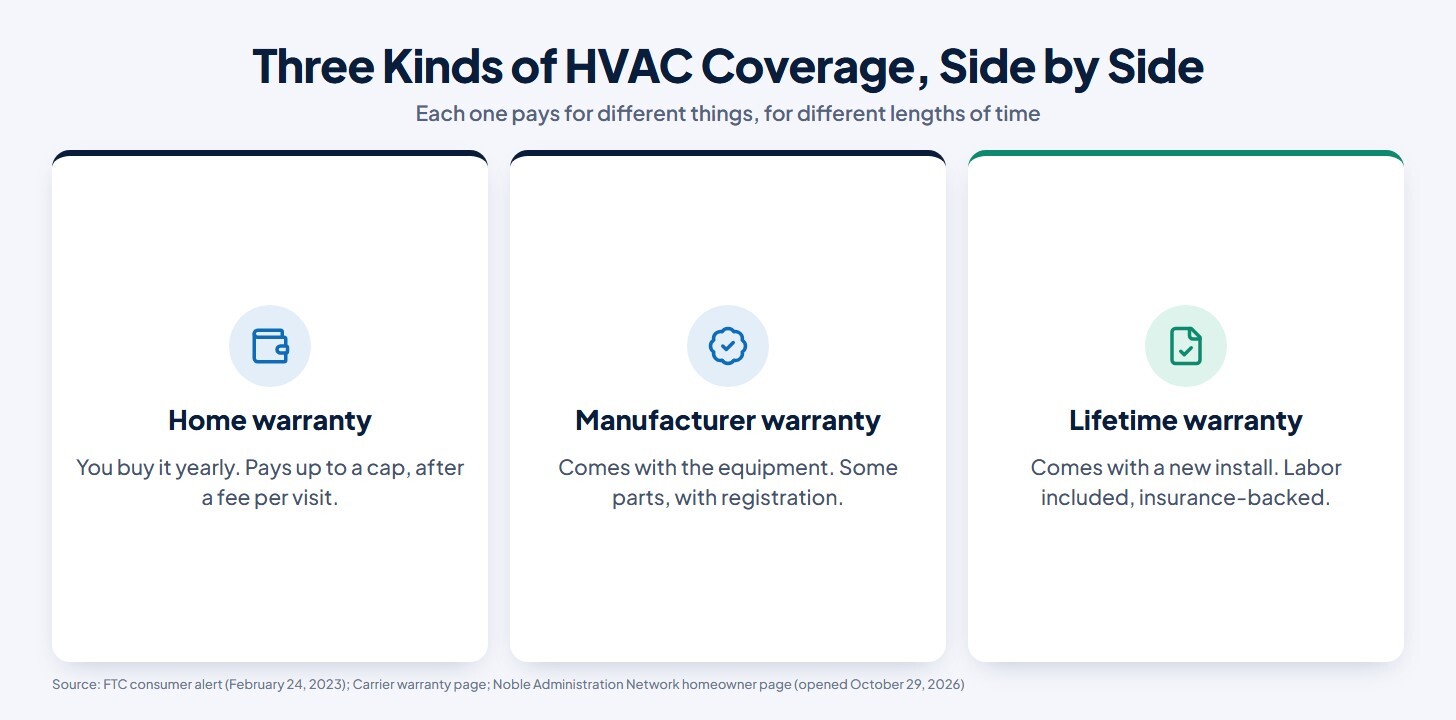
Home, manufacturer, and lifetime warranties are three different kinds of coverage. A home warranty is a plan you buy and renew. A manufacturer warranty comes with the equipment and covers some parts, with registration. A lifetime warranty from your installing retailer comes with a new system and can include labor. Each one pays for different things, for different lengths of time.
| Question | Home warranty | Manufacturer warranty | Lifetime warranty through your installer |
|---|---|---|---|
| How you get the coverage | You buy it from a home warranty company | The coverage comes with the equipment | It comes with a new system from a participating installer |
| How long the coverage lasts | One year at a time, renewed | Usually 5 to 10 years on some parts, with registration | As long as you own the home, on programs like Noble's |
| Labor | Set by the contract, so check it | Not covered on most brands' base warranty | Included on some programs, such as Noble's |
| Dollar limit | A cap per system, from $2,000 to unlimited at large providers | Covers the listed parts | Set by the program's written terms |
| Your cost per repair | A service fee each visit, $65 to $125 at large providers | Labor on most brands, and anything not listed | $0 for covered repairs on some programs |
| Existing older system | Yes, though pre-existing problems are often excluded | Only if it's still in its term | No, it starts with a new install |
Carrier's warranty page shows how a manufacturer warranty works. Register within 90 days of installation and you can pick a 10-year parts-only warranty. Skip registration and the standard 5-year parts-only warranty applies, and labor isn't covered. A 5-year parts plus 3-year labor option needs a participating installer. Our brand-by-brand guide covers the other major makers.
A lifetime warranty through the installer fills the gap the other two leave. Noble's lifetime warranty is one example: offered through participating HVAC retailers, it covers repairs on the major internal components, with labor included, for as long as you own the home, and a covered repair costs you $0. Every contract is backed by a national, brand-name A-rated insurance company, so the coverage doesn't depend on the installer staying in business. Our guide to what happens to a warranty if the company closes explains why that backing matters.
A home warranty makes the most sense for an older system that's past its manufacturer warranty, especially if the plan's HVAC cap is close to what a replacement would cost and you also want appliances covered. It makes less sense for a new system that already carries parts and labor coverage from the manufacturer and the installer.
Weigh a home warranty like this. Add up a year of plan payments and the service fees for the visits you expect. Then compare that with the repairs you'd likely face on a system of your age, and with the cap. If your system is near the end of its life, our repair or replace guide and its repair-or-replace rule of thumb will tell you whether a repair is even worth paying for.
If you're buying a house, a home warranty can cover the system you inherit for the first year, though problems that existed before the plan started are often excluded. When that system needs replacing, ask every installer what coverage comes with the new one. Our new home HVAC warranty guide walks through what the builder and the manufacturer each cover, and our guide for new homeowners choosing a lifetime warranty lists the checks to run before you trust the word "lifetime."
One honest caveat: a plan you never use is money spent on peace of mind. That's a fair purchase for some families. Just know the number before you buy it.
Ask six things before you sign: the HVAC limit per system and per year, the service fee per visit, which heating and cooling types and parts are listed, whether pre-existing problems are covered, what maintenance records the company wants, and how cancellation works. Get every answer from the written contract, not the sales page.
The FTC also suggests researching the company itself by searching its name with words like "review" or "complaint." If you live in Florida, the Department of Financial Services notes that a home warranty can be written by a home warranty association licensed under section 634.303 of the Florida Statutes or by an authorized insurance company, and other states have their own rules, so check with your state's insurance department.
And if your current system is nearing replacement, compare the plan against the coverage a new install can carry. Ask each installer whether labor is covered, for how long, and who backs the coverage.
Enter your ZIP code to see whether a lifetime warranty with labor included can come with your next heating or cooling system, or read exactly what it covers first.

Sometimes, up to the plan's limit. Plans usually repair a failed part first and replace the system only when it can't be repaired. If the replacement costs more than the HVAC cap, you pay the difference, plus the service fee for the visit.
What is the HVAC coverage limit on a home warranty?The HVAC limit depends on the plan. Across four large providers This Old House reviewed in October 2026, HVAC limits ran from $2,000 to unlimited, and American Home Shield lists a $5,000 covered item limit for air conditioning. Read the cap in your own contract.
How much is the service fee on a home warranty?Across the four providers This Old House reviewed in October 2026, service fees ran $65 to $125 a visit. You pay the fee each time a technician comes out, on top of the plan's monthly or yearly price.
Does a home warranty cover an old HVAC system?Some plans cover older systems, but pre-existing problems are often excluded, and so are breakdowns caused by poor maintenance, so keep your service records and read the contract's exclusions before you buy.
Is a home warranty better than a manufacturer warranty for HVAC?The two warranties cover different things. A manufacturer warranty comes with the equipment and covers some parts, with registration, usually without labor. A home warranty is a plan you buy that covers repairs up to a cap after a service fee. If your system is past its manufacturer's term, a home warranty can pay for repairs the manufacturer no longer will.
Can a home warranty and a lifetime HVAC warranty cover the same house?Yes. A home warranty can cover appliances and other systems, while a lifetime warranty that comes with a new system covers the major internal components of that system. Check each contract so you know which one pays for which repair.