How Long Does a Furnace Last? Lifespan by Type
By Noble Administration Network · November 5, 2026 · How we research and compare
Noble Administration Network | Published on: November 5, 2026 | Time to read: 14 min | Updated on: November 5, 2026
Most gas and oil furnaces last 15 to 20 years, and electric furnaces often last 20 to 30, according to Carrier and Lennox. InterNACHI puts furnaces in general at 15 to 25 years with regular maintenance. ENERGY STAR suggests considering a replacement once a furnace is more than 15 years old.
How long does a furnace last in your house? It depends on the fuel it burns, how well it's kept up, and whether it was sized right. This guide gives the lifespan of each kind of furnace with dated sources, the signs yours is near the end, when a repair still makes sense, and what each kind of warranty pays for when it fails.
Key Takeaways
A gas furnace usually lasts 15 to 20 years, an oil furnace about the same with proper maintenance, and an electric furnace 20 to 30 years. Electric furnaces last longest because they don't burn fuel and carry fewer moving parts. A well-built, well-kept furnace of any type can reach 25 to 30 years.
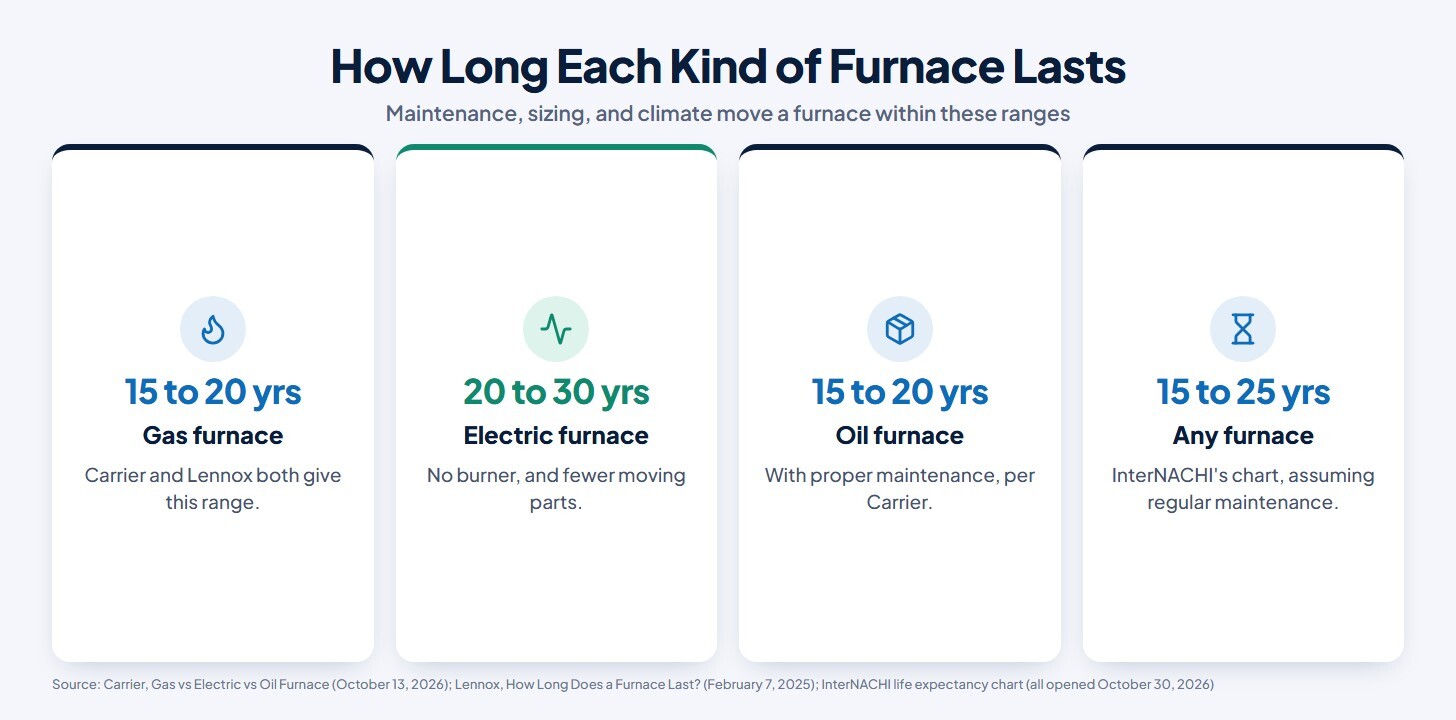
| Furnace type | Typical lifespan | Source, and the date we read it |
|---|---|---|
| Gas furnace | 15 to 20 years | Carrier's furnace lifespan guide and Lennox's furnace guide, both read October 30, 2026 |
| Electric furnace | 20 to 30 years | Carrier's gas, electric, and oil comparison and Lennox, read October 30, 2026 |
| Oil furnace | 15 to 20 years, with proper maintenance | Carrier's gas, electric, and oil comparison, read October 30, 2026 |
| A high-quality or high-efficiency furnace | Up to 30 years | Carrier's furnace lifespan guide, read October 30, 2026 |
| Any furnace, general chart | 15 to 25 years | InterNACHI's life expectancy chart, read October 30, 2026 |
| Any furnace, general guide | 15 to 20 years or more | Trane's repair or replace guide, read October 30, 2026 |
Carrier's comparison, dated October 13, 2026, says electric furnaces "typically last the longest" because they "have fewer moving parts and do not involve combustion." InterNACHI notes that its ranges assume regular recommended maintenance and normal wear, and it calls them guidelines only. Treat every number in this table the same way: a range for a typical house, not a promise for yours.
Manufacturers publish most of these figures, so treat the high end of each range as the best case. A furnace that runs hard all winter in a cold climate, or one that's rarely serviced, will land at the low end.
An HVAC system doesn't wear out all at once, because each piece has its own lifespan. InterNACHI puts a central air conditioner at 7 to 15 years, a heat pump at 10 to 15, and a furnace at 15 to 25. Trane gives 15 to 20 years for an air conditioner and about 15 for a heat pump.
| Equipment | InterNACHI | Trane |
|---|---|---|
| Central air conditioner | 7 to 15 years | 15 to 20 years |
| Heat pump | 10 to 15 years | 15 years |
| Furnace | 15 to 25 years | 15 to 20 years or more |
Trane adds that well-maintained central air conditioners and furnaces "can last up to 20 years, while heat pumps can last up to 15 years." Going by these ranges, if your furnace and air conditioner went in on the same day, the air conditioner will often be the first to go. That's worth knowing when you get a quote for one, because replacing both at once can be the better plan. Our repair or replace guide walks through that decision for the whole system.
Maintenance, sizing, and how many hours it runs decide where your furnace lands in its range. ENERGY STAR says a dirty filter can damage equipment and lead to early failure, and Carrier says a furnace that's too big or too small for the house wears its parts out faster.
Keep a dated record of every visit. It's the same record a warranty can ask you to show, which our guide to what a lifetime HVAC warranty covers explains.
For homeowners
Replacing your furnace? Ask for a lifetime warranty with labor included.
See what a Noble lifetime warranty covers on a new furnace, and the yearly maintenance that keeps it active.
See what's coveredAge is the first sign. ENERGY STAR says to consider replacing a furnace that's more than 15 years old. The others are repairs that keep coming, rising energy bills, rooms that won't heat evenly, new noises, a slow start, and cold air from the vents.
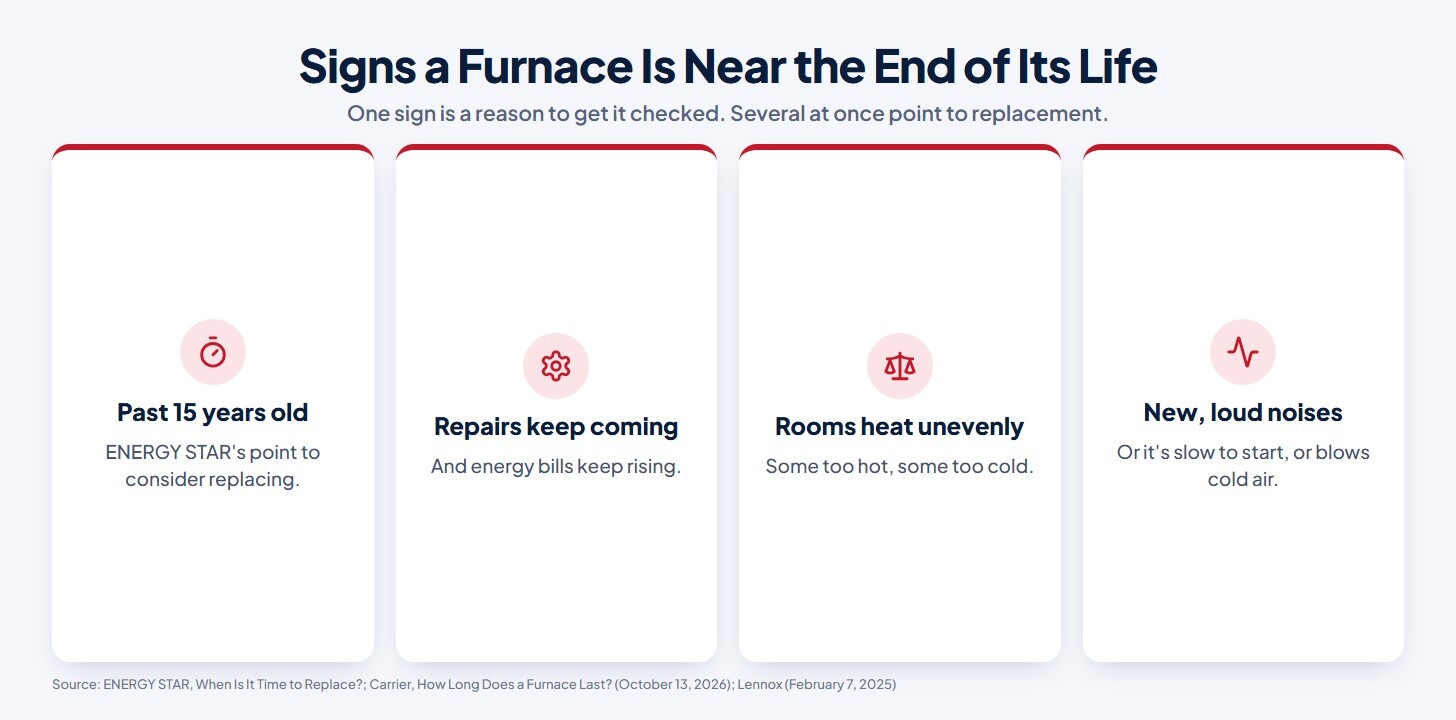
| Sign | What the source says | Source |
|---|---|---|
| The furnace is more than 15 years old | Consider replacing a furnace or boiler past 15 years | ENERGY STAR, When Is It Time to Replace? |
| Repairs keep coming | Several repairs within a few years show the furnace is failing | Lennox |
| Energy bills are going up | A rise in bills can mean the system is running less efficiently | Lennox and ENERGY STAR |
| Rooms heat unevenly | Some rooms are too hot or too cold | ENERGY STAR and Carrier |
| New or loud noises | Sounds you aren't used to hearing | Lennox and Carrier |
| The furnace is slow to start | A long wait to turn on may mean it's starting to fail | Lennox |
| It blows cold air or can't hold the setting | Blowing cold air, or struggling to maintain the thermostat setting | Carrier |
One sign on its own is a reason to have the furnace checked, not a reason to replace it. Two or three together, on a furnace past 15 years, usually point to replacement.
Safety comes before any of that. A gas or oil furnace burns fuel, and HomeGuide notes that only a technician's combustion analysis test can fully confirm a cracked heat exchanger that's leaking carbon monoxide. The U.S. Consumer Product Safety Commission advises CO alarms with battery power or battery backup on every level of the home and outside sleeping areas. It lists headache, dizziness, weakness, nausea, vomiting, sleepiness, and confusion as symptoms of CO poisoning.
Lennox's guidance is to replace a furnace when a repair costs more than half the price of a new one. Age shifts the math. HomeGuide's advice is to replace just the heat exchanger when the furnace is less than 10 years old with no other issues and the repair costs much less than a new furnace.
HomeGuide's heat exchanger cost guide, updated June 23, 2025, puts a heat exchanger replacement at $1,000 to $3,000 on average and a new furnace at $3,500 to $7,500 or more. Carrier's furnace guide says replacing a 20-year-old furnace is often the smart financial move.
Say your furnace is 14 years old and the quote to replace its heat exchanger is $2,000, HomeGuide's national average. A new furnace at the low end of HomeGuide's range is $3,500, and half that price is $1,750. The repair costs more than half the price of a new furnace, and the furnace is past the 10-year mark, so both rules point to replacing it. These inputs are assumptions, so use the numbers from your own quotes.
Two more things change the answer. A repair that a warranty pays for in full costs you far less than the quote, so check your coverage before you decide. And a replacement is a chance to choose the coverage that comes with the new furnace. Our HVAC cost by square footage guide shows what a new system costs for a home your size.
Labor, most of all. A manufacturer warranty covers some parts, with registration, usually for 10 years, and often gives the heat exchanger 20 years or a limited lifetime term. On most brands you pay the technician's labor and trip charges to install the covered part, and you can lose coverage if you skip maintenance.
| Brand & document | Parts | Heat exchanger | Labor | What you need to do |
|---|---|---|---|---|
| Goodman GR9S80 gas furnace page | 10-year parts warranty | 20-year heat exchanger warranty | Not listed on the product page | Register online within 60 days of installation |
| Carrier warranty page | 10-year parts-only warranty with registration, or the standard 5-year parts warranty if you register late | Not stated on this page | Not covered under the standard warranty. A 5-year parts and 3-year labor option needs a participating installer | Register within 90 days of installation |
| Lennox Basic Limited Warranty, form W900002-02, dated 8/1/2025 | 10 years on covered components in a home | Lifetime term on some gas furnaces, for the original owner living in the home, and 20 years for later owners | The owner pays labor, trip charges, and diagnostic calls | Maintain the equipment, because failure to maintain it voids the warranty |
Every page in this table was read on October 30, 2026. Our brand-by-brand warranty guide covers the other major makers.
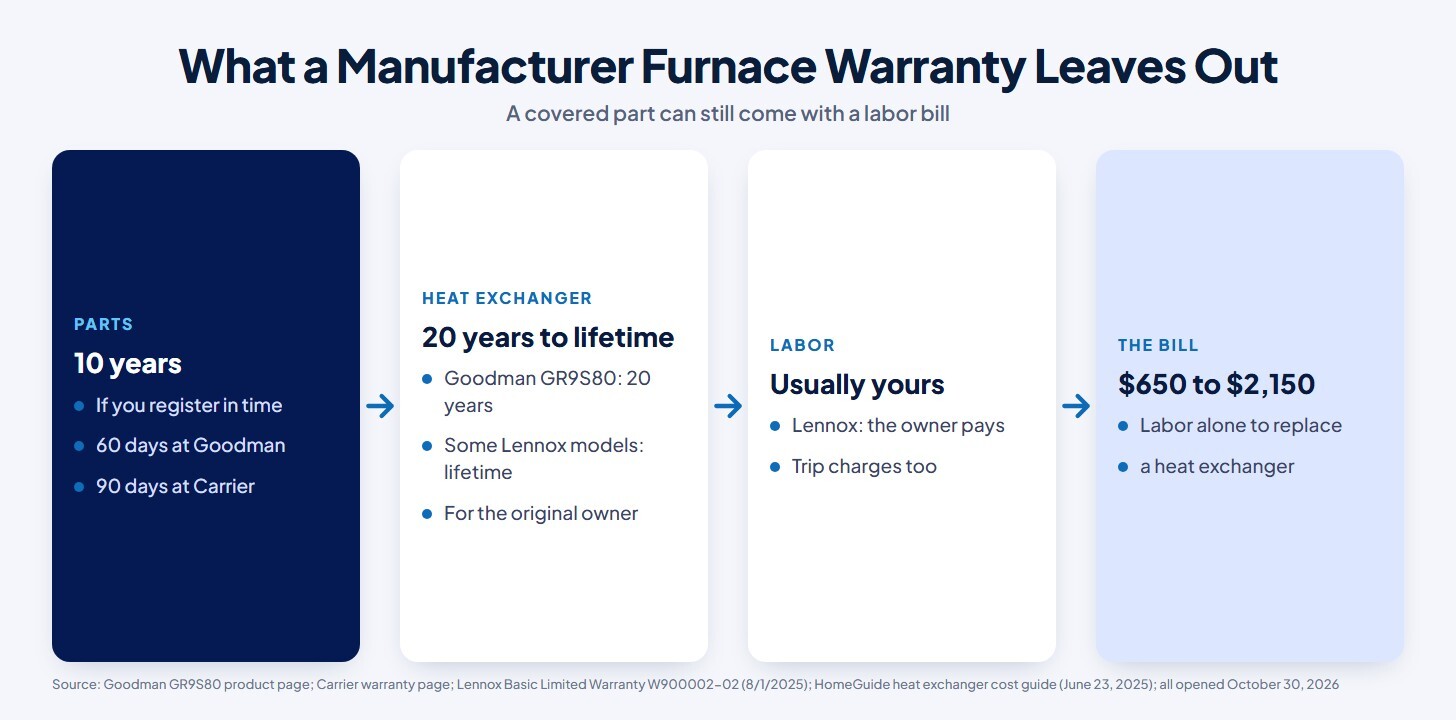
The labor is where the money goes. HomeGuide puts the heat exchanger part at $350 to $850 and the labor to replace it at $650 to $2,150. It adds that a heat exchanger warranty "only covers the part, not labor." So a heat exchanger with a lifetime term can still leave you with a labor bill of $650 or more.
Lennox's lifetime term is for the original owner who still lives in the home, and it drops to 20 years for anyone who buys the house later. Our guide to what a lifetime warranty means on HVAC explains how to read those words on any quote.
It pays for the repair, not only the part. When a Noble retailer installs your new system, covered repairs to its major internal components, gas furnaces included, come with the labor paid, for as long as you own your home. A covered repair costs you $0, and you keep the warranty active with yearly maintenance.
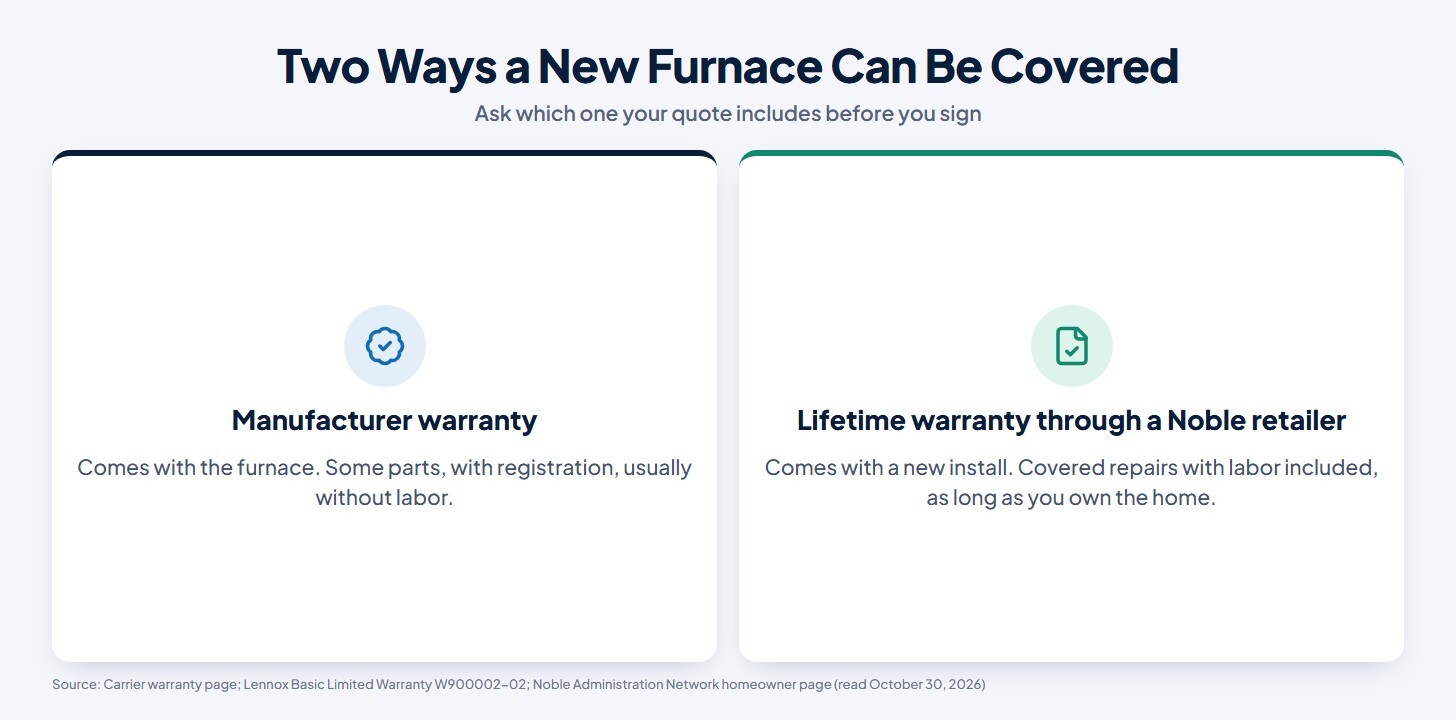
| Question | Manufacturer furnace warranty | Lifetime warranty through a Noble retailer |
|---|---|---|
| What's covered? | Some parts, with registration, and often a longer term on the heat exchanger | Covered repairs on the major internal components of the system the retailer installed |
| Is labor included? | Not on most brands | Yes, on covered repairs |
| How long does the warranty last? | Usually 10 years on parts, and 20 years to lifetime on the heat exchanger | As long as you own your home and keep up the maintenance |
| What do you pay for a covered repair? | Labor and trip charges on most brands | $0 |
| Who stands behind the warranty? | The manufacturer | A national, brand-name A-rated insurance company stands behind every contract |
| What keeps the warranty active? | Registering on time and maintaining the equipment | A spring and a fall service every year, with proof of each sent to Noble within 30 days |
The coverage applies to the systems Noble retailers install: central air conditioning, gas furnaces, heat pumps, ductless mini splits, and packaged units. It comes with a new install, so it doesn't cover a furnace already in your house. It's valid for the original purchaser and doesn't transfer to a new owner when you sell.
Every contract is backed by a national, brand-name A-rated insurance company, so the coverage doesn't depend on the installing company staying in business. Our guide to what happens to a warranty if the company closes explains why that backing matters. Noble's written Lifetime Warranty Program Details set out the full terms, so read them before you sign.
Ask four things about every quote: how long the parts warranty lasts and whether you need to register it, whether labor is covered and for how long, who pays for repairs if the installing company closes, and what maintenance you'll need to keep the coverage active. Get the answers in writing.
Ask every installer the same questions so you can compare the answers side by side. If you'd like a quote that includes a lifetime warranty with labor, find a Noble retailer near you, or read exactly what Noble's lifetime warranty covers first.
Enter your ZIP code to see whether a retailer near you can install your next furnace with a Noble lifetime warranty, labor included on covered repairs for as long as you own your home.

Most gas furnaces last 15 to 20 years, according to Carrier and Lennox. Yearly maintenance and a monthly filter check help a gas furnace reach the top of that range, and ENERGY STAR suggests considering a replacement once a furnace is more than 15 years old.
Can a furnace last 30 years?Some can. Carrier says a high-quality furnace can potentially last up to 30 years, and Carrier and Lennox both put electric furnaces at 20 to 30 years. Most gas and oil furnaces last 15 to 20.
Is it worth repairing a 20-year-old furnace?Usually not for a major repair. Carrier says replacing a 20-year-old furnace is often the smart financial move, and Lennox suggests replacing a furnace when a repair costs more than half the price of a new one.
How long does an HVAC system last?Each part has its own lifespan. InterNACHI puts a central air conditioner at 7 to 15 years, a heat pump at 10 to 15, and a furnace at 15 to 25. Trane gives 15 to 20 years for an air conditioner and about 15 for a heat pump.
Does a furnace warranty cover labor?A manufacturer furnace warranty usually doesn't. Lennox's basic limited warranty makes the owner pay labor and trip charges, and Carrier's standard warranty leaves labor out. A lifetime warranty through a Noble retailer includes labor on covered repairs.
How can I make my furnace last longer?Check or change the filter every month, book a heating check every fall, and keep a dated record of each visit. ENERGY STAR says a dirty filter can damage equipment and lead to early failure.