What Does a Limited Lifetime Warranty Mean on HVAC?
By Noble Team · October 19, 2026
Noble Admin Network | Published on: October 19, 2026 | Time to read: 13 min | Updated on: October 19, 2026
A limited lifetime warranty is a lifetime warranty with written limits. "Limited" is the federal label for any warranty that misses one of the standards for a full warranty. On HVAC equipment it usually means one part, such as the furnace heat exchanger, covered for the original owner, with the labor bill left to you.
You'll see "limited lifetime warranty" on furnace brochures, on installer quotes, and on almost anything else you buy for a house. The phrase sounds like a contradiction, and it isn't one. This guide explains what each word means, how the four kinds of HVAC coverage use the word lifetime, what the limits can cost, and how to read the fine print before you sign.
It's a promise to repair or replace something for a long or open-ended period, with conditions written into it. The word limited tells you there are conditions. The word lifetime tells you the length, measured by whatever life the document names. Neither word means much until you've read the sentence that defines it.
On a heating and cooling system, you'll usually meet the phrase in two places. Equipment makers use it for one long-lived part, most often a furnace's heat exchanger. Installers use it for their own warranty programs, which range from one part to the major internal components of the system. The words are the same, and the coverage can be very different.
Lennox's Basic Limited Warranty gives the heat exchanger in some of its gas furnaces a limited lifetime term. That term applies to the original owner who still lives in the home, and it drops to 20 years for later owners. The same document says the owner pays the labor and trip charges on warranty service, and that failing to maintain the equipment voids the warranty.
That's a fair warranty, and it's a good picture of what limited usually means on equipment: one part, one owner, parts without labor. Other parts on the same furnace carry shorter terms. Manufacturer warranties usually cover some parts, with registration, for 5 to 10 years, and most brands leave the labor to the owner. Carrier's condensing gas furnace warranty works the same way on some models: a lifetime heat exchanger term if the original owner registers the furnace within 90 days, and 20 years for everyone else. For the brand-by-brand details, see what HVAC manufacturer warranties cover.
Because federal law gives a written warranty on a consumer product only two labels: full or limited. A full warranty has to meet every federal minimum standard. A warranty that misses any one of them, for example by charging for labor or covering only the first owner, has to be called limited. So nearly every HVAC warranty carries the word.
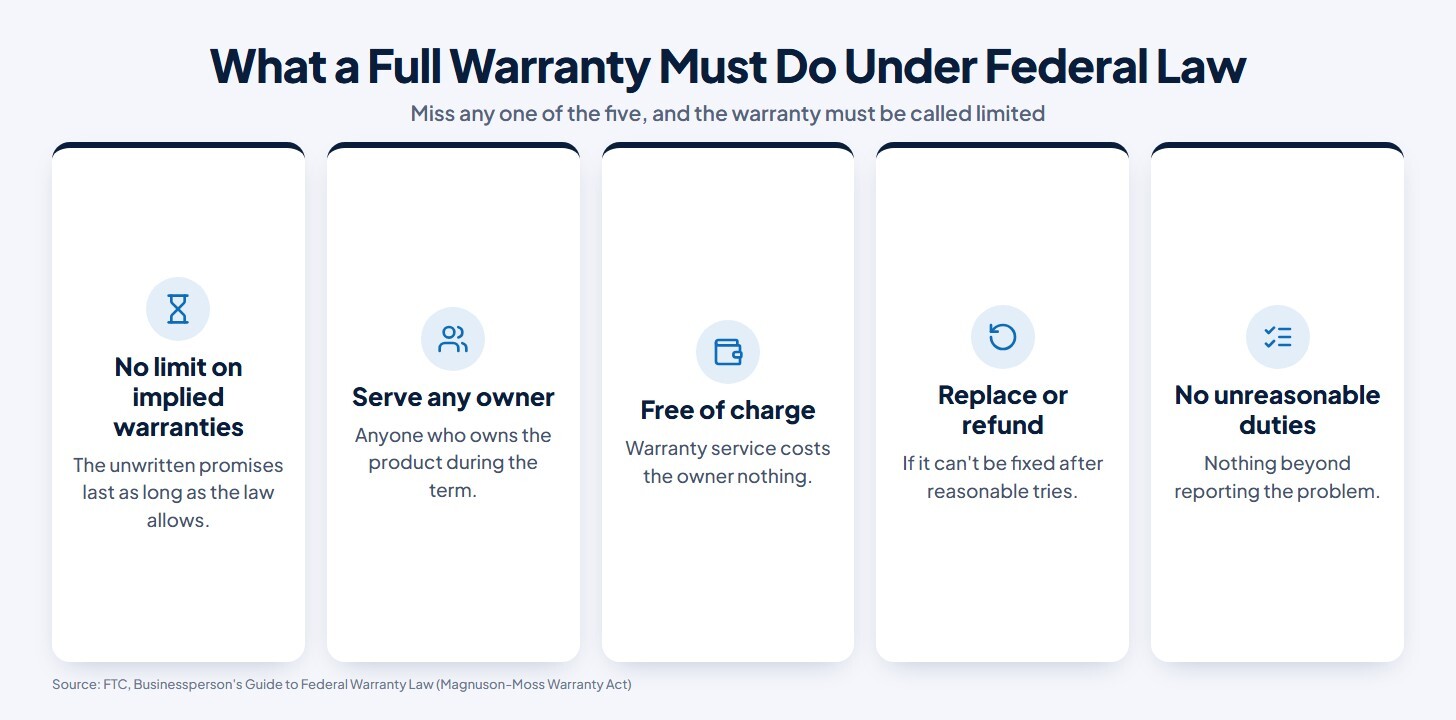
The rule comes from the Magnuson-Moss Warranty Act, and the FTC explains it in its guide to federal warranty law. It lists five things a full warranty does: it leaves implied warranties unlimited, it serves anyone who owns the product during the warranty period, it provides warranty service free of charge, it offers a replacement or a full refund when the product can't be fixed after a reasonable number of tries, and it asks nothing of the owner beyond reporting the problem unless the duty is reasonable. If any one of those isn't true, the warranty is limited. The FTC even counts requiring a registration card as a duty a full warranty can't impose.
So the label tells you how to read the document, not whether it's good. A limited warranty can be generous, and it can be thin. The FTC's consumer advice on warranties gives the rule that settles most questions: if a part or repair isn't listed, assume it isn't covered.
Whichever life the document names, and it's rarely your own. It can be the product's useful life, the time the original owner keeps it, or, less often, the original owner's own life. The FTC tells companies to say which life they mean, so look for the sentence that defines it before you count on the word lifetime.
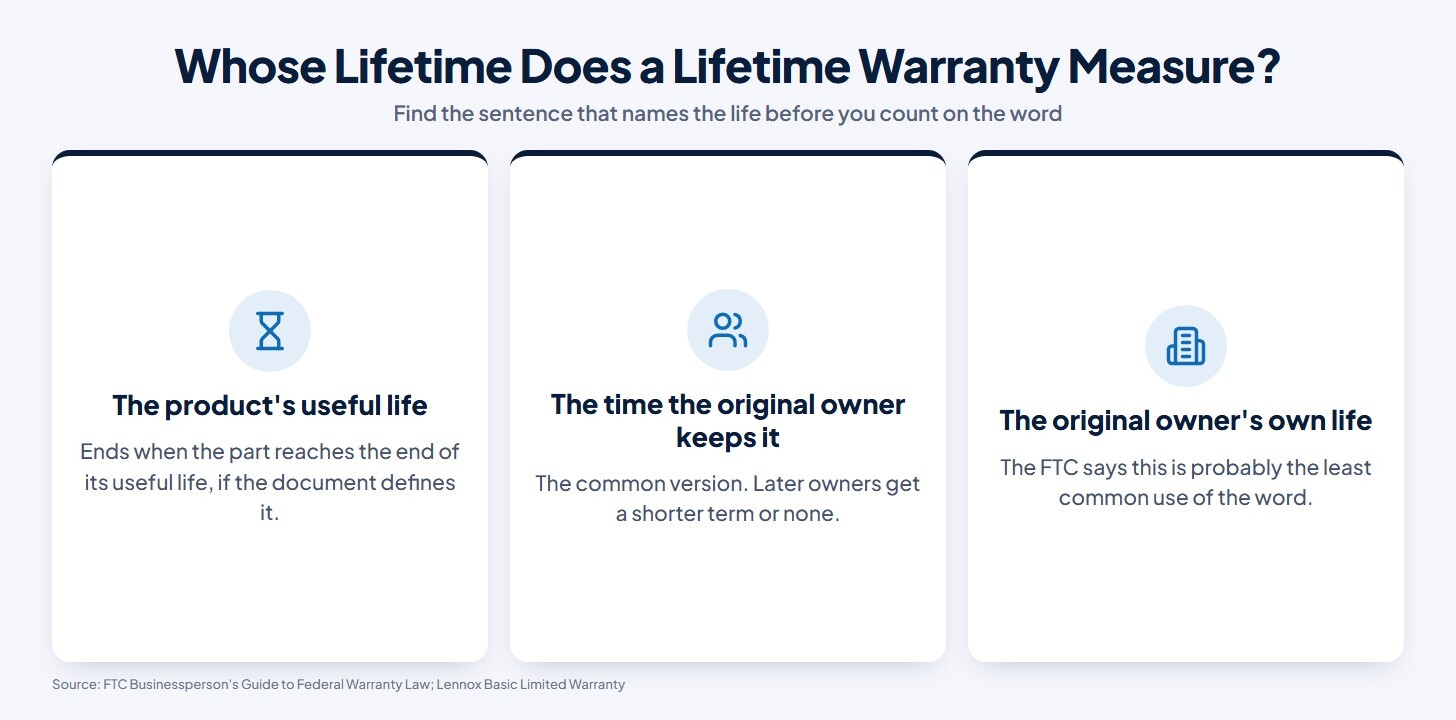
The FTC's warranty guide is direct about it: it notes that it's often hard to tell whose life measures the period of coverage, and it says ads should tell consumers which life measures the warranty's duration. A warranty that says lifetime and nothing else hasn't told you how long it lasts.
Check the start date too. Most manufacturer terms begin at installation, or at closing on a newly built home, and some installer warranties pay only after the manufacturer's parts warranty ends. If you're buying a newly built home, our guide to the new home HVAC warranty covers how those start dates work, and whether coverage passes to a buyer.
For homeowners
See what a lifetime warranty with labor included covers.
The Noble lifetime warranty covers repairs on the major internal components of your system, labor included, for as long as you own your home. Every contract is A-rated insurance-backed.
See what's coveredA full, or "true," lifetime warranty would have to meet every federal standard, including free repairs for anyone who owns the product during the term. Almost no HVAC warranty does that, so in practice you're choosing between limited warranties. The useful comparison isn't the label. It's how much each one covers, for whom, and whether labor is included.
Two limited lifetime warranties can sit at opposite ends of that range. One covers a single heat exchanger, for the original owner, with labor left to you. Another covers the major internal components of the system, with labor, for as long as the original owner keeps the home. Both are legally limited, and they aren't close to the same thing.
A lifetime workmanship guarantee is a third thing again. It's usually an installer's promise about its own installation work, not about parts that fail. Here's how a lifetime workmanship guarantee compares with a warranty.
It means four different things. On a manufacturer warranty it usually means one part for the original owner. On an installer's lifetime warranty it can mean the major internal components while you own the home. A workmanship guarantee covers the installation, not parts. A home warranty isn't lifetime coverage at all, because it renews one year at a time.
| Coverage | What "lifetime" means | What it covers | Labor | What it costs you | Who stands behind it |
|---|---|---|---|---|---|
| Manufacturer limited lifetime | Usually the original owner while living in the home. Later owners get a fixed term, such as 20 years. | One part on some models, most often the furnace heat exchanger. Other parts usually 10 years when registered. | Not on most brands. The owner pays labor and trip charges. | Included in the equipment price. Labor on a heat exchanger replacement runs $650 to $2,150. | The manufacturer |
| Installer lifetime warranty | Varies. Often as long as you own the home. | Varies, from one part to the major internal components of the system. | Varies. Some include labor on covered repairs. | Included in the system price or sold separately. Read the quote. | The installer, a warranty administrator, or an insurance company behind it |
| Lifetime workmanship guarantee | As long as the installer stands behind its work. | Mistakes in the installation, not parts that wear out. | The installer's own labor to correct its work. | Usually included. | The installing company only |
| Home warranty | Not lifetime. A one-year service contract that renews. | Repairs on listed systems, up to a cap: $2,000 to $6,500 per system across plans, $5,000 on one American Home Shield plan. | Included, after a service fee of $75 to $125 a visit. | About $564 to $984 a year. | The home warranty company |
Sources, checked October 17, 2026: the Lennox and Carrier warranty documents, HomeGuide for heat exchanger labor, NerdWallet for home warranty caps, the American Home Shield ShieldGold plan, and This Old House for home warranty fees and annual cost. The home warranty figures are national ranges, and your plan's contract sets the real numbers. For a side-by-side of these options with the questions to ask before you sign, see how the four types of HVAC warranty compare.
Read it in a set order: the sentence that defines the term, the list of covered parts, the labor clause, what you must do to keep it, the exclusions, and who pays the claims. Those six lines answer almost every question. Read them before you sign, and keep the document with your receipt and service records.
Two of those lines deserve a closer look. Your duties decide whether the coverage stays in force, and our guide to what a lifetime HVAC warranty covers, including labor walks through what keeps coverage valid. The backer decides whether a claim gets paid years from now, which is why insurance backing matters for HVAC warranty claims.
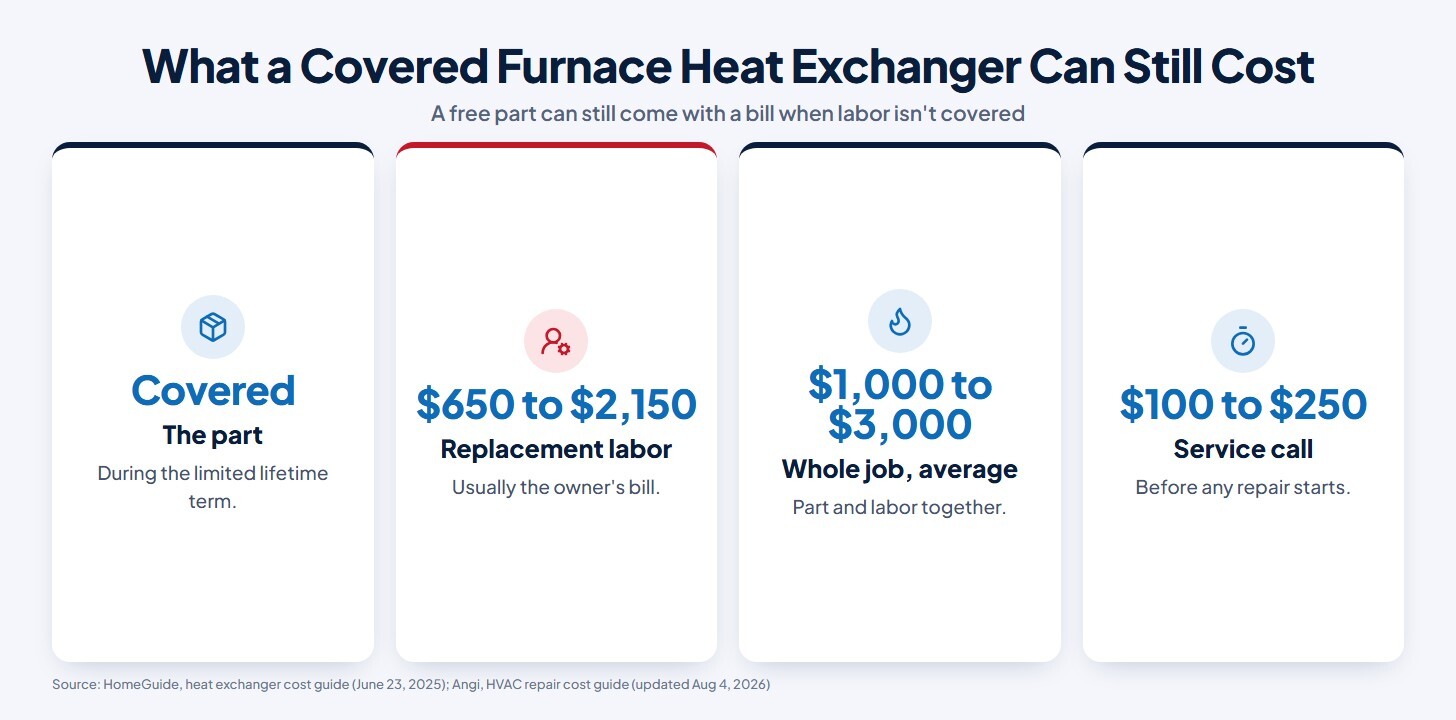
The labor, and it can cost more than the part. A limited lifetime term on a furnace heat exchanger pays for the part, while the owner usually pays for the hours it takes to install it. HomeGuide puts heat exchanger replacement labor at $650 to $2,150, on a job that averages $1,000 to $3,000 in total.
| Cost on a covered repair | Under a typical manufacturer warranty | What it can run |
|---|---|---|
| The failed part | Covered during the term | Covered |
| Labor to replace it | The owner pays, on Lennox's and Carrier's terms | $650 to $2,150 for a heat exchanger |
| Trip and diagnostic charges | The owner pays | A service call of $100 to $250 |
| Refrigerant | The owner pays, on Carrier's terms | Depends on the system and the refrigerant |
The figures come from HomeGuide's heat exchanger cost guide, which says the warranty "only covers the part, not labor," and from Angi's HVAC repair cost guide, updated August 4, 2026, which puts a service call at $100 to $250. Carrier's heat pump warranty lists labor and "any cost to replace, refill or dispose of refrigerant" among the things it doesn't cover. Those are normal terms, and they're why a free part can still come with a bill.
That gap is the main reason to read the labor clause first. If you're weighing extra labor coverage, our guide to whether a 10-year HVAC labor warranty is worth it runs the numbers.
It fills the gap a manufacturer's limited lifetime term leaves open, when it's written well. A good installer warranty names the systems and parts it covers, includes labor, says plainly whose lifetime it measures, and names who pays the claims. Noble's warranty, offered through participating HVAC retailers, is one example of how those lines can read.
Noble's published program details, which call it the "Lifetime HVAC Limited Warranty," cover repairs on the major internal components of central air conditioners, gas furnaces, heat pumps, ductless mini splits, and packaged units for as long as the original buyer owns the home, and Noble's homeowner terms include labor on covered repairs. Every contract is backed by a national, brand-name A-rated insurance company, and the coverage stays in force with a spring and a fall service every year, as the program details set out. It's still a limited warranty under federal law, like nearly every warranty you'll be offered, and the label is the least important thing on the page.
To see whether a participating retailer serves your area, start with the ZIP code check, or read the full homeowner overview first.
Enter your ZIP code to see whether a lifetime warranty, A-rated insurance-backed, can come with your next heating or cooling system.

Only what the document lists, for the people and the period it names. Limited means the warranty misses at least one federal standard for a full warranty, such as free labor or coverage for later owners. If a part isn't listed, assume it isn't covered.
What is the difference between a lifetime guarantee and a lifetime warranty?On HVAC, a lifetime guarantee usually means an installer's promise about its own workmanship, while a lifetime warranty covers parts that fail. Read each document, because companies use the two words loosely.
Is labor part of a limited lifetime warranty?Usually not on a manufacturer warranty. Many say the owner pays labor and trip charges on warranty service. Some installer lifetime warranties include labor on covered repairs, so check the labor line before you count on it.
What is the difference between a full and a limited warranty?A full warranty meets every federal minimum standard, including free repairs and coverage for anyone who owns the product during the term. Any warranty that misses one of those standards must be labeled limited.
How long is a lifetime warranty on a furnace heat exchanger?It depends on the brand and the owner. Some manufacturers give the original owner a limited lifetime term on the heat exchanger while they live in the home, and a fixed term, such as 20 years, to later owners.