HVAC Maintenance Agreements & Service Contracts: What to Include & Charge
By Noble Administration Network · October 30, 2026 · How we research and compare
Noble Administration Network | Published on: October 30, 2026 | Time to read: 14 min | Updated on: November 7, 2026
An HVAC maintenance agreement, also called an HVAC service agreement or HVAC service contract, is a yearly plan a homeowner buys from your shop. It usually covers two visits, a spring cooling check and a fall heating check, plus perks such as priority service and repair discounts. Price it from your own loaded labor cost, and keep the dated service records a warranty can ask for.
Use this page to write or fix the agreement your shop sells, whatever you call it on the invoice. You'll get a checklist of what to put in it, the work each seasonal visit should cover, a worksheet that prices the plan from your own labor cost, how the plan keeps equipment warranties in force, and a sample outline you can copy.
Key Takeaways
Include eight parts: who the agreement is between and when it starts, the equipment it covers, what each visit includes, when the visits happen, the member perks, the price and billing, the warranty records you'll keep, and how it renews or ends. ServiceTitan's service agreement template uses a similar list, with scope, pricing, payment, and termination terms.
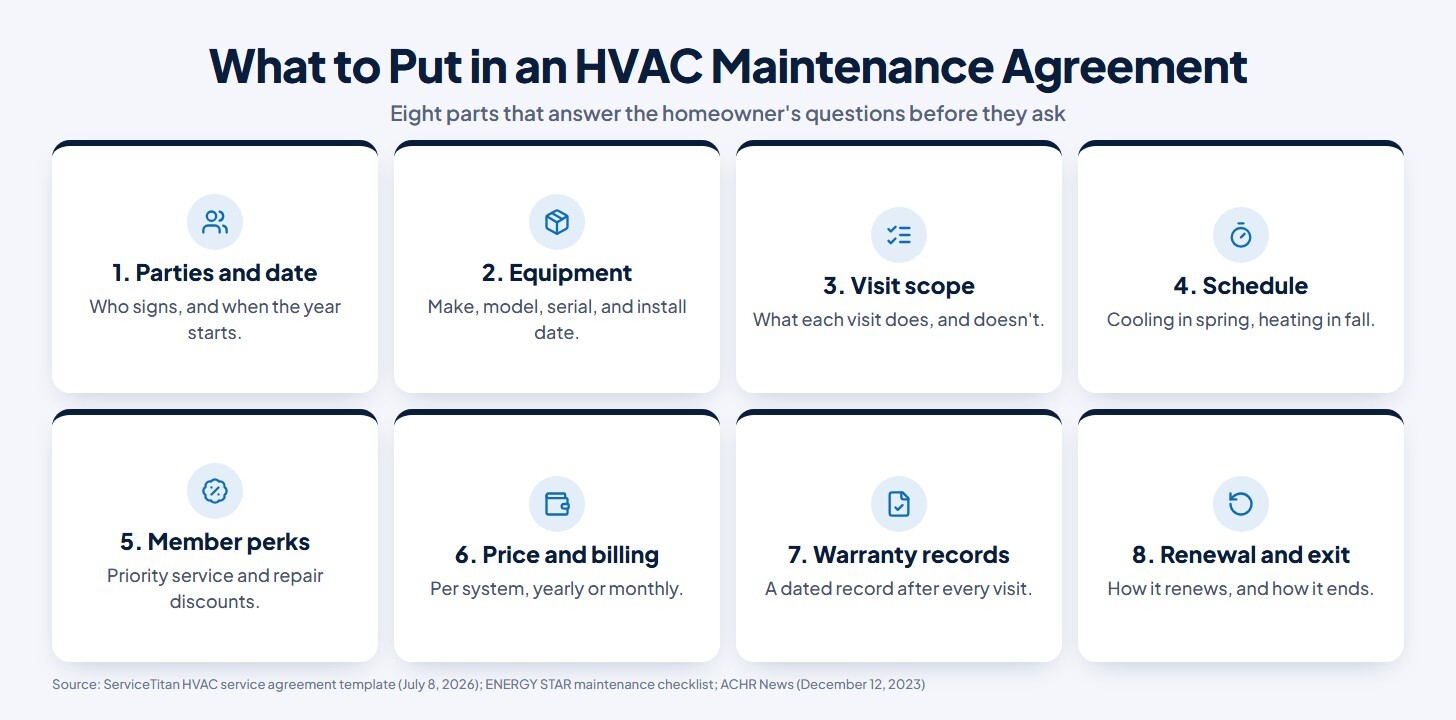
| Part | What to write | Why it matters |
|---|---|---|
| 1. Parties & start date | The homeowner's name, the service address, your shop's name and license number, the start date, and both signatures | It settles who can book visits and when the 12 months begin. |
| 2. Equipment covered | The make, model, serial number, and install date of each system | The install date tells you which warranty terms apply. |
| 3. Visit scope | The checklist for each visit, and what a visit doesn't include, such as repairs and parts | Every tech works the same list. |
| 4. Schedule | Two visits a year, spring for cooling and fall for heating, and how your office books them | Visits that never get booked turn into cancellations. |
| 5. Member perks | Priority service, a repair discount, and any waived trip charge, each with its exact amount | In a 2023 survey, 80% of homeowners wanted parts discounts, 78% wanted labor discounts, and 77% wanted priority service. |
| 6. Price and billing | The price per system or per home, billed yearly, quarterly, or monthly, and what happens when a payment fails | A card on file keeps the plan paid. |
| 7. Warranty records | A dated service record after every visit, a copy for the homeowner, and a check that each system is registered | Some warranties can ask for proof of maintenance. |
| 8. Renewal & cancellation | Whether the plan renews on its own, when you'll send a reminder, any price change, and how either side can cancel | Clear terms keep members from lapsing by accident. |
The perk figures come from a Clear Seas Research survey of 400 homeowners that ACHR News reported in December 2023. Have your attorney review the final wording for your state before you sell the plan.
Every visit should cover the basics on ENERGY STAR's maintenance checklist: thermostat settings, electrical connections, moving parts, the condensate drain, and the system controls. The spring visit adds the cooling work, such as the coils, the refrigerant level, and the blower. The fall visit adds the gas connections, the burner, and the heat exchanger.
| Visit | What the tech does | What to write on the service record |
|---|---|---|
| Every visit | Checks the thermostat settings, tightens electrical connections and measures motor voltage and current, lubricates moving parts, clears the condensate drain, and tests that the system starts, runs, and shuts off correctly | The date, the tech's name, the readings, and anything found |
| Spring cooling visit | Cleans the evaporator and condenser coils, checks the refrigerant level, and cleans and adjusts the blower | The refrigerant reading and the coil condition |
| Fall heating visit | Checks the gas or oil connections, the gas pressure, the burner combustion, and the heat exchanger | The gas pressure and the heat exchanger condition |
| Between visits | The homeowner checks or changes the air filter every month, as ENERGY STAR advises | The filter size |
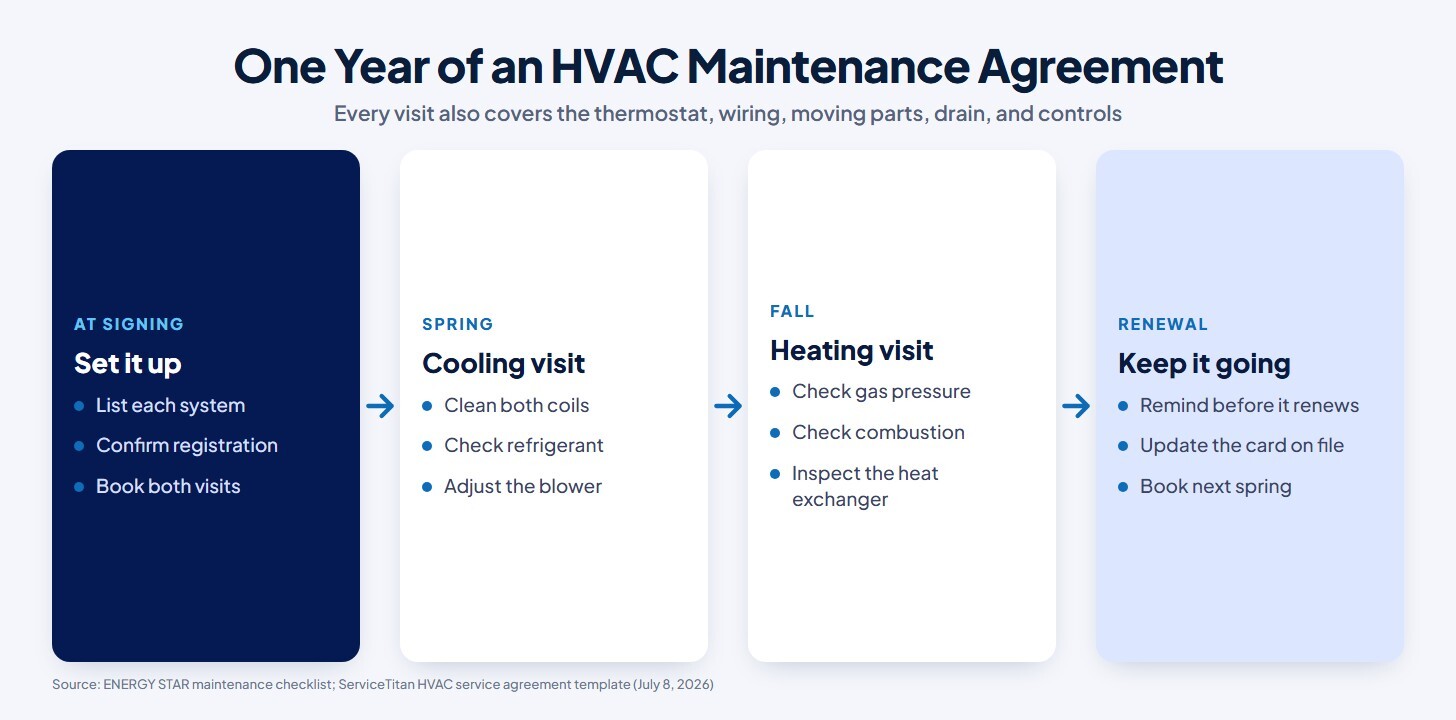
Don't sell a one-visit plan. In the 2023 survey, homeowners expected an agreement to include at least two service visits a year. Book both on the day the homeowner signs, and start the spring visits before cooling season, because a cooling check that waits for the first heat wave competes with every no-cool call on your board.
Start from what one hour of a tech's time really costs your shop, not from a competitor's flyer. Add the wage, the benefits, and your overhead to get a fully loaded hour, multiply by the time two visits take, add materials, and then add your margin. Check the result against what your market pays before you print it.
The wage and the benefits rate below come from the Bureau of Labor Statistics. Swap in your own overhead, visit time, materials, and margin.
| Line | How to figure it | Worked example |
|---|---|---|
| 1. Tech wage per hour | Your tech's hourly pay. The BLS median for HVAC mechanics and installers was $29.33 an hour in May 2025. | $29.33 |
| 2. Benefits and payroll taxes | About 45.8% on top of wages: installation, maintenance, and repair workers cost $15.41 in benefits for every $33.61 in wages per hour worked in June 2026, from BLS Employer Costs for Employee Compensation | $13.45 |
| 3. Overhead per billable hour | Trucks, fuel, office staff, software, and insurance for the year, divided by the hours your techs bill | $35.00 (assumed) |
| 4. Fully loaded labor hour | Line 1 plus line 2 plus line 3 | $77.78 |
| 5. Hours per visit | Time on site plus drive time | 1.5 hours (assumed) |
| 6. Cost per visit | Line 4 times line 5 | $116.67 |
| 7. Visit cost per year | Line 6 times the visits in the plan, usually two | $233.34 |
| 8. Materials per year | Coil cleaner, drain treatment, and any filters you include | $20.00 (assumed) |
| 9. Yearly cost to deliver | Line 7 plus line 8 | $253.34 |
| 10. Price at your margin | Line 9 divided by one minus your margin, here 30% | $361.91, rounded up to $365 a year, or about $30.42 a month |
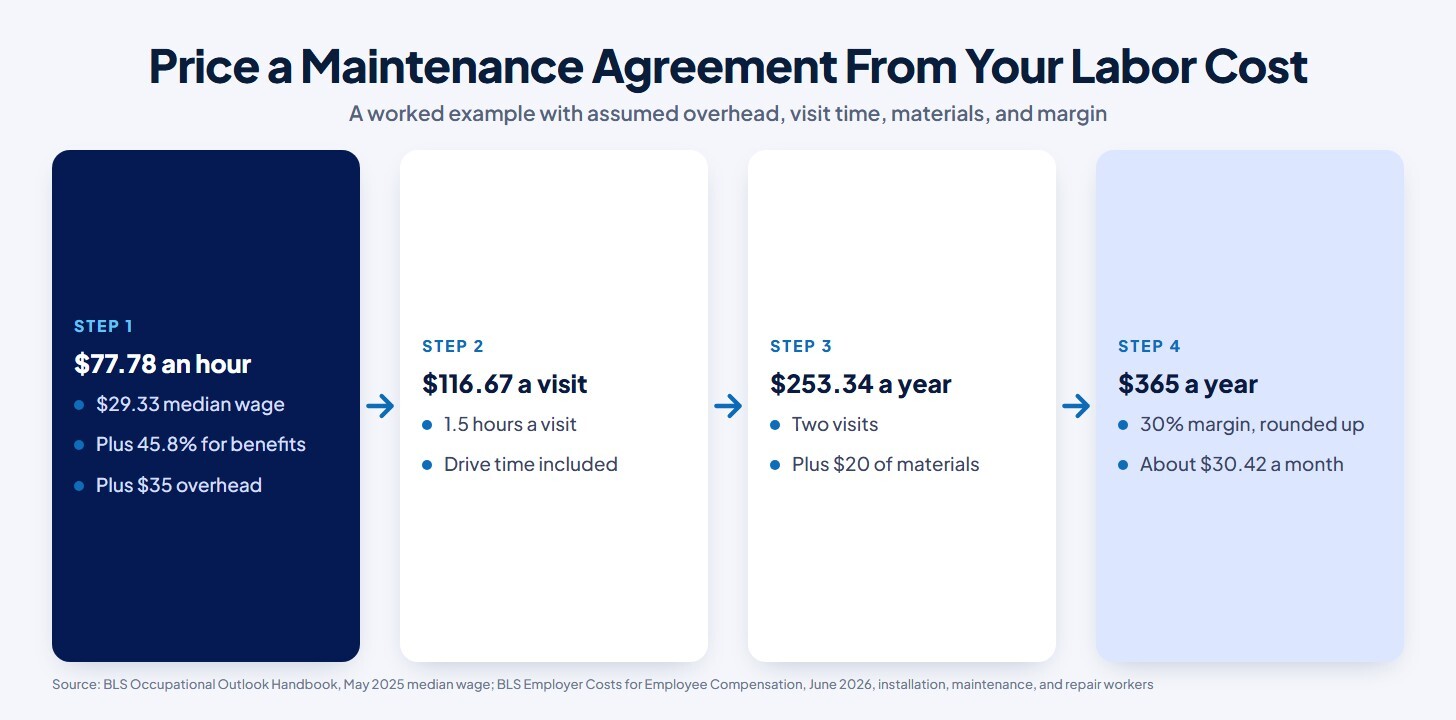
In the example, each member costs $253.34 a year to serve and pays $365, so the plan adds about $112 a year per member before any repair work. A repair discount is a cost too, so count it when you set the margin.
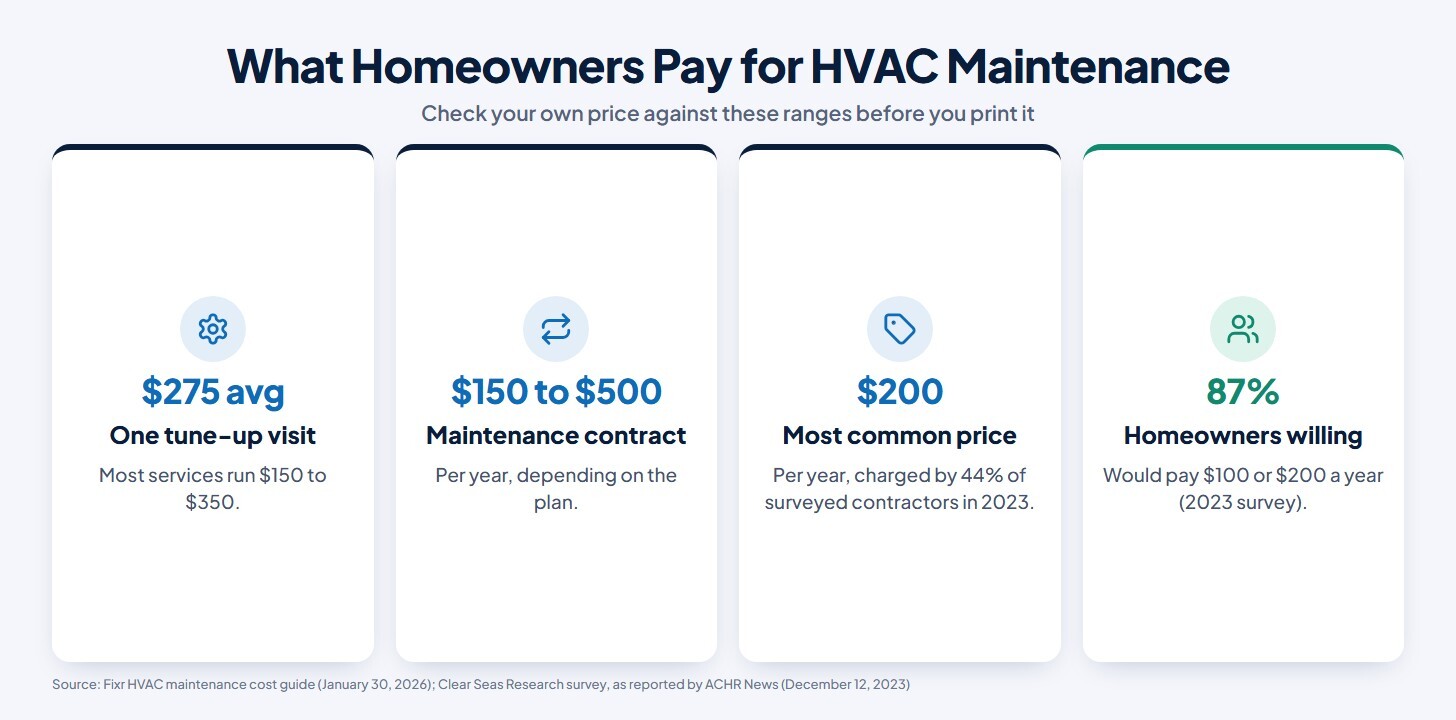
Then check your number against the market. Fixr's 2026 cost guide says a single annual tune-up averages $275, and that an HVAC maintenance contract runs $150 to $500 a year. In the 2023 survey, 44% of contractors charged $200 a year, 29% charged $300, 19% charged $400 or more, and 8% charged $100. On the homeowner side, 87% said they'd pay $100 or $200. If your price lands above your market, cut the cost, not the visit: route visits by neighborhood to shrink drive time, or price per system.
A St. Louis contractor that ACHR News profiled in December 2023 charged $250 a year per system for two tune-ups, priority service, a 10% discount on parts and labor, and a $25 yearly rebate. Homeowners could prepay or pay by monthly card billing.
Free tools for HVAC retailers
Get the free resources Noble built for HVAC shops.
The territory calculator, the homeowner close sheet, and the technician field card are free on the resources page, with no form and no sales call attached.
See the resourcesHere's a sample outline you can copy into your own agreement. It follows the eight parts above in the order a homeowner reads them, with blanks in brackets for your office to fill in for each home. Have your attorney review the final wording for your state before your techs hand it to a homeowner to sign.
Print the visit checklist from the section above on the back, so the homeowner sees the same list your tech works from.
Many equipment warranties give longer coverage only when the system is registered on time and don't pay for damage from poor maintenance. Some can ask for written proof. A maintenance agreement does that work on a schedule and leaves a dated record after every visit. That record is the proof a warranty can ask the homeowner to show.
Lifetime and extended labor warranties can carry their own maintenance terms, so match your visit schedule to each one you offer. Noble's lifetime warranty is one example: it's A-rated insurance-backed and requires a spring and a fall service every year, with proof within 30 days, as its program details set out. If you're still choosing a program, see our comparison of HVAC extended warranty programs.
One limit matters for your pitch. The FTC's guide to federal warranty law says a manufacturer generally can't make a specific brand of service a condition of its warranty unless that service is free. So present your agreement as the easiest way to get the maintenance done and documented, not as the only way to keep the warranty. Register every system on install day, write each warranty's maintenance terms into your visit scope, and put the registration date in the equipment list.
A maintenance agreement only becomes recurring revenue when it renews. Put the renewal terms in writing, remind the homeowner before the date, keep the card on file current, and book next spring's visit before the tech leaves the fall visit. Then track your renewal rate every month, because that rate decides how fast your base grows.
Here's why, using assumed numbers. A shop that signs 200 new members a year at $365 and renews 80% of them has 200 members after year one, 360 after year two, and 488 after year three. That's $178,120 a year in plan revenue and 976 visits your techs can schedule in the spring and fall.
A warranty that requires maintenance 2X a year gives members one more reason to renew. For the words that work with a homeowner, see our guide on selling HVAC warranties to homeowners, and for how the warranty itself is priced, read about bundling a warranty versus selling it separately or the ways a shop can put a lifetime warranty on its installs. The free territory calculator turns your quotes, close rate, and maintenance price into five years of install and maintenance revenue.
For most residential shops, yes, as long as the price covers your loaded labor cost and members renew. In the 2023 survey ACHR News reported, 75% of homeowners rated service agreements important, and 72% of the contractors surveyed offered them. In our worked example, each member adds about $112 a year before any repair work.
They're often worth it for the homeowner too. Fixr's 2026 guide puts a single tune-up at an average of $275, so two tune-ups bought one at a time run about $550 by our math, and it puts a yearly HVAC service contract at $150 to $500. Carrier puts the typical system lifespan at 15 to 20 years, so dated service records also help the homeowner when a repair or replacement decision comes up.
An agreement stops being worth it when the price sits below your loaded cost, or when visits never get booked.
Under federal warranty law, a written plan to maintain or repair a product for a set period is a service contract, so a maintenance agreement is one kind. A maintenance agreement pays for scheduled tune-ups and member perks. Some plans also promise to pay for certain repairs. A manufacturer's warranty comes with the equipment.
The FTC draws one more line: a warranty is part of what the buyer paid for the product, and a service contract is an agreement separate from the sale.
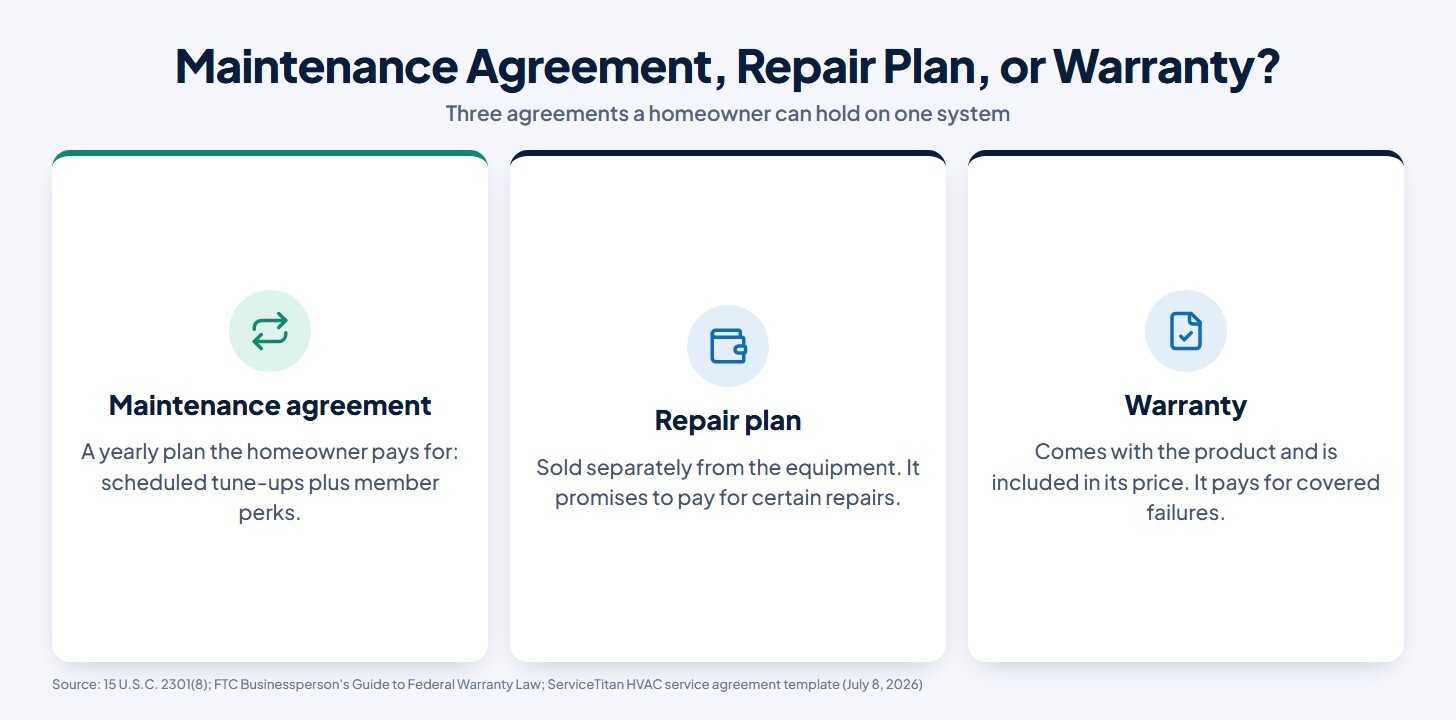
| Question | Maintenance agreement | Repair plan | Manufacturer warranty |
|---|---|---|---|
| What does it pay for? | Two seasonal tune-ups, the inspection, and the perks you list | Usually certain repairs, and sometimes tune-ups too | Covered part failures, as its terms say |
| How does the homeowner get it? | Buys it from your shop, yearly or monthly | Buys it separately from the equipment | Gets it with the equipment, after registering where required |
| How long does it last? | Twelve months, then it renews or ends | Whatever its terms say | Usually 5 to 10 years on some parts |
| What does it ask of the homeowner? | To be home for the visits and keep paying | Whatever its terms say | Often registration and proper maintenance |
If you want to sell repair coverage, have your attorney check your state's rules first, because a repair promise is a different product from a tune-up plan. When a homeowner asks who pays a covered repair under a lifetime warranty, our guide to insurance-backed HVAC warranties answers it.
Noble offers the warranty to one residential HVAC retailer per territory, exclusively. Every warranty you sell gives your maintenance agreement a reason to renew.

Write down the parties and start date, each system's make, model, and serial number, the visit checklist, the spring and fall schedule, the member perks, the price and billing, the service records you'll keep, and the renewal and cancellation terms.
Are HVAC maintenance agreements worth it?For most residential shops, yes, as long as the price covers your loaded labor cost and members renew. In the 2023 survey that ACHR News reported, 75% of homeowners rated service agreements important, and 72% of the contractors surveyed offered them.
What is the difference between a maintenance agreement and a repair plan?Under federal warranty law, a written plan to maintain or repair a product for a set period is a service contract, so a maintenance agreement is one kind. A maintenance agreement pays for scheduled tune-ups and member perks. Some plans also promise to pay for certain repairs. A manufacturer's warranty comes with the equipment.
How much should a service contract cost?Fixr's 2026 cost guide puts a yearly HVAC maintenance contract at $150 to $500. Price yours from your own costs. In our worked example, two visits and materials cost $253.34 a year to deliver, and a 30% margin, rounded up, prices the plan at $365.
Can a manufacturer require a homeowner to use your shop for maintenance?Generally no. The FTC's guide says a warrantor can't make a specific brand of service a condition of coverage unless that service is free. Sell the agreement as the easy way to get documented maintenance.
Should an HVAC maintenance agreement renew automatically?Automatic renewal keeps members from lapsing by accident. Write the renewal terms into the agreement, remind the homeowner before each renewal date, and say plainly how to cancel.